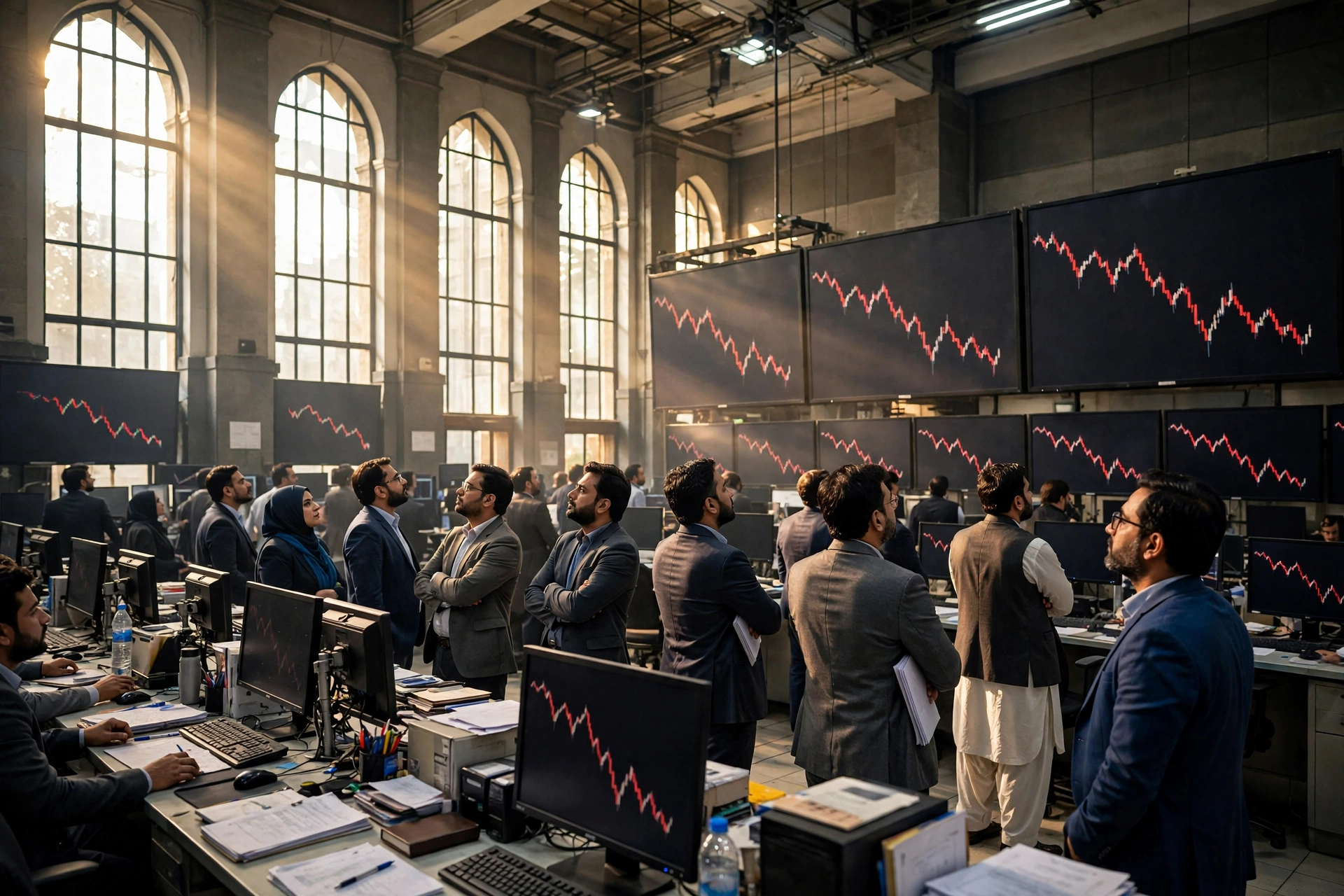

The Pakistan Stock Exchange endured a volatile week as escalating geopolitical tensions, elevated international oil prices and rising bond yields wiped out the optimism generated by Pakistan’s staff-level agreement with the International Monetary Fund. The benchmark KSE-100 index fell 0.6 percent week-on-week to close at 167,089 points on Friday, shedding 1,066 points, according to Arif Habib Limited. Investors stayed cautious despite a deal that could unlock $1.2 billion in IMF disbursements.
A week of sharp swings
The week opened on a negative note as regional and domestic political concerns pushed the index down. On Monday, the KSE-100 dived 2,288 points, or 1.36 percent, to close at 165,867, slipping below the 166,000 support level. Tuesday brought a strong rebound, with the benchmark gaining 2,593 points, or 1.56 percent, to 168,460. Wednesday was quieter, the index edging up just 120 points.
The mood turned again on Thursday. A sharp rise in global crude prices amid heightened Middle East risks triggered widespread profit-taking, dragging the index down 1,139 points, or 0.68 percent, to 167,442. Friday’s session traded in both directions, settling 353 points, or 0.21 percent, lower at 167,089. Trading activity weakened: average daily volume fell 18.6 percent week-on-week to 427 million shares, while the average traded value stood at $67 million, down 2 percent.
Geopolitics drown out IMF cheer
Market sentiment stayed subdued all week amid attacks on key shipping routes. Yemen’s Houthis expanded their targets to Saudi Arabia’s civilian infrastructure and energy facilities, while Ukrainian drone strikes on Russian refineries and concerns over US energy supplies kept Brent crude above $100 a barrel, according to AKD Securities. JS Global linked the caution to persistent US-Iran tensions and the escalation between Saudi Arabia and the Houthis.
The staff-level agreement on the fourth review of the Extended Fund Facility and the third review of the Resilience and Sustainability Facility provided some support. The agreement paves the way for disbursements of $1 billion and $210 million under the two programmes, subject to approval by the IMF Executive Board, bringing total disbursements to about $5.7 billion. Pakistan’s $1.21 billion IMF staff-level agreement was finalised earlier in October, but the Fund cautioned that risks remained elevated, urging the government to phase out fuel subsidies, broaden the tax base and ensure timely energy tariff adjustments.
Winners, losers and the data
Sector-wise, banks were the biggest drag on the benchmark, shedding 566 points, followed by fertiliser companies with 234 points. Automobiles and cement also dragged. Habib Bank, MCB Bank and United Bank were the largest negative contributors, collectively accounting for 388 points of the decline. Oil marketing companies led the positive contributions, adding 110 points, followed by power companies with 36 points. Pakistan State Oil was the largest individual contributor, adding 113 points.
In the bond market, the government raised Rs381 billion against a Rs350 billion target in its latest Pakistan Investment Bonds auction. Cut-off yields rose by 26 to 41 basis points across three-, five- and 10-year tenors, while the two-year yield declined by 19 basis points, fuelling expectations of a possible policy rate hike. On the macro front, Pakistan’s foreign exchange reserves held by the State Bank rose by $15 million to $21.5 billion as of October 2. The rupee appreciated marginally by 0.03 percent to close at Rs277 against the dollar, near the current USD to PKR exchange rate in Pakistan. Central government debt stood at Rs82.95 trillion at the end of August, up 7.1 percent year-on-year but down 0.5 percent month-on-month.
Cement, coal and corporate snapshots
In the cement sector, despatches rose 6 percent year-on-year to 4.62 million tonnes in September, supported by a 7 percent increase in domestic sales, while exports remained flat. In the first quarter of FY27, despatches rose 4 percent to 13.14 million tonnes.
Elsewhere, the Sindh Engro Coal Mining Company is expanding its Thar Block-II mine to supply additional coal to Lucky Electric Power Company, potentially enabling a complete transition to local coal and reducing reliance on imports. In auto sales, Sazgar Engineering’s four-wheeler sales stayed flat year-on-year at 2,474 units in August-September, while three-wheeler sales rose 32 percent to 5,173 units. Petrol prices increased 2.1 percent to Rs398.96 per litre, while high-speed diesel prices fell 0.9 percent to Rs395.72. Meanwhile, July-September remittances of $10.9 billion remain one of the steadier supports for the external account.
What comes next
Looking ahead, analysts expect quarterly earnings announcements and geopolitical developments to shape market sentiment. The index was trading at a 7.5 times price-to-earnings ratio, with a dividend yield of 6.7 percent. Easing inflation, improving economic indicators and any de-escalation in the Middle East could moderate oil prices and strengthen the case for monetary easing. For now, though, persistent geopolitical uncertainty continues to constrain gains.
Follow latest business and economy news in Pakistan for weekly market roundups and corporate coverage.