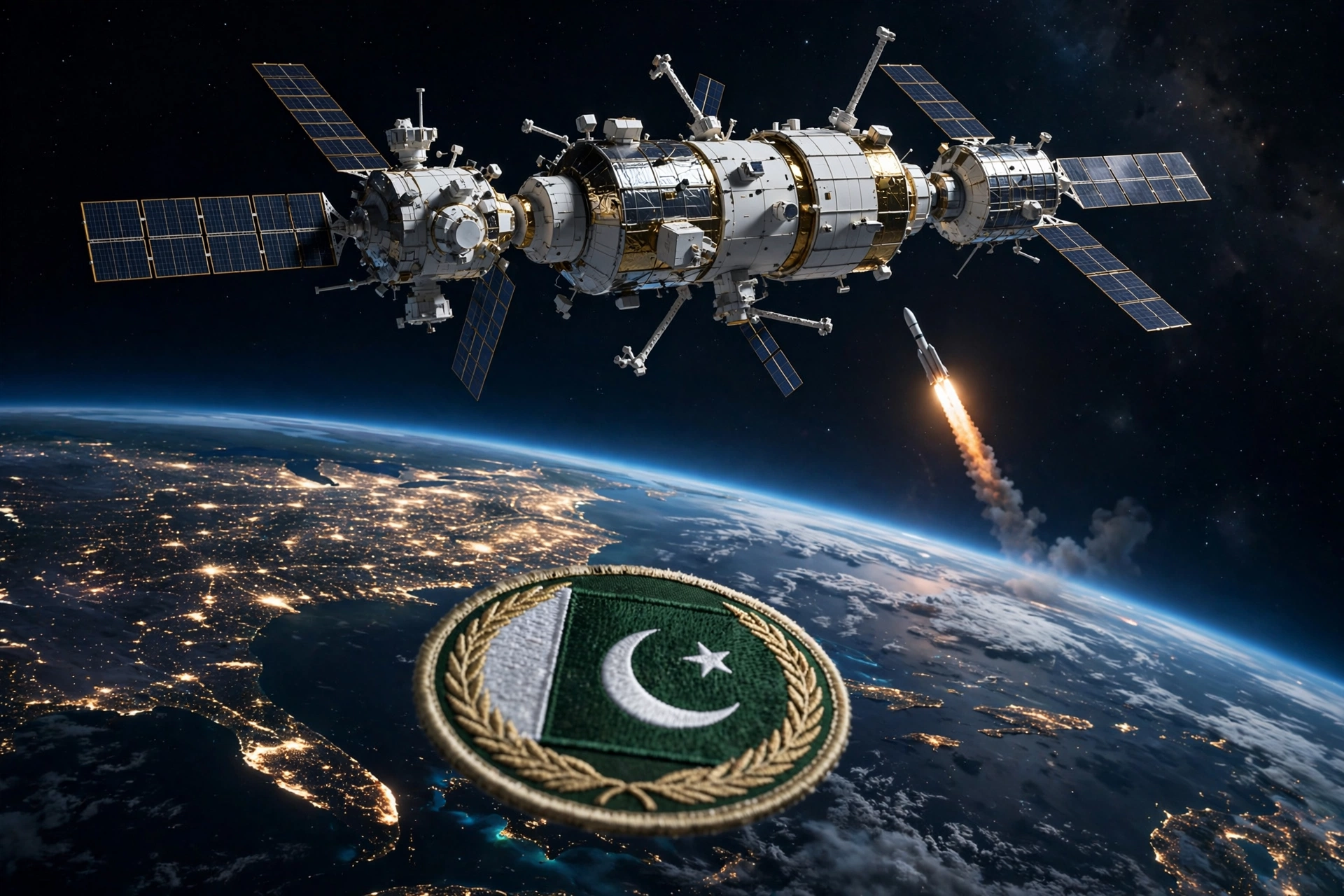

Pakistan is closing in on a historic first: sending its own astronaut into space aboard China’s Tiangong space station. Two Pakistani pilots, Muhammad Zeeshan Ali and Khurram Daud, are completing intensive training at the China Astronaut Research and Training Centre in Beijing, and the final selection between the two is expected in mid to late October 2026. Whoever is chosen will become the first Pakistani in space and the first foreign astronaut to visit Tiangong.
Two Pilots, One Seat
Both candidates are pilots with experience in high-speed flying, a deliberate choice by Pakistan’s space agency SUPARCO. According to SUPARCO officials cited by Reuters, the two beat out roughly 20 finalists drawn from a national pool of pilots and scientists, screened for medical fitness, psychological resilience and, critically, tolerance for the high g-forces of launch and landing. SUPARCO’s director of artificial intelligence, Uzair Ansari, told Reuters that pilots were preferred because relatively few scientists have experience coping with the physical demands of human spaceflight.
Their training has been demanding. The two men are learning Mandarin from scratch, studying Chinese spacecraft systems, spinning in centrifuges and learning to eat, sleep and repair equipment in weightlessness. Intensive Chinese-language instruction is essential because coordination aboard Tiangong is conducted in Chinese. Amer Gilani, who oversees human spaceflight cooperation at SUPARCO, told Reuters the mission was conceived by the two countries back in 2019, and that the chosen astronaut will not return to Pakistan before launch, flying straight from training in China and returning home only after a recovery period following re-entry.
What the Mission Will Involve
The Pakistani astronaut will fly as a payload specialist, not as a pilot of the spacecraft. That means he will not operate the Chinese capsule; his job will be to run Pakistan’s scientific experiments in orbit while serving as a full crew member alongside Chinese taikonauts. The mission is expected to last about a week, far shorter than the six-month tours typical of Chinese crews, and it is planned for later in 2026. China has not yet announced which candidate will fly or the exact launch date.
On the science side, more than 300 experiment proposals were submitted by universities in Karachi, Lahore and Islamabad, from which four were selected in cooperation with Chinese institutions. According to reporting by Reuters, the selected work focuses on biotechnology, including research linked to challenges such as food insecurity and climate change. SUPARCO’s earlier statements described Pakistan’s planned microgravity research more broadly, spanning material science, fluid physics, life science and biotechnology.
Years in the Making
The mission is the product of a formal cooperation agreement signed in Islamabad in February 2025 between SUPARCO and the China Manned Space Agency, an exchange witnessed by Prime Minister Shehbaz Sharif. In April 2026, China identified Zeeshan Ali and Khurram Daud as the two candidates selected for training. The two countries reaffirmed the programme in a joint statement in May 2026, with China welcoming the Pakistani trainees and looking forward to a Pakistani becoming the first foreign astronaut to enter the space station.
The astronaut programme sits inside a much wider Pakistan-China space partnership that straddles the Belt and Road Initiative. It has already produced Chinese-launched Pakistani satellites, cooperation on a joint satellite-navigation system, and a Pakistani-built lunar rover that is planned to fly on China’s Chang’e 8 mission around 2028. The broader momentum in space technology is visible elsewhere too, including concepts like how space-based solar power could soon become reality, where China is also among the leaders.
For Pakistan, the flight represents a significant step for a space programme that has historically focused on satellites and applications such as communications, remote sensing and earth observation, and SUPARCO says it is intended to build lasting national expertise in human spaceflight. It also reflects how the country keeps widening its international partnerships, from space cooperation with Beijing to steps like Pakistan and Azerbaijan deepening bilateral ties in 2026. With the final selection decision now just weeks away, one of the two pilots will soon make history, and readers can follow the countdown in our latest technology news in Pakistan and the rest of our Pakistan international news coverage.