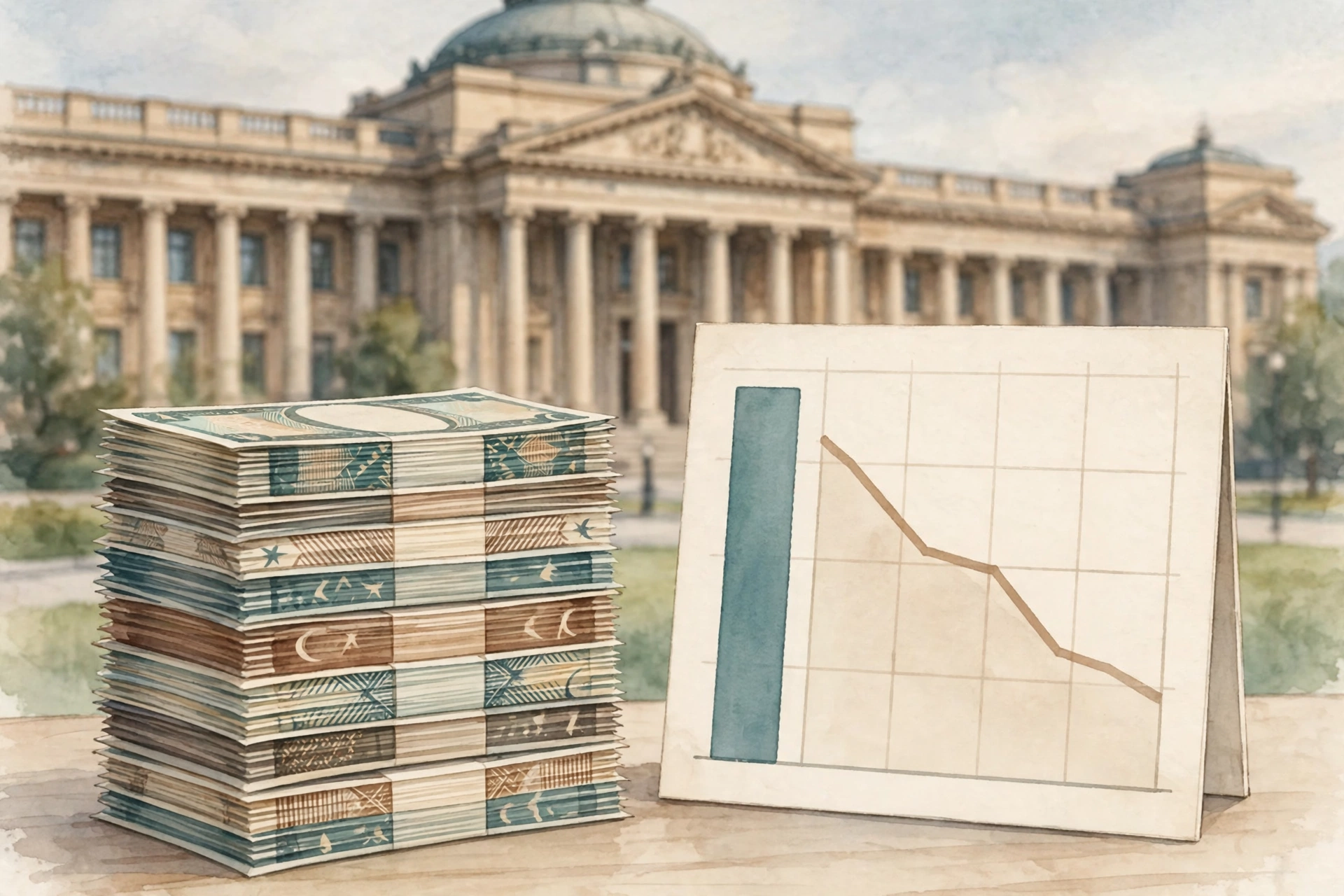

Pakistan owes more than ever, yet the official measure of its debt burden has improved. The Finance Division’s Debt Sustainability Analysis for fiscal years 2027 to 2029, released this week, puts public and publicly guaranteed debt at Rs90.98 trillion at the end of June 2026, up Rs6.2 trillion in a year. The debt-to-GDP ratio fell from 74.3 per cent to 72 per cent. But State Bank figures tell the other half: by the end of September, total debt and liabilities had reached Rs98.88 trillion, and servicing them cost Rs2.9 trillion in three months, a third more than a year earlier. Both are correct; the gap between them is the real story.
What the new figures actually say
Total public debt stood at Rs86.7 trillion at the end of June 2026, up from Rs80.5 trillion a year earlier: domestic debt Rs59.4 trillion and external debt Rs27.3 trillion, equal to 98.1 billion dollars. Domestic borrowing was about 68.5 per cent of the total, limiting exchange rate exposure. Government guarantees of borrowing by public sector enterprises added Rs4.28 trillion, almost unchanged from Rs4.27 trillion, taking the headline total to Rs90.98 trillion. Interest payments fell 21.7 per cent, from Rs8.88 trillion in fiscal year 2025 to Rs6.95 trillion in fiscal year 2026, as rates came down. The Finance Division expects the federal fiscal deficit to narrow from 4.9 per cent of GDP in fiscal year 2027 to 4.2 per cent by fiscal year 2029.
Why the ratio fell while the debt rose
The ratio is a fraction, and only its top half is debt. The bottom half is the size of the economy, and in rupee terms the economy grew faster than the debt during fiscal year 2026. Debt rose 7.3 per cent, while nominal GDP, lifted by real growth and inflation, rose faster, so the ratio fell 2.3 points. That is not paying debt down: on average the stock grew by about Rs17 billion every day of the year, a PakMirror calculation. The Finance Division also publishes more than one ratio. Total public debt alone was 68.3 per cent of GDP at the end of June 2026, per the ministry’s Annual Debt Review. Add guarantees and it becomes 72 per cent, the Debt Sustainability Analysis figure. Under the Fiscal Responsibility and Debt Limitation Act, which subtracts government deposits with the banking system, it is 60.8 per cent. Same debt, different counts. What matters is the cash cost, and the exchange rate decides part of it: nearly a third of public debt is in foreign currency, so every move in the USD to PKR exchange rate today changes the rupee value of what Pakistan owes.
The September update changes the picture
State Bank data published in mid-November put total debt and liabilities at Rs98.88 trillion at the end of September 2026, up 6.46 per cent from Rs92.88 trillion a year earlier; total debt alone was Rs97.04 trillion. Central government debt actually fell Rs937 billion in the quarter, to Rs82.66 trillion, after a Rs1.3 trillion fiscal surplus and a 3 per cent cut in domestic borrowing. But the bill for carrying the debt jumped. Servicing cost Rs2.9 trillion in July to September, up 33.27 per cent from Rs2.18 trillion a year earlier. External principal repayments almost doubled, to Rs1.18 trillion from Rs634 billion, and interest rose 14.7 per cent to Rs1.69 trillion. Pakistan paid 5.63 billion dollars in external debt servicing in the quarter, 4.53 billion dollars of it principal. Interest alone in three months was about a quarter of the whole interest bill for fiscal year 2026, a PakMirror calculation. The trade gap sits behind much of this: the October trade deficit was revised to $4.13 billion, and imports not paid for by exports or remittances add to borrowing.
What could still go wrong
Its stress tests show the risk. Under a combined shock of slower growth, rates 300 basis points higher and a 15 per cent weaker rupee, debt would reach 76.2 per cent of GDP by fiscal year 2029, instead of falling to 64.6 per cent in the baseline. Only 27 per cent of government securities carry a fixed rate, the average time before rates reset is about 1.4 years, and 40 per cent of external debt is at floating rates. The Finance Division aims to lift the average maturity of domestic debt from 3.82 years to 4.25 years by June 2028, with more fixed-rate borrowing.
What to watch next
The International Monetary Fund board is expected to meet in December on the next 1.2 billion dollar tranche. The next State Bank release will show if the surplus was a one-off. Households already feel the squeeze: December electricity bills are set to rise while debt servicing takes a growing share of the budget. More business and economy news from Pakistan.