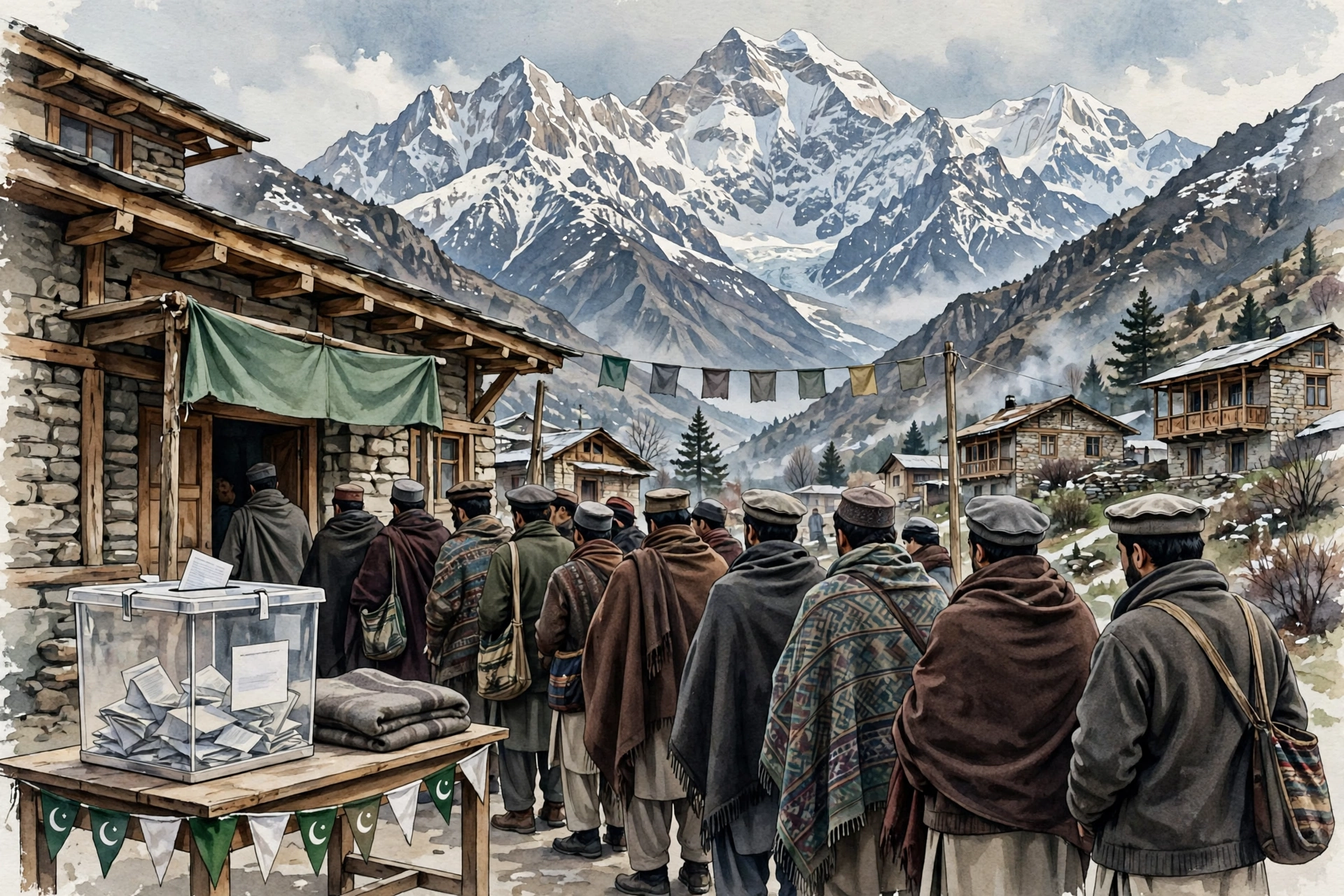

Gilgit-Baltistan’s chief election commissioner, Raja Shehbaz Khan, on Thursday announced a two-phase schedule for the region’s first local government elections in 22 years, setting December 5, 2026 as polling day for the three new municipal corporations of Gilgit, Skardu and Chilas. Nomination papers will be accepted from October 26, and the second phase, covering union councils, district councils and municipal committees, will be held in April 2027.
The announcement came in a media talk in Gilgit, a day after the GB Assembly passed the amended Local Government Act 2026 that created the three corporations. The chief election commissioner said the corporation elections will be held on a multi-ward basis, with a 17 per cent quota for women and reserved seats for youth, non-Muslim minorities and disabled persons, and that the new system guarantees effective representation for every segment of society in local governments.
The seat math for the three corporations
Official documents put the combined strength of the three corporations at 98 seats. Gilgit’s municipal corporation will have 52 seats: 42 directly elected members, seven reserved for women, and one each for a non-Muslim, a youth representative and a disabled person. Skardu’s corporation will have 28 seats: 21 directly elected, four for women, and one each for the other three reserved categories. Chilas, the smallest of the three, will have 18 seats: 13 directly elected, two for women, and one each for a non-Muslim, a youth member and a disabled person.
The reserved-seat design means each corporation’s house will include voices that have historically been shut out of local decision making. Women get the largest reserved bloc under the 17 per cent quota, with the youth, minority and disability seats completing a structure the chief election commissioner says is meant to bring neglected groups into municipal governance.
A year of false starts
The December 5 date is the third election schedule announced for GB’s local polls in less than a year. The election commission first fixed February 14, 2026 for union, district and municipal corporation polls, then postponed that date indefinitely, citing harsh winter weather in the region. In June, the chief election commissioner announced a new date of August 2, scheduling the polls unilaterally under the 2014 law without consulting Chief Minister Amjad Hussain Advocate, who insisted the elections be held under a new 2026 law. The dispute froze the process, the commission postponed the programme again, and Governor Syed Mehdi Shah returned an earlier version of the bill with objections.
The logjam broke on Wednesday, when the GB Assembly passed the amended Local Government Act 2026 by a majority vote after the revised draft cleared the cabinet. Local Bodies Minister Zulfiqar Ali Murad reintroduced the bill after addressing the governor’s objections, and the opposition’s request for more time was overruled. The amended law creates the three municipal corporations, where elected members will choose mayors and deputy mayors, and establishes union and district councils across all districts.
What the two phases will change
The first phase on December 5 will give GB’s three cities elected municipal governments for the first time in more than two decades, ending a 22-year gap that stretches back to the last local elections in 2004. The second phase in April 2027 will complete the structure, with elected union councils, district councils and municipal committees bringing grassroots representation to the rest of the region.
The contrast with the federal capital is hard to miss: Islamabad’s own local elections have also been delayed for years, and the Election Commission has summoned top officials for an October 21 hearing to fix a schedule for the capital’s long-overdue polls.
What comes next
With nominations opening on October 26, candidates in Gilgit, Skardu and Chilas have just over five weeks to file papers, campaign and contest the December 5 polls. Once elected, the corporation members will pick mayors and deputy mayors, and attention will shift to the April 2027 phase, when the union and district councils complete GB’s first fully elected local government tier in 22 years. Follow PakMirror’s latest Pakistan politics coverage for updates.