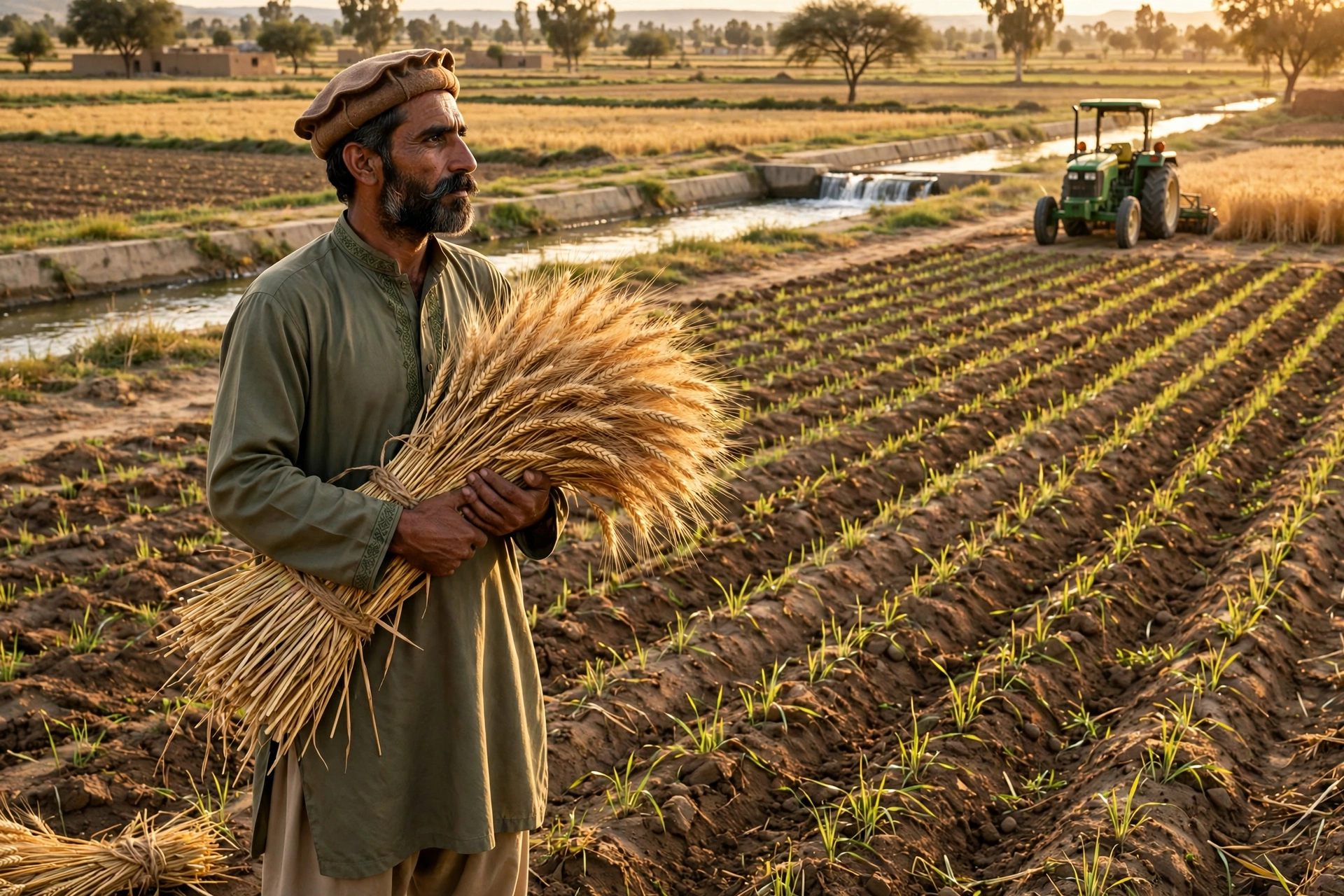

On Sunday, small farmers across Pakistan staged nationwide demonstrations under the Pakistan Kissan Rabta Committee (PKRC), an alliance of 36 farmer organisations, demanding a guaranteed wheat support price of Rs5,000 per 40kg maund, a halt to corporate land grabbing and genetically modified crops, and the restoration of state wheat procurement through PASSCO (Dawn, October 19). The Rs5,000 figure is not pulled from thin air: it roughly matches open-market wheat rates and what the government reportedly paid for imported Ukrainian wheat. The deeper story is that there is no official support price left to announce, because Pakistan withdrew from wheat procurement as a condition of its IMF programme.
What the farmers demanded on Sunday
The October 18 demonstrations highlighted what the committee calls a deepening rural crisis: soaring diesel, electricity, fertiliser and seed costs, and crop returns the farmers call nonviable (Dawn, October 19). The PKRC charter also seeks Rs700 per 40kg for sugarcane, an end to private-sector wheat procurement, and a return to state purchasing through PASSCO and provincial food departments, with the state guaranteeing purchase of every grain (Dawn, October 7).
The farmers want the price announced before sowing, so growers can judge whether planting is viable. PKRC President Tariq Mahmood and Secretary General Riffat Maqsood say small landholders are near financial collapse, while leader Farooq Tariq argues food security lies in agrarian reform and seed sovereignty, not in handing farm resources to commercial conglomerates. The protesters also opposed IMF and World Bank-backed market deregulation.
The Rs5,000 number, decoded
Growing a maund of wheat costs about Rs3,761 this season, says the Pakistan Kissan Ittehad (PKI), the country’s leading farmers’ body (Express Tribune, August 25). The last official support price, set by the Economic Coordination Committee in March 2023, was Rs3,900 per 40kg maund, barely Rs139 above production cost. Adding a 25 percent profit margin, PKI calculates that a fair price would be closer to Rs4,702 per maund. The PKRC’s Rs5,000 demand sits about six percent above that figure.
Then there is the market paradox, laid out by PTI MPA Ejaz Shafi in a Punjab Assembly adjournment motion (Dawn, October 9). Shafi said farmers sold last season’s wheat at Rs3,000 to Rs3,200 per maund, below production cost, while it now trades at Rs5,000 to Rs5,500, a rally bringing growers zero benefit. He added the government paid Rs5,000 per maund for Ukrainian imported wheat, but will not pay local farmers the same. The demand is simple: pay us what the market and the import bill already say wheat is worth.
Why there is no official price left to announce
In September 2024, Pakistan agreed with the IMF to phase out support prices in agriculture, wheat in FY2024-25 and sugar by June 2026 (Express Tribune, October 5). In December 2025, the government formally withdrew from wheat procurement to meet that condition: no support price, prices tied to international benchmarks, private companies handling strategic-reserve procurement, and 6.2 million tonnes of emergency stocks split between the federation and provinces (Express Tribune, December 26, 2025).
So the Rs5,000 demand collides with a policy that dismantled the price mechanism. Announcing a guaranteed price would mean reversing an IMF commitment, the same lender whose IMF-linked revenue targets FBR is chasing in briefings to the prime minister. The NA Standing Committee on National Food Security has approved Rs5,000, but Punjab has not implemented it, according to Shafi’s motion.
The cost squeeze behind the anger
Farmers’ groups put Pakistan’s per-maund cultivation costs at Rs2,800 to Rs3,400, among South Asia’s highest, against Rs2,200 to Rs2,250 in India, where fertiliser is more tightly regulated (Express Tribune, August 25). The Gulf conflict, Hormuz shipping disruptions and the Russia-Ukraine war have pushed up fertiliser, freight and diesel costs, alongside higher tube-well electricity tariffs. Water shortages are also hitting irrigation at the start of the Rabi season.
PKI says three years of policy missteps cost growers Rs2,200 billion, and warns of a near-three-million-tonne shortfall forcing roughly $1.2 billion in imports, a bill that would eat into SBP’s $21 billion reserves cushion.
What happens next
The calendar is the farmers’ strongest argument. The Rabi sowing window is open now: if growers conclude wheat will not pay, they will plant less, making PKI’s shortfall warning self-fulfilling. For consumers the stakes run the other way, which is why Punjab’s Rs10 billion flour subsidy to keep flour affordable was approved earlier this month.
The government must now choose: announce a support price and reopen the argument with the IMF, or let the market rule and gamble on sowing. Separately, farmers’ leader Sardar Zafar Hussain Khan warns of a nationwide November 5 protest if support prices stay unannounced (Dawn, October 5). For the latest, follow the latest national news from Pakistan.