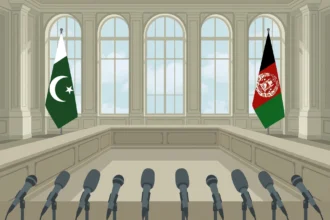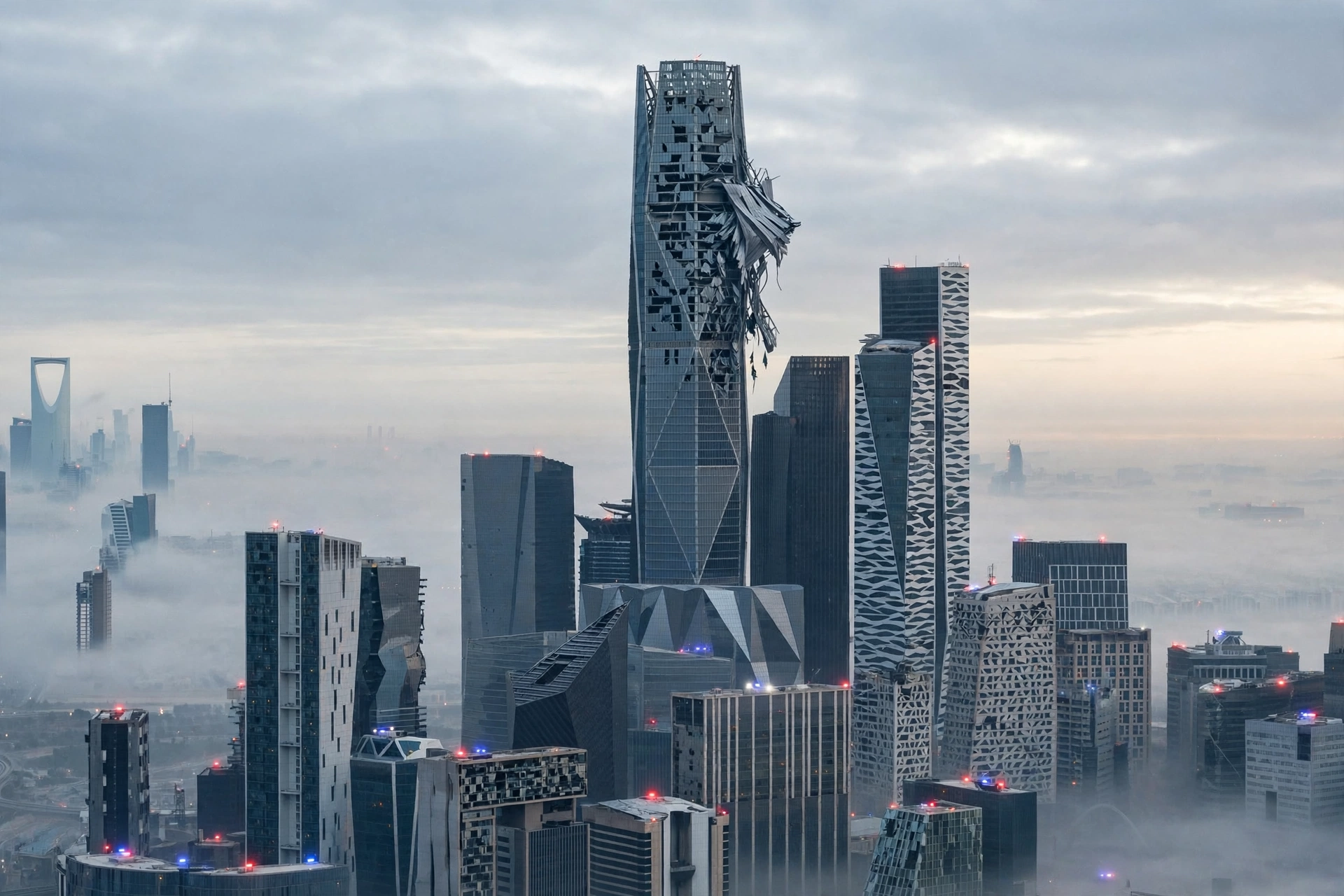

Pakistan condemned the Houthi strike on Riyadh’s tallest tower on Friday, but the Foreign Office statement said nothing about the defence pact the prime minister invoked after the October airport attacks. The strike hit the 80 storey Public Investment Fund Tower in the King Abdullah Financial District before dawn on Thursday, shattering windows across seven to eight floors. No one was injured. It was the second strike on the district in 11 days, and the target was the headquarters of a fund holding about $1.2 trillion in assets.
What happened in Riyadh
Saudi Arabia confirmed on Thursday that the attack caused material damage to the Public Investment Fund Tower, the headquarters of the kingdom’s sovereign wealth fund. Civil defence said the pre-dawn strike damaged several floors of the 385 metre tower, Riyadh’s tallest, and nearby buildings. Roads to the district were closed and occupants were evacuated.
The Saudi led coalition said its air defences dealt with the missile threat and that falling debris caused the damage. It said it intercepted four ballistic missiles and two drones, and later destroyed a Houthi launchpad in Yemen. Houthi spokesman Yahya Saree said the group had targeted the airport and the financial district with cruise missiles. The strike followed a suspected Houthi missile on 8 November that damaged the nearby Aramco Tower. The renewed fighting has shattered a 2022 UN brokered truce, Reuters reported.
The words Pakistan chose, and the ones it left out
The Foreign Office statement, issued on Friday as press release 342/2026, was read out by spokesperson Sajjad Haider Khan. It said Pakistan unequivocally condemned the attack by the Houthi militia on a tower at the King Abdullah Financial District, calling it a grave violation of Saudi Arabia’s sovereignty. It warned that attacks on civilian infrastructure endangered innocent lives and must cease forthwith, and added that Pakistan stands firmly with Saudi Arabia and backs its right to defend its sovereignty.
Two details stand out. The statement did not name the building, although Saudi photographs identified the Public Investment Fund Tower. And it did not mention any defence pact. That is a change from October, when Prime Minister Shehbaz Sharif invoked the Makkah Joint Defence Agreement by name after the airport attacks, calling Pakistan’s commitment to the kingdom’s security resolute. On 11 October, Pakistan joined Saudi Arabia, Egypt and Turkiye in a joint statement condemning the airport attacks.
The pact’s limits are already on the record
The Makkah Joint Defence Agreement was signed on 7 August 2026 in Mecca by Saudi Arabia, Pakistan and Turkiye. Its 16 articles treat an external armed attack on one signatory as an attack on all three. Pakistan says both countries have ratified it, and Turkiye’s parliament has approved it. The story of how the Makkah Pact was ratified, and the three steps that decide its future, shows how much of the framework is still being built.
The pact has already been tested, and each time the allies drew a line at offensive war. Turkish Foreign Minister Hakan Fidan said on 8 October the agreement was defensive, not offensive, and Turkiye would not send troops abroad to launch attacks. Defence Minister Yasar Guler said Turkiye did not foresee conflict with the Houthis. Pakistan’s parliament voted in 2015 against joining the Saudi led war in Yemen. The pact promises collective defence. So far it has produced statements, air defence cooperation and intelligence sharing, not combat.
Why the strike still reaches Pakistan
On 11 October, a projectile struck Passenger Hall 4 at King Khalid International Airport, killing a Pakistani resident and injuring 11 people, six of them Pakistanis, Saudi aviation authorities said. The economic stake is just as direct. Saudi Arabia sent $981.6 million of October’s $3.89 billion in remittances, the largest share of any country, State Bank figures show. October remittances hit $3.89 billion and covered the whole trade gap, and every dollar sent home converts at the USD to PKR exchange rate today.
The target raises the stakes for Riyadh too: the district is the centrepiece of the Vision 2030 drive, and the fund is its main engine. Middle East Online reports the fighting has forced postponement of the Future Investment Initiative conference and the AFC Asian Cup.
What happens next
Three tests lie ahead: whether the prime minister or the Foreign Office names the Makkah agreement after the next strike, as Sharif did in October; whether the pact’s committee announces a concrete step rather than another statement; and whether the Houthis strike the financial district a third time. For now the pattern is clear: the Houthis have reached the tallest tower in Riyadh twice in 11 days, Pakistan condemns each strike, and the defence pact remains unmentioned and untested in combat. Follow our international news coverage for the next development.