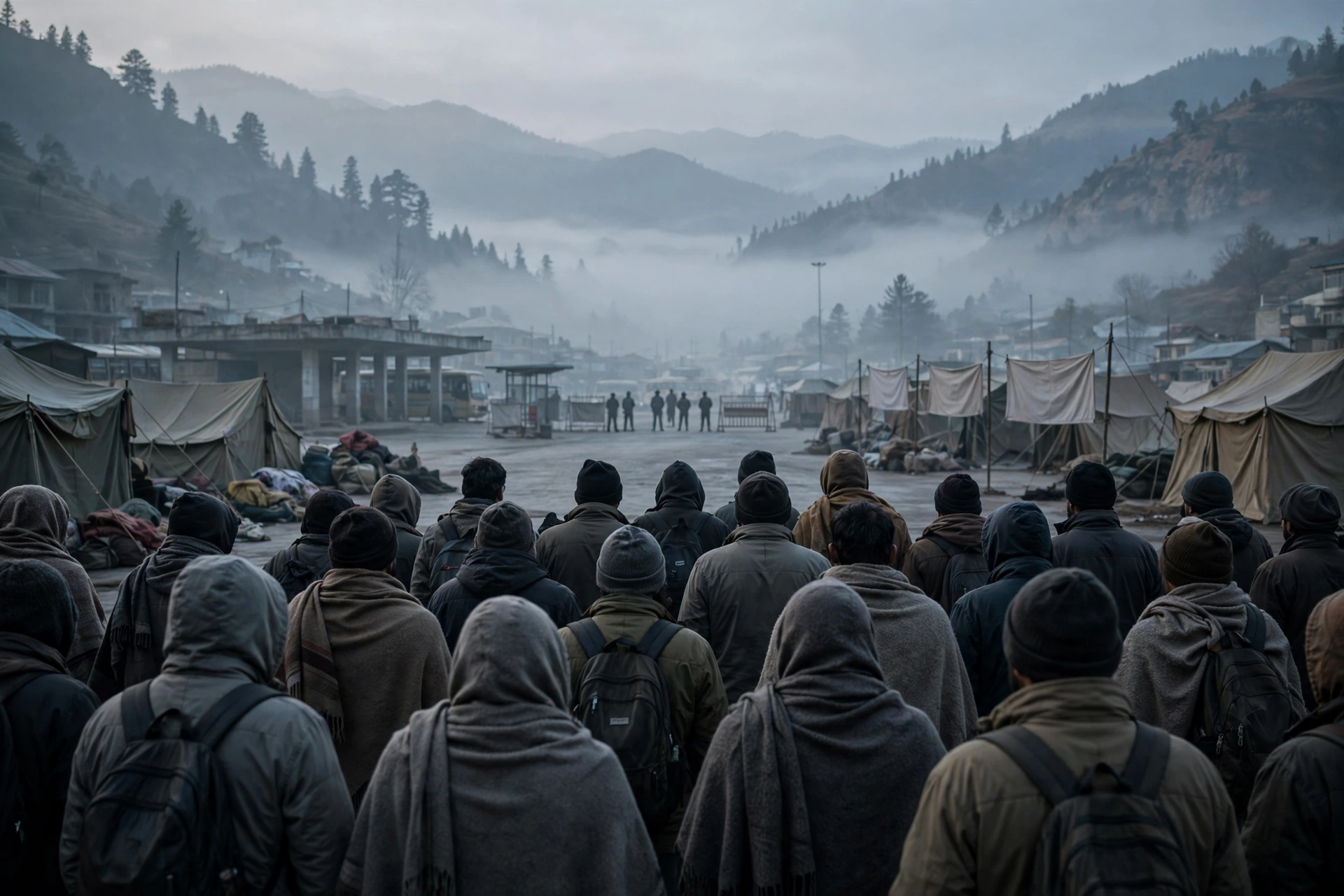

Security forces moved into Rawalakot before dawn on Thursday 5 November and cleared protest camps that had stood for 153 days. By evening, three different death tolls circulated, police had confirmed none of them, and no official statement had been issued. What is certain is that the sit-in is over. Almost everything else about the morning remains disputed.
The operation began at about 6.00 am at the Matyal Mara bus terminal and D-Chowk, where the Jammu Kashmir Joint Awami Action Committee, known as JAAC, had held a sit-in since 5 June. The committee was demanding political and administrative reforms. JAAC says three supporters were killed and 18 injured. A local journalist puts the dead at five. The United Kashmir People’s National Party, or UKPNP, says seven were killed. Police have confirmed no deaths at all.
Three tolls, one morning
Each figure comes from a different source. JAAC has confirmed three deaths so far and has named all three: Ehtisham and Atif Noor, both from Chamba Nar, and Adil Rashid from Mang Mor. The committee also named 18 injured people.
Local journalist Ajmal Shaheen, quoted by Kashgil News, reported five civilian deaths. His list adds Ahsan Tariq of Nanota, who had appeared on JAAC’s list of injured people, while the fifth victim remains unidentified. The UKPNP, in a statement issued from Geneva, claimed seven killed and 18 seriously injured, naming the same three men as JAAC but adding an unverified report that four children may have died in an alleged drone strike on a house. The party itself said that claim requires urgent independent verification. No source has independently confirmed any of the three tolls. A house belonging to Shakeel Khan near the bus terminal also caught fire, with the cause disputed, and mobile phone services around the bus terminal were disrupted.
Two accounts of the same operation
The two sides describe the morning in completely different terms. JAAC core committee member Umar Nazir said the protest sites were attacked from all four sides and that several people were injured in drone strikes over two to three hours.
Police tell a different story. In a statement from the spokesperson for the Deputy Inspector General of Police in the Poonch region, authorities said the operation aimed to remove illegal obstructions and restore freedom of movement. Police alleged that armed individuals opened indiscriminate fire on law enforcement personnel, prompting a response. The statement acknowledged injuries among police personnel and those it described as armed individuals, but gave no confirmed casualty figures. It did not address the drone or death allegations.
153 days without a deal
The camps had been in place since 5 June, in a standoff over governance and protest restrictions. Despite the prolonged sit-ins, the authorities and protest leaders failed to reach an agreement.
The JAAC had already been declared an outlawed organisation by the government in Pakistan-administered Kashmir. Six United Nations human rights experts recently questioned that designation in a communication to the Government of Pakistan, reference AL PAK 4/2026, raising concerns about alleged state violence, deaths and arrests.
The timing also matters. The crackdown came the same day the federal government suspended Article 140-A in Khyber Pakhtunkhwa and the Election Commission halted local polls there, while Punjab finally gets a local polls date, 7 February 2027. Both moves came on the same day, and the Federal Constitutional Court barred the Peshawar High Court from hearing detention cases in Khyber Pakhtunkhwa the same morning.
The clampdown after the operation
Following the operation, the district administration imposed Section 144, restricting public gatherings and movement in Rawalakot. Announcements from local mosques instructed residents to remain indoors and warned against gatherings of five or more people.
News of the reported killings prompted demonstrations in Muzaffarabad, the capital of Pakistan-administered Jammu and Kashmir. Students gathered at the University of Azad Jammu and Kashmir and Upper Adda, demanding accountability for the reported deaths. The protests indicated that the confrontation could spread beyond the Poonch region.
What to watch next
Three tests will decide how this story develops. The first is whether any authority publishes a confirmed casualty figure or orders an independent investigation. Until then, every figure in this article should be read as a claim, not a confirmed fact.
The second test is whether the restrictions lift. Section 144, the mosque announcements and the disruption to mobile services all point to an administration that expects further trouble.
The third test is whether the JAAC regroups or talks resume. The committee has lost its camps, and the UN experts’ letter gives it an international audience it did not have before. What happens next depends on whether anyone independent is allowed to establish what actually happened on Thursday morning. For more national news from Pakistan, follow our continuing coverage.