
Islamabad: Foreign Minister Ishaq Dar made two phone calls on Thursday, one to Turkiye’s Hakan Fidan and another to Egypt’s Badr Abdelatty, in a single-day diplomatic push to lock in a common position before the OIC Council of Ministers meets in Iraq on October 17 and 18. The calls, both confirmed by the Foreign Office, centred on Gaza, Palestine and the wider fallout of the US-Iran confrontation. Taken together, they read as a deliberate pre-summit move: Pakistan working the phones so it arrives in Iraq with key allies already on the same page.
Two calls, one purpose
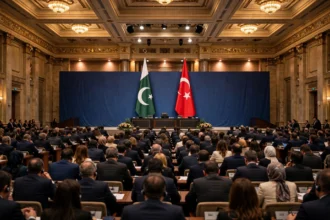
Dar’s conversation with Fidan covered regional and international developments, including the situation in Gaza and Palestine, according to the Foreign Office. The two ministers also discussed the agenda and strategy for the OIC Council of Ministers meeting in Iraq, and underlined the importance of close coordination in advancing common objectives through bilateral engagement and cooperation at multilateral forums.
The second call, to Egypt’s Badr Abdelatty, carried the same theme. The two foreign ministers discussed the latest regional developments and stressed that dialogue and diplomacy remain the only way forward. They reaffirmed their resolve to keep supporting efforts towards dialogue and de-escalation, and agreed to stay closely engaged on matters of mutual interest.
Each call was reported separately as a routine Foreign Office statement. The pattern only emerges when the two are read together: two capitals, one day, one summit on the calendar.
Why the timing matters
The OIC Council of Ministers session in Iraq on October 17-18 gives the timing its meaning. Meetings of this kind are where the Muslim world’s common positions on Gaza and the US-Iran crisis get hammered out, and Dar’s calls show Pakistan trying to shape that outcome before the sitting begins rather than negotiating it on the floor.
Pakistan, a key OIC member, has been vocal on Gaza, repeatedly urging world powers to hold Israel accountable for alleged war crimes in the occupied territories. Arriving in Iraq with Turkiye and Egypt aligned would strengthen that push.
Pakistan’s go-between role
The calls also fit Pakistan’s wider mediation effort. Islamabad has been working to bring the United States and Iran to the negotiating table since their conflict began in February, when US and Israeli attacks on Iran opened the war; a ceasefire followed in April, but clashes resumed as negotiations stalled despite a framework agreement in June. Pakistani officials have vowed to continue the mediation drive.
Both calls sit inside that drive. Engaging Egypt and Turkiye, two regional players with their own channels and leverage, extends the diplomatic perimeter around any future talks. At this week’s International Justice Summit in Istanbul, Barrister Aqeel Malik represented Pakistan on the migration and human dignity panel, another sign of how active Islamabad’s multilateral calendar has become.
The Turkiye factor: a pact ally, not just a partner
The Fidan call carries extra weight because of the trilateral defence pact Pakistan signed with Turkiye and Saudi Arabia in August, which treats an attack on any one of the three as an attack on all. Pakistan and Turkiye have also been deepening cooperation under the Makkah Defence Alliance framework, including last month’s Strategic Political and Defence Committee meeting in Istanbul.
That turns coordination with Ankara from routine diplomacy into alliance management. The relationship already has a security track, through the anti-terror pact Pakistan and Turkiye signed to boost security cooperation, and Thursday’s call adds a diplomatic layer ahead of a summit where both will need to speak with one voice.
What is at stake for Pakistan
There is a domestic reason for the urgency. Pakistan is already reeling from the adverse economic impact of the global surge in food and fuel prices, and every escalation in the Gulf lands directly on Pakistani households. A wider regional conflict would push oil higher, rattle the Strait of Hormuz route and feed straight into the cost of living, where fuel costs are already squeezing household budgets.
What to watch in Iraq
The October 17-18 session will show whether Dar’s phone diplomacy pays off. Three things are worth watching: whether the ministers agree a common line on Gaza and the US-Iran crisis, whether Pakistan’s mediation effort gets a formal OIC-level push, and whether the coordination Dar sought with Turkiye and Egypt shows up in the session’s final language.
For now, the message from the two calls is simple: Islamabad does not want to walk into the Iraq meeting empty-handed. More on this developing file in PakMirror’s international news coverage.