
One year ago this month, Pakistan’s trade with Afghanistan ground to a halt after deadly border clashes in October 2025. Twelve months on, three very different bills are circulating for the closed crossings. Business groups put the damage at more than $2.5 billion, traders estimate cumulative losses of Rs380 billion to Rs400 billion, and Pakistan’s official trade data shows bilateral trade shrinking from $1.3 billion in 2024-25 to $358 million in 2025-26. New CNA reporting from Peshawar adds the human detail: a pharmaceutical corridor that called Afghanistan its largest export market, and depots that moved 40 to 50 trucks a day now standing idle. The crossings have partly reopened for refugee repatriation, but for cargo the gates are still shut.
The official numbers: $1.3 billion becomes $358 million
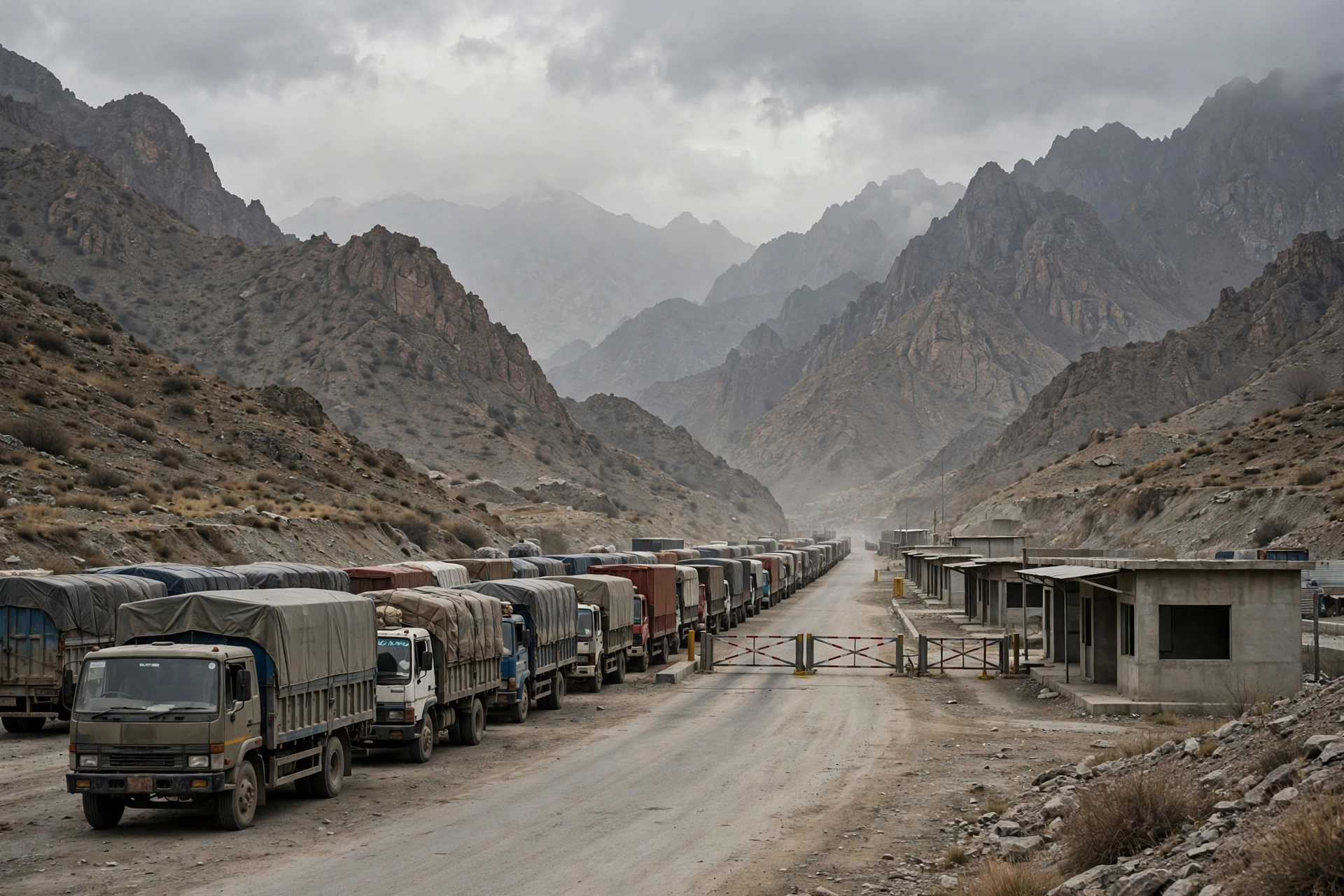
Dawn reported on October 19 that figures released by Pakistan’s Trade Development Authority put bilateral trade with Afghanistan at $358 million in 2025-26, down from $1.3 billion the previous year. Torkham was closed after clashes on October 12, 2025, while Kharlachi, Ghulam Khan and Angoor Adda in Khyber Pakhtunkhwa and Chaman in Balochistan have also stayed shut to commercial traffic. Transport and pharmaceuticals took the heaviest hits.
Transit trade fell harder: Afghan containers through Pakistan dropped from nearly 89,000, worth about $5 billion, to 11,592 worth $367 million in 2025-26. Pakistan’s main exports to Afghanistan are pharmaceuticals, cement, plastics, rice, fruit and vegetables. Islamabad’s stated position is that border restrictions will stay until the Taliban take practical action against armed groups operating in Afghanistan.
The traders’ ledger: a daily burn of millions
Business groups estimate more than $2.5 billion in trade has been lost since the suspension, according to CNA. The Khyber Chamber of Commerce and Industry says the shutdown cost around $2.5 billion in total, including $1.644 billion in exports and $817 million in imports, while the province lost Rs7.27 billion in cess revenue. A meeting with the interior minister promised to traders was never convened.
Traders quoted by Profit on October 12 put cumulative losses at Rs380 to 400 billion, with daily export losses of about $2.5 million and daily import losses near Rs540 million, roughly $75 million in exports a month. These are trade-circle estimates, not an official audit.
The halted commerce once fed steady foreign exchange through KP customs posts, mainly via Torkham; see the latest USD to PKR exchange rate figures for where the rupee stands today. Traders estimate about 2,500 taxi drivers and 3,000 labourers in Landi Kotal lost their work, alongside clearing agents, transporters, hotel owners and shopkeepers.
The human cost at Torkham
CNA’s reporting this week puts faces on the figures. At a Peshawar pharmaceutical factory, about 70 percent of the medicines packed were intended for Afghanistan and Central Asia, though its managers no longer know where their output will go. The factory sits just 60 kilometres from the Torkham crossing.
Exporter Mansour Ilahi, who sells rice, meat, citrus fruits and potatoes, told CNA that Afghanistan and Central Asia previously accounted for 80 percent of his revenue; after a year of closure, that share is down to 5 percent. A truck depot that once handled 40 to 50 trucks a day carrying goods from across Pakistan to Afghanistan now has no business. Traders federation president Malik Sohni said up to 50 trucks of potatoes and 25 of green vegetables crossed into Afghanistan daily before the closure, and that he alone lost Rs180 million to falling prices.
Pakistani households are no strangers to what disrupted supply routes do to prices, as the record Rs600-a-kilo LPG crunch has shown this winter.
What comes next: Istanbul and the price of reopening
There is some movement: Torkham has reopened for the repatriation of Afghan refugees, but commercial trade stays suspended, and the Foreign Office says it will resume only once the security situation stabilises. Customs staff were redeployed at the terminal and scanners restored this week, but the cargo gates had not opened at the time of publication.
The political price is clear: Pakistan wants the Taliban to take practical action against armed groups in Afghanistan, the condition behind its recent one-condition formula for Afghanistan talks. Delegations meet again in Istanbul on October 25 to work out ceasefire details. For traders the demand is simpler, and was put by KCCI’s Yousaf Afridi in September: the Torkham border should not be politicised, and trade should be kept separate from politics.
Until those talks produce results, the one-year ledger stands as a warning of what closed borders cost: $942 million in lost bilateral trade by official count, $2.5 billion by the traders’ arithmetic, and thousands of livelihoods in between. For more on the forces moving Pakistan’s trade and economy, follow PakMirror’s business and economy coverage.