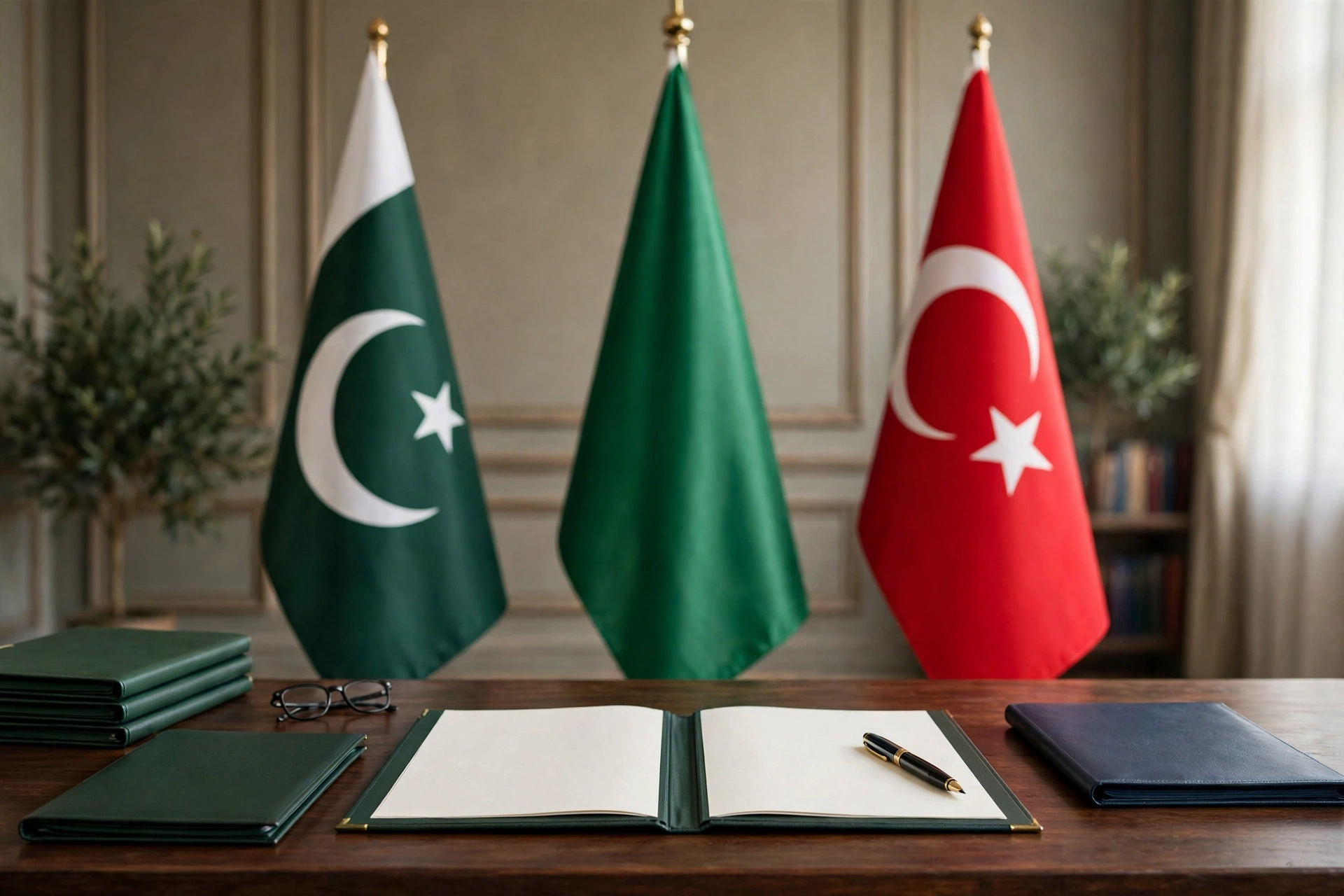

Pakistan and Saudi Arabia have completed ratification of the 16-article Makkah Joint Defence Agreement, the Foreign Office confirmed at its weekly briefing on Friday, and on October 27 Turkiye’s Foreign Affairs Committee approved the pact by a majority vote, sending it to the General Assembly for a final vote. The August 7 Mecca signature has thus moved to one final parliamentary step. But ratification is not the same as activation: on October 5 the alliance’s own committee decided to move immediately to practical implementation, including the rapid deployment of agreed military forces and capabilities in Saudi Arabia. What happens next depends on three open questions: when Turkiye’s General Assembly votes, what exactly the agreed forces are, and whether the current attacks on Saudi Arabia by Yemen’s Ansar Allah movement will become the test case for the pact’s mutual defence clause.
The 11-week sprint from signature to ratification
The agreement was signed on August 7 in Mecca by Turkish President Recep Tayyip Erdogan, Prime Minister Shehbaz Sharif, and Saudi Crown Prince Mohammed bin Salman. Weeks later, Yemen’s Houthis attacked Saudi Arabia. On October 5, the alliance’s Strategic, Political and Defence Committee held an emergency meeting in Riyadh and called for the rapid deployment in Saudi Arabia of “the agreed military forces and capabilities.” The same meeting condemned the attempted targeting of Makkah and Madinah and attacks on Saudi cities and civilian and economic facilities. Turkiye submitted the agreement to its parliament on October 20, and on October 23 Ishaq Dar met his Turkish counterpart Hakan Fidan in Istanbul, where the two condemned Houthi attacks on Saudi Arabia and reaffirmed coordination on regional security.
What the text actually commits
The pact comprises 16 articles with no hidden provisions, and Pakistan endorses the text released from the Turkish parliament. Article 1 commits the parties to use “all necessary means” to eliminate threats to one another’s territorial integrity, sovereignty, or internationally recognised borders. Article 2 says that if one party suffers an armed attack by another country or group of countries, the others shall immediately provide assistance using the full range of mutual assistance measures available to them. The provision refers to Article 51 of the UN Charter, the pact binds the three countries for the first ten years, and it also covers defence-industry and intelligence cooperation.
Open question one: Turkiye’s parliament
Turkiye’s constitution requires parliamentary approval, and that track cleared its first hurdle on October 27, when the Foreign Affairs Committee approved the bill by a majority vote, with the ruling AK Party and its allies backing it despite opposition objections. Deputy Foreign Minister Levent Gumrukcu answered lawmakers’ questions in a session open to the public, and chairman Fuat Oktay argued the agreement aims to increase deterrence and cooperation and will not undermine Turkiye’s existing alliances, including NATO. The bill now goes to the General Assembly for debate and a vote, and no date has been set. Turkiye has set public limits on its own role: Foreign Minister Fidan says the agreement is not an “offensive agreement”, and officials say no Turkish troops will be deployed to fight in Yemen or to attack the Houthis.
Open question two: which forces, and whether Article 2 applies
The October 5 decision speaks of rapid deployment of “agreed military forces and capabilities” in the kingdom, but what those are has never been disclosed, and the Turkish official’s remark that no deployment under the alliance had taken place so far sits awkwardly beside the committee’s language of immediate implementation. This is the biggest blank in the story: no government has said which units, systems or assets are moving. Equally unresolved is whether the Houthi attacks trigger Article 2. Asked directly, the spokesperson said the pact is defensive, “not directed against any particular country,” and that any assistance would be decided collectively after an objective assessment. The political signal points toward the pact’s first real test, but the legal trigger has not been formally invoked. The Istanbul summit this week already put Pakistan’s new defence architecture to its first diplomatic test; the Makkah pact may now face its first operational one.
Why Pakistan finished first, and what to watch
In Pakistan, signing and ratifying international agreements falls within the executive’s authority under Articles 90 and 99 of the Constitution, so parliament had no formal role. Three markers will show where this goes next: the General Assembly debate and vote date; any disclosure of which forces were agreed for deployment and whether anything is actually moving; and whether a future strike on the kingdom is ever publicly framed as an Article 2 case. At the same briefing, the spokesperson was evasive about the Iran border trade halt that stranded LPG and other freight at Taftan and Gabd-Rimdan. For more, see PakMirror’s national news from Pakistan.