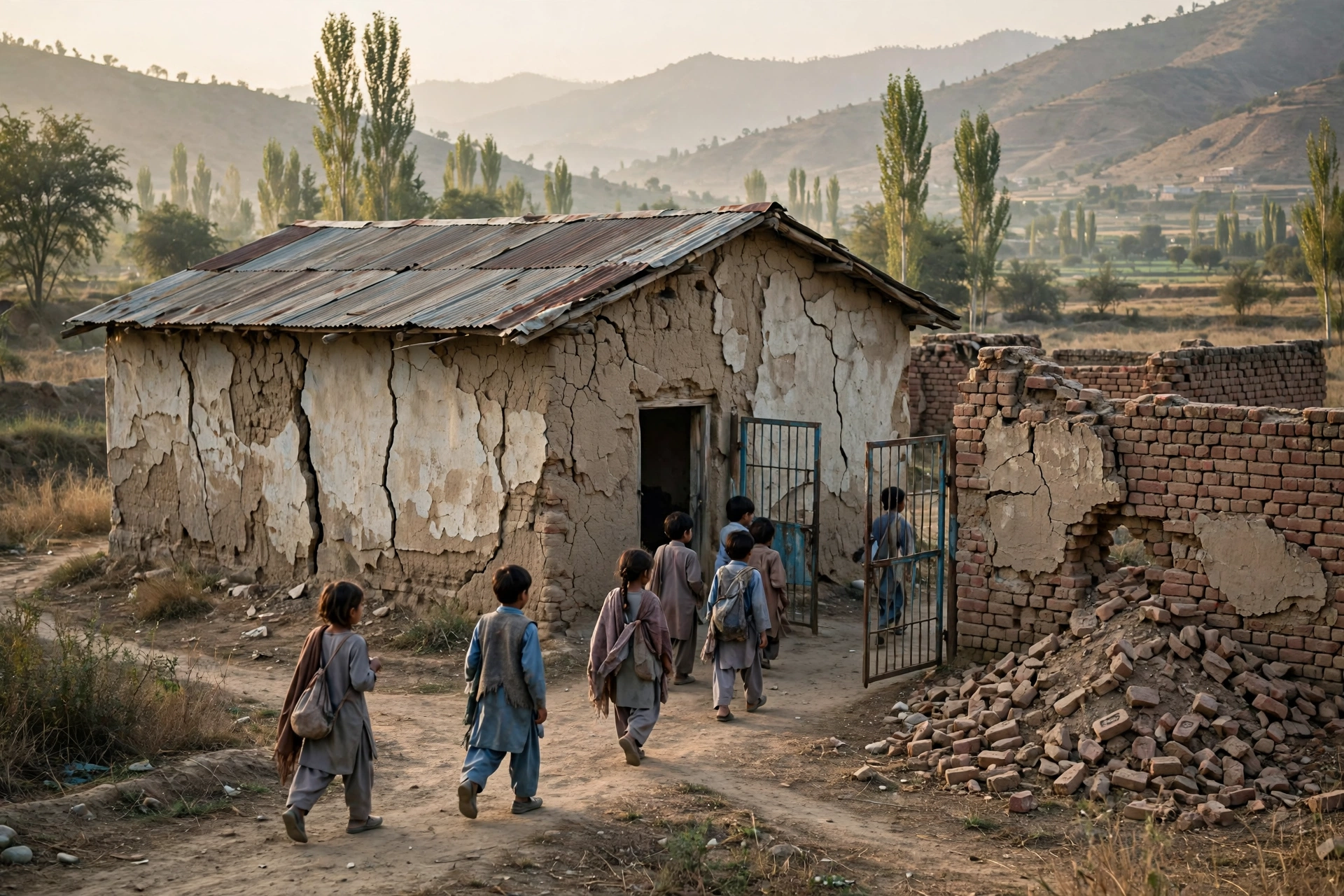

Government schools across Bannu district need an estimated Rs4.509 billion in repairs and basic facilities, according to a school-level infrastructure assessment by the district education office reported by Dawn on October 22. The assessment covers 672 government schools, identifies 711 classrooms needing repairs, flags washrooms missing at 209 schools, and lists boundary walls as damaged or missing at 33 schools. The headline number hides a sharper truth: primary schools absorb Rs3.72 billion of the total, about 82.5 percent, making this overwhelmingly a primary-school crisis. At today’s USD to PKR exchange rate, the bill is roughly $16.3 million. The data lands in the middle of a wider reckoning for Khyber Pakhtunkhwa’s classrooms, days after the provincial government ordered province-wide safety audits following the Peshawar school roof collapse that triggered province-wide safety audits.
The bill, broken down by school level
The skew is impossible to miss. Primary schools account for 585 of the 672 affected schools, about 87 percent, and 630 of the 711 classrooms needing repairs, close to 89 percent. Their share also includes 188 of the 209 missing washrooms and 22 of the 33 damaged or missing boundary walls, at an estimated cost of Rs3.72 billion.
The remaining tiers look small by comparison: Rs342.95 million across 35 middle schools, Rs394.52 million across 39 high schools, and Rs51.56 million across 13 higher secondary schools. The category figures add up cleanly to the Rs4.509 billion headline, which suggests an internally consistent spreadsheet rather than a rounded guess. Averaged out, the bill is about Rs6.7 million per affected school, though that average bundles very different scopes of work at different sites.
Two pockets carry two-thirds of the damage
The geography is as concentrated as the school-level split. Bannu tehsil alone has 417 government schools with 227 classrooms needing repairs and 158 washrooms to be built, and every one of the district’s 33 boundary-wall cases falls within it. The Wazir subdivision adds 250 classrooms across 108 schools, plus 32 washrooms. Together the two pockets hold 477 of the 711 damaged classrooms, about 67 percent of the district’s total.
The rest is comparatively lighter: Miryan needs 99 classroom repairs and 11 washrooms across 56 schools, Domel needs 49 repairs and four washrooms across 42 schools, Kaki needs 60 classroom repairs across 30 schools, and Bakakhel needs 26 repairs and four washrooms across 16 schools. The boundary-wall detail matters beyond the numbers: the assessment notes that missing walls directly affect student safety, so the map tells planners exactly where the first wall-rebuilding crews should go.
Why the timing matters
This assessment did not arrive in a vacuum. On October 15, the roof of a private school in Peshawar’s Dir Colony collapsed, killing students and injuring dozens. The next day, the KP government ordered building audits of all private schools within four to five days and all government schools within 15 days, with committees empowered to classify buildings as safe, in need of repairs, or potentially unsafe. Residents were even asked to send videos of schools in poor condition through WhatsApp, Facebook and X.
The Bannu district education office data is precisely the kind of granular picture those audits are meant to produce: school by school, classroom by classroom, washroom by washroom. Its release now gives the audit drive its first district-scale baseline, and sets a precedent. If every district produced a similar line-item assessment, the province would finally know the true size of its school infrastructure backlog instead of discovering it one collapsed roof at a time.
What happens next
The assessment is explicit about the ask: the provincial government and the relevant education authorities should prioritise school infrastructure in development planning and allocate resources to the most pressing needs. The data even ranks those needs, with primary schools and the Bannu tehsil and Wazir subdivision pockets at the top of the queue.
The decision-making frame around that ask has just changed. Bannu is one of 12 districts brought under a new designated-districts administrative arrangement, for which dedicated secretaries, including one for the education and social sector, were assigned on October 22. So the Rs4.509 billion question will now move through a freshly reorganised administration. The real test is whether the assessment becomes an allocation: a line-item bill is only as good as the budget line that follows it. For continuing updates on this and other developing stories, follow PakMirror’s national news coverage.