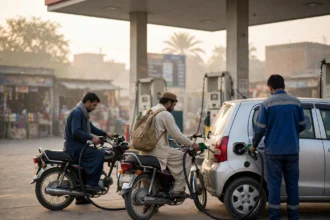
Prime Minister Shehbaz Sharif on Thursday ordered the licences of petrol pumps cancelled if they refuse subsidised fuel to registered beneficiaries of the Prime Minister’s Fuel Relief Programme. It was the second order in 24 hours, and the first to name a specific punishment, after the cabinet told the petroleum ministry a day earlier to take action against pumps withholding relief.
At a review meeting in Islamabad, the prime minister was told that 15,519,282 citizens had registered under the scheme and Rs28.6 billion had been paid out as of 4 November.
A warning becomes a threat in one day
On Wednesday 4 November, the prime minister told his cabinet that complaints had been received that some petrol pumps were not passing on fuel relief to consumers. He directed Petroleum Minister Ali Pervaiz Malik to act against the violators. That order, covered in the cabinet order a day earlier to act against pumps withholding relief, named no station, no count of pumps and no deadline.
Thursday’s meeting went one step further, directing the authorities to cancel the licences of pumps that fail to provide subsidised fuel to registered beneficiaries. No notification has been published, no station has been named, and no appeal process or timetable has been announced. Until a list or count of cancelled licences appears, the order remains an intention, not a recorded enforcement action.
Rs28.6bn out of Rs75bn: the money so far
The figures describe a scheme that is large, but spending more slowly than its allocation allows. Of the 15,519,282 registered citizens, 15.06 million are motorcycle owners and 449,000 own cars with engines of up to 800cc. A total of 63,153,685 subsidy tokens had been issued and 59,445,347 redeemed, a redemption rate of just over 94 percent.
The Economic Coordination Committee approved Rs75 billion for the scheme on 10 September as a technical supplementary grant, for a three month programme. The Rs28.6 billion disbursed by 4 November is 38 percent of that allocation, while 52 days of a roughly 90 day window had passed, about 58 percent. Two and three wheelers receive Rs500 a week, equal to five litres at the Rs100 a litre relief rate, and cars of up to 800cc receive Rs1,000 every ten days.
The six percent that never got through
A 94 percent redemption rate sounds like success, but the remaining six percent is about 3.7 million unredeemed tokens. A high level meeting on 25 October was told that 31,000 consumers had been denied subsidy, that 10,344 tokens had expired, and that the national average of redemptions was close to 500 across roughly 8,000 stations, below which a station was to be audited.
The 9771 helpline had received 3,000 calls by late October, of which about 400 were resolved at the first level. Punjab accounted for 1,700 calls and Sindh for 618. The threat is aimed at a small share of stations, but most of those complaints were still waiting when the prime minister spoke.
Prices fall while the subsidy still matters
The crackdown comes in a week when pump prices themselves have been falling. On 6 November the government cut petrol by Rs9.41 a litre to Rs352.59 and high speed diesel by Rs5.56 to Rs382.25, the fourth consecutive daily reduction. Petrol has fallen Rs25.32 a litre since Monday and diesel Rs20.71. Daily pricing has applied since 17 July, replacing the weekly review.
The prime minister had already told the cabinet that a Rs15 a litre rise due on Friday 30 October did not go ahead, because refineries were asked to share windfall profits made while international prices were elevated. He also announced direct LPG imports, declaring the era of the LPG mafia over. That matters for the same households the subsidy serves: rickshaw drivers cutting meals as fuel costs bite shows what happens when cooking and transport fuel both stay expensive. Fuel is an import, so the USD to PKR exchange rate today sets the rupee cost of every subsidised litre.
What to watch next
Three tests will show whether Thursday’s order changes anything on the ground. First, whether any licence is actually cancelled and named, and whether the count is published. Second, whether a notification and an appeal process appear, so that a pump accused of denying relief can be checked. Third, whether the scheme survives past mid December, when its three month window ends, under IMF pressure to phase it out promptly.
Until the first licence is cancelled, the strongest fact is the arithmetic: 15.5 million people registered, Rs28.6 billion paid out, 38 percent of the allocation spent, and 31,000 people who were told the relief was theirs and then did not get it. For more business and economy news from Pakistan, the test is simple: the next meeting should name a pump, not just a policy.