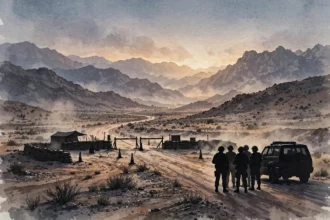
Pakistani security forces foiled an infiltration attempt in the Shaluzan sector of Kurram district on Thursday, 5 November 2026, after troops detected a heavily armed Fitna al-Khawarij group trying to cross from Afghanistan. Afghan Taliban posts then opened fire on Pakistani positions, security sources said, and Pakistani troops answered with heavy weapons. The sources said the infiltration failed and the Taliban posts took heavy damage. No casualty figures have been reported, no statement has been issued by the military, and the details have not been independently confirmed. The incident came five days after Pakistan’s military spokesperson warned that the Afghan Taliban could not absorb the punishment Pakistan could inflict.
Five days from warning to test
The military spokesperson, Lt Gen Ahmed Sharif Chaudhry, told Reuters in an interview reported on 1 November that Pakistan could counter threats from the Afghan Taliban, including drones, and was ready for attempts to test its readiness. “Whatever they want to send, they can; they may try. We have the capability to take them on,” he said. “They don’t have, I think, the capability to then absorb the punishment that we can put on them.” He added: “If you do it, then there will be a cost. And we are capable of imposing that cost and we have a clear strategy how to impose that cost.” He also called India the biggest terror sponsor facing Pakistan. He has also said Afghan forces at times provide fire cover to militants trying to cross into Pakistan. Thursday’s account matches that description. It is the first reported test of the warning.
The same sector, a thinner record
Kurram has seen this pattern before. The difference is in the record. On 10 October, troops detected khwarij approaching the border in the same district, and Afghan Taliban posts opened fire to support them. The next day the ISPR issued a statement: 12 khwarij and Afghan Taliban personnel had been killed, and Naib Subedar Hidayat Aman, 40, from Ghizer district, had embraced martyrdom. The October record gave names and numbers. The November record gives neither. There is no ISPR statement, no figure for militants or Taliban personnel killed or wounded, no word on whether any Pakistani soldier was hurt, and no Afghan response has been reported. The October clashes in the same district show what a full official account looks like. Until one appears for 5 November, the incident rests on unnamed security sources alone.
Four incidents in ten days
The Kurram incident does not stand alone. It is the fourth border incident in ten days along the same belt, according to the Express Tribune account carried by khabr.pk. On 27 October, shelling in Angoor Adda, Lower South Waziristan, killed one civilian and injured five members of one family, and Pakistan destroyed Afghan Taliban checkpoints in response. On 30 October, the army destroyed several Afghan Taliban posts near South Waziristan and Parachinar. On 1 November, security forces responded to firing from Afghan border posts near Angoor Adda, and Afghan Taliban personnel abandoned their positions. The pattern is now a cluster, not a single clash, even as the Pakistan Institute for Conflict and Security Studies counted 143 attacks in October, down from 226 in September.
The strain inside Kurram
The same district faced pressure from a second direction on the same day. Three polio vaccination workers, Salahuddin, Ali Muhammad and Bilal Khan, were abducted in the Gandao area of Central Kurram, police and local sources said. No militant group has claimed responsibility. In a separate development, polio campaign supervisor Abdul Jalil, abducted from Chapri in Jamrud tehsil of Khyber district three days earlier, was released, confirmed by Khyber District Police Officer Waqar Ahmad. The abductions came during a nationwide vaccination campaign running from 2 to 8 November and targeting about 24 million children under five across 97 districts. Pakistan also confirmed its ninth polio case of 2026 on Thursday, a seven-month-old boy from Khyber. Kurram is fighting on two fronts at once.
What to watch next
Three tests will show whether Thursday changes anything. First, whether the ISPR issues a statement with figures for the 5 November incident, or whether it stays a sources-only account. Second, whether Kabul responds at all. Islamabad accuses the Afghan Taliban of harbouring militants; Kabul denies it, and no Afghan response has been reported. Third, whether intelligence operations widened across Khyber Pakhtunkhwa the same week change the pattern on the border. The government decided on 4 November to expand intelligence-based operations, a day before the infiltration attempt, under the Khyber Pakhtunkhwa emergency proclaimed on 11 October. The warning has now been tested once. What matters next is an official record, an answer from Kabul, and a visible change on the ground. For more national news from Pakistan, see our National News coverage.