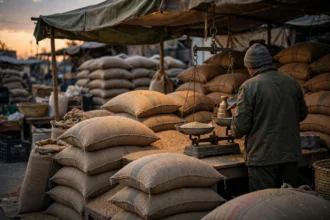
The first LPG auction now has a shape. The committee set up to run it met for the first time in Islamabad on 7 November and fixed the rules: 90 percent of locally produced LPG goes under the hammer, each company may buy at most 20 metric tonnes a day, and the first auction comes next week, under camera surveillance. Prime Minister Shehbaz Sharif said on 6 November that the LPG mafia era is over. PakMirror reported on 4 November when the quota system was abolished. Three days later the test is narrow: the auction covers about a third of daily use, its floor sits far above the official price, and clearing it needs 90 companies buying at the maximum every day.
Twenty tonnes a day, and a door left open
Each company may buy at most 20 metric tonnes a day, in lots of five and ten tonnes, in the presence of the media. Clearing 1,800 to 2,250 tonnes a day needs 90 to 113 companies buying at the cap every day. At the cap, one company takes 20,000 kg, about 1,695 cylinders. If fewer buyers turn up, local gas goes unsold. Bottlers must be prequalified by OGRA, and the proposal also lets PARCO send 75 percent of its auctionable share to its own subsidiary, Pakistan Petroleum Gas Limited, bypassing the auction. OGRA will audit storage, and the Competition Commission will watch for cartels.
The 90 percent that is really one third
Pakistan burns about 2.4 million tonnes of LPG a year, roughly 6,575 tonnes a day. Local output is 2,000 to 2,500 tonnes a day, only 30 to 38 percent of daily use. Ninety percent of that is 1,800 to 2,250 tonnes a day under the hammer, 27 to 34 percent of daily use. The rest, about 70 percent, is imported, and no auction touches it. State companies will now import in bulk through government and business deals. That is the larger half, with no auction and no timetable.
The floor sits far above the official price
The auction floor will be set 5 percent below PSO’s import-parity price, and the petroleum minister has put landed imported LPG at Rs450 to Rs500 per kg. That puts the floor at roughly Rs427 to Rs475 per kg, about 45 to 60 percent above the official Rs294. At the floor, the gas alone in one cylinder would cost Rs5,045 to Rs5,605, before bottling and transport, against the official Rs3,470. Open-market LPG already sells for up to Rs630 per kg. The official price must rise towards import parity once OGRA stops monthly notifications, and the open-market price may fall towards it. Rickshaw drivers cutting meals as LPG costs bite have the least room to wait.
The 70 percent the auction cannot touch
Distributors say about 70 percent of Pakistan’s LPG came from Iran, and the Taftan border crossing remains suspended. The Gulf supplied only about 225,000 tonnes of the roughly 1.3 million tonnes consumed, about 17 percent. Replacing Iranian volumes through Gulf deals at Rs450 to Rs500 per kg landed is the winter test, and it is priced in dollars, so every rupee of movement in the USD to PKR exchange rate today feeds into the import-parity benchmark. Demand is projected to reach 4.16 million tonnes by 2032-33 against domestic production of 1.35 million tonnes. The auction shares the smaller slice. It creates no extra gas.
Nine days to the strike deadline
Announced 3 November, approved by cabinet 4 November, first committee meeting 7 November. The first auction comes next week. The Pakistan LPG Marketers Association has threatened a nationwide suspension from 16 November if the private sector is sidelined, nine days after the committee first met, and it estimates the new formula could raise prices by 25 to 30 percent. An eight-member committee reviews the reforms over a month, so the auction starts before it finishes. Auction money above the producer price should flow into two protection funds, but no size, subsidy or household list has been published.
What to watch next
Three tests will show whether the auction is a fix or a ceremony. First, the clearing price, near the Rs427 to Rs475 floor or above it. Second, whether the marketers carry out the 16 November suspension, and whether state importers have cargoes by then. Third, whether the 10 percent quota reaches remote areas, and whether the protection fund publishes one verifiable subsidy figure. Until then, the auction sells the gas Pakistan has, not the gas it needs. More business and economy news from Pakistan is available on the site.