
Pakistan will replace the quota system for locally produced LPG with transparent auctions, and will bring state firms into bulk imports. Petroleum Minister Ali Pervaiz Malik announced the move in Islamabad on 3 November, alongside Information Minister Attaullah Tarar. It aims to end discretionary allocations and prevent winter shortages, after disruptions pushed some open market prices above Rs700 a kilo. The minister put landed imported gas at Rs450 to Rs500 a kilo, far above the official November price of Rs294.07 a kilo.
What changes, in four moves
First, local LPG leaves the quota. Companies will offer it in lots of five to ten tonnes, and auction results will be made public under the supervision of the relevant authorities. Second, state firms lead imports. Pakistan State Oil, the Sui gas companies and Pakistan LNG Limited will arrange bulk purchases through government to government and business to business deals, while the private sector will also be allowed to import.
Third, costs become public. Importers must disclose monthly procurement costs, including the Saudi Aramco contract price, premiums and freight, on their websites. The regulator will make licensing more transparent and audit storage to prevent hoarding, while the Competition Commission will act against manipulation and cartelisation. Fourth, extra revenue goes to protection, through a Price Stabilisation Fund and a Vulnerable Protection Fund, with subsidised rates to be set by the prime minister.
The price paradox in one cylinder
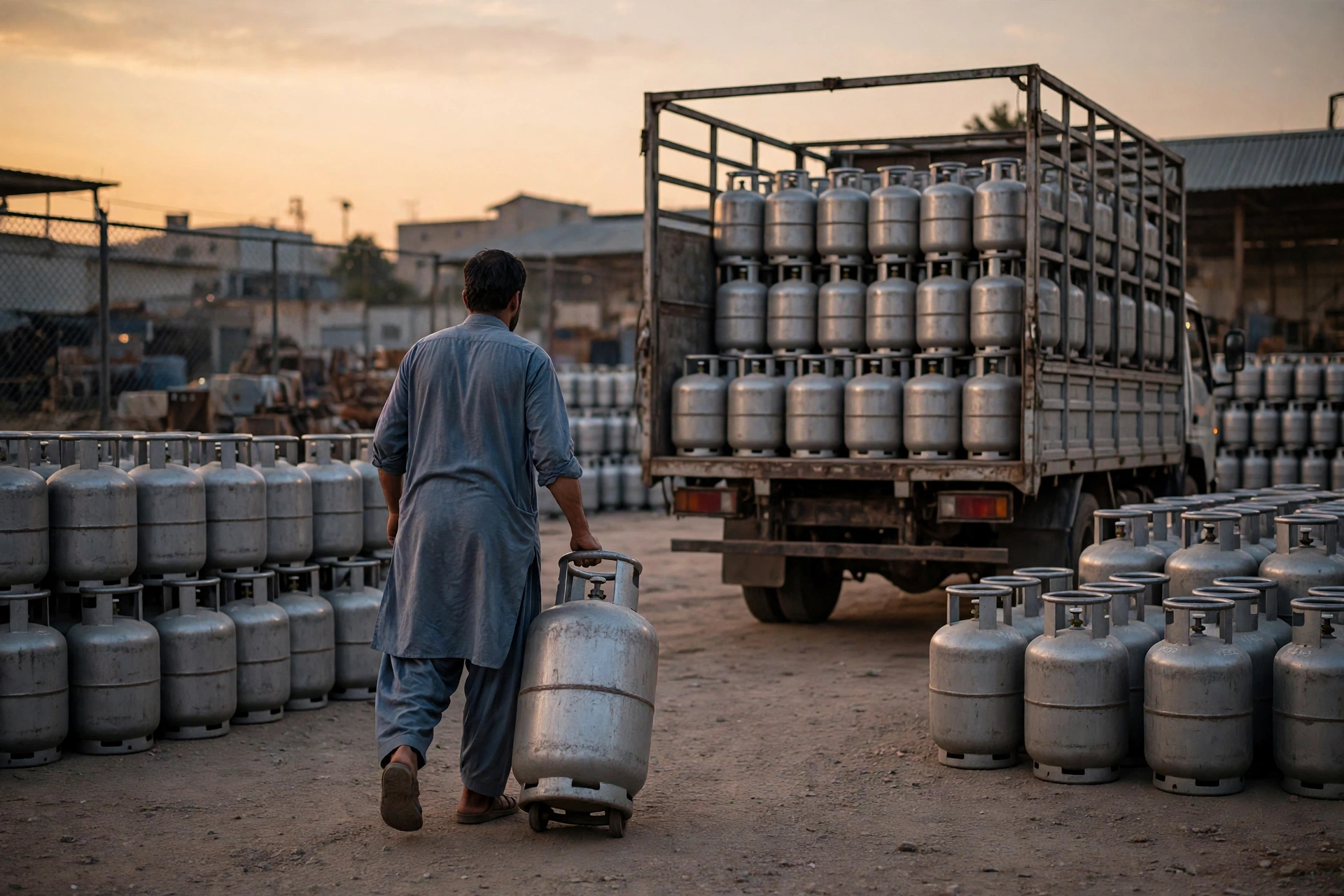
The official November price is Rs294.07 a kilo, putting an 11.8 kilo domestic cylinder at Rs3,470. At the minister’s landed range, the same cylinder costs Rs5,310 at Rs450 a kilo and Rs5,900 at Rs500 a kilo. That is Rs1,840 to Rs2,430 above the official cylinder, or about 53 percent to 70 percent above the official per kilo rate. At the open market prices reported by The News, Rs700 to Rs800 a kilo, the same cylinder costs Rs8,260 to Rs9,440.
Readers can compare three LPG prices in November, from Rs294 to Rs630 a kilo, where the open market ceiling was already Rs630. The gap is not new: filling plant prices in January to July 2026 exceeded the notified price by Rs60 to Rs79 a kilo on average, reaching Rs158 a kilo in March. Lahore rickshaw drivers cutting meals as LPG soared show what that gap does to a daily budget.
Demand puts the import task in scale. The minister put demand at about 2.4 million tonnes a year, with local production at 2,000 to 2,500 tonnes a day. Bloom Pakistan reported imports at about 71 percent of supply.
Who gets the 10 percent, and who pays for protection
Ten percent of the quota reserved for hard areas will be distributed transparently through state owned companies in consultation with provincial authorities. Earlier proposal documents described the same share as going to state marketers at the producer price to supply Gilgit-Baltistan, northern areas and other remote locations. The remaining 90 percent would be sold through monthly auctions at a floor price set five percent below the import parity price of Pakistan State Oil.
The protection side is thinnest so far. The earlier proposal described a Producer Price Differential Fund for households meeting Benazir Income Support Programme criteria. The 3 November announcement names two funds and says the prime minister will set subsidised rates. Until an eligibility list and a first subsidised price are published, households paying Rs700 a kilo today cannot tell whether they qualify.
The November 16 clock, and the private sector question
The reform arrives against a deadline it did not set. The Pakistan LPG Marketers Association has threatened a strike from 16 November if the government proceeds with a draft policy that sidelines private firms or reverses deregulation. The prime minister’s eight member ministerial committee, formed on 31 October, is due to report in late November, after the strike date.
That sequence creates the central tension. The announcement allows private imports, but state firms lead bulk buying, set the benchmark through import parity, and distribute the hard area share. Private firms will ask whether they get equal access to terminals and storage, and whether published state costs become a ceiling they can beat or a floor they must follow.
Three tests before winter bites
First, watch the first auction: a date, a published lot list, a floor price tied to a named import parity figure, and results made public. Second, watch the first state import and cost sheet. If a state firm publishes the Saudi Aramco price, premium and freight, and the street price moves toward Rs450 to Rs500, the mechanism is working. The petrol pricing formula rewritten on November 2 is a useful parallel.
Third, watch the subsidised rate and the winter gas promise together. A named rate, with eligibility and a delivery route, plus piped gas at meal times in December and January, would mean protection and supply arrived together. For more business and economy news from Pakistan, the number to track is whether one cylinder, bought in December, costs closer to Rs5,310 than to Rs9,440.