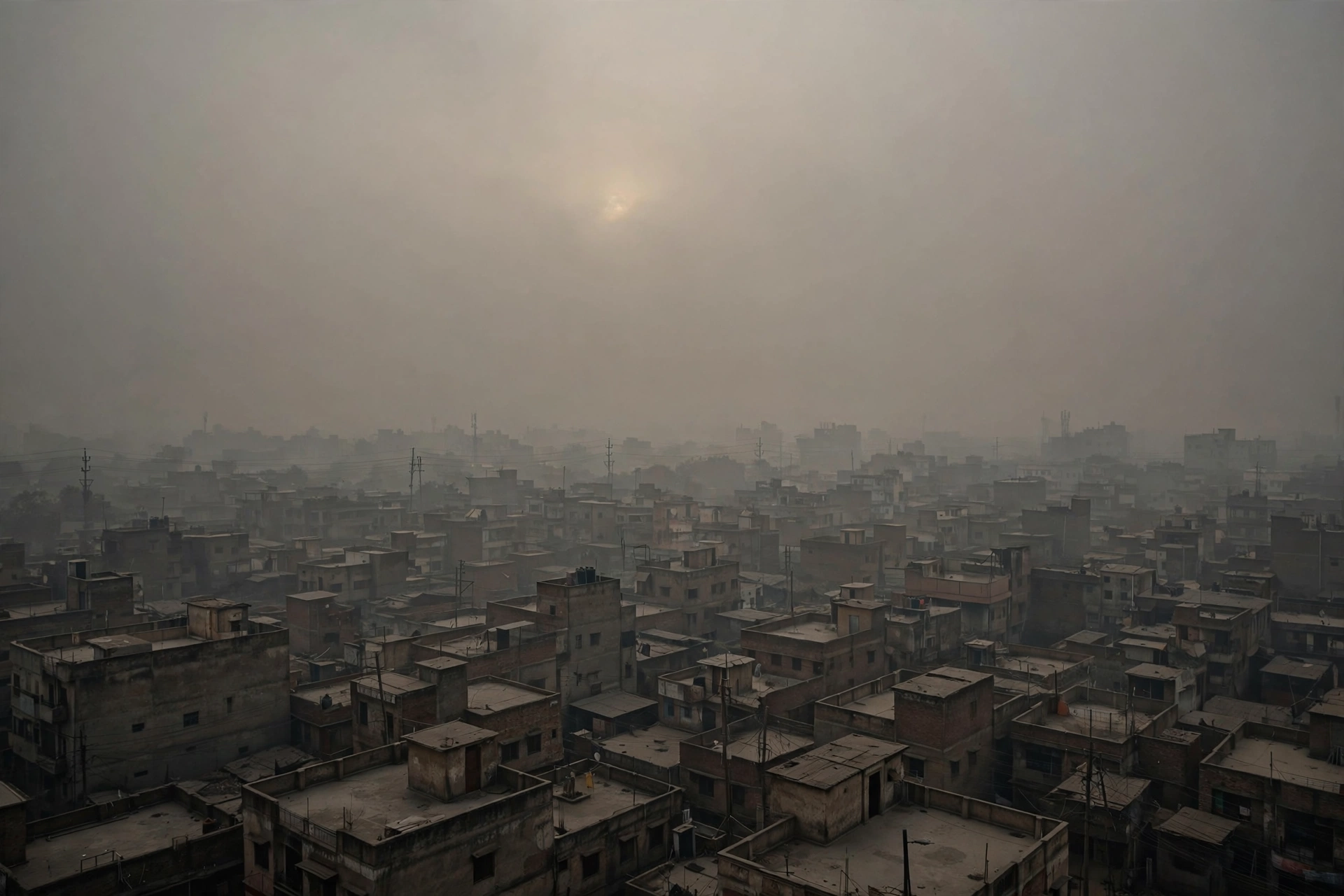

On Monday morning, Lahore was again the most polluted major city in the world. IQAir put the city at 563 at 8am, with an hourly reading reaching 647, and fine particle pollution at 357 micrograms per cubic metre. Senior Minister Marriyum Aurangzeb linked the spike to easterly winds and Diwali fireworks in India. Her own department issued an assessment the same day, and its numbers tell a narrower story.
What Punjab’s own model attributes to India
The department’s assessment, issued on 9 November, uses satellite observations, ground monitors and a factor-attribution model. It estimates that regional haze added 75 AQI points to Lahore between 1 and 5 November, ranging from minus 23 to plus 92 points. Seasonal conditions, longer and colder nights and stronger inversions, added 56 points, and temperature and humidity added 22 points by helping particles grow.
The model estimates the direct influence of air arriving from India at between minus 6 and plus 13 AQI points. That is a separate figure from regional haze, a belt stretching from Ludhiana and Bathinda through Lahore and Faisalabad to Multan. Back-trajectory analysis shows air over Lahore on Monday spent 22 of the previous 24 hours over Indian territory, and 17 hours on Tuesday. Diwali firecrackers added to the regional load, the department says, but their share was not separately quantified. The wind direction is not in dispute; the size of the share is, and the model puts it far below the two larger factors.
The week in numbers
The Pakistan Air Quality Initiative, reported on 9 November, found Lahore’s average AQI in the first week of November was 268, with five days very unhealthy and two hazardous. Average fine particle pollution was 215.5 micrograms per cubic metre, about 25 per cent higher than the same period in 2025. The department agrees: satellite-observed haze rose 56 per cent in the first week of November, and station readings rose 41 per cent, against the same period last year.
The season’s busiest fire day so far fell on Diwali itself. HamariHawa, using NASA satellite data, counted 2,859 fire spots across both Punjabs on Sunday 8 November, the most of any day this season, and the first time in seven seasons that the busiest day fell on Diwali. Lahore’s fine particle reading rose from 219 micrograms per cubic metre at 9am on Sunday to 398.5 at 9am on Monday. The same analysis is careful: the data cannot apportion Monday morning between the fires, the fireworks, and Lahore itself. One model got the night wrong: the Copernicus service had Lahore getting cleaner overnight, while the measured figure rose from 212 to 398.5.
October’s improvement did not survive the season
October did look cleaner, as PakMirror reported on 2 November. The department’s assessment backs that improvement with two datasets: NASA’s GEOS-CF data showed a 27 per cent decline in October, and ground stations showed a 19 per cent fall. But the Pakistan Air Quality Initiative had already shown that after adjusting for weather, the October improvement narrowed to about 4 per cent. November has now erased that gain. The first week of the month ran 41 per cent worse than the same week last year.
The initiative’s national report puts the toll at 3.9 years of life expectancy lost, about 128,000 premature deaths a year, and 6.5 per cent of GDP. In Lahore, prolonged exposure could cut life expectancy by up to seven years. Transport is the largest source of primary fine particle emissions in the city, ahead of industry at 28 per cent and brick kilns at 17 per cent, and the report says measures exist that could cut emissions by up to 50 per cent.
No relief in the forecast
The department’s forecast for the rest of the week puts Lahore at 283 today, 295 tomorrow, 284 on Thursday and 218 on Friday, still unhealthy throughout. Its model identified 90 to 91 per cent of days when the AQI crossed 300, tested over 110 dates across two smog seasons. Friday’s reading is the test: near 218, the model has earned its claim, and near 300, the forecast needs explaining. The World Bank-backed Punjab Clean Air Programme, approved at 300 million dollars in March 2025 and running to June 2030, aims to cut fine particle pollution by 35 per cent over a decade. A decade-long programme cannot be judged on one week, but this week shows what it faces: a regional haze belt, a season that traps what the region emits, and a debate about whose smoke it is instead of how much smoke there is.
Three things to watch: Friday’s reading against the forecast 218; the station-level data behind the model; and anything new from the government about local sources. More national news from Pakistan