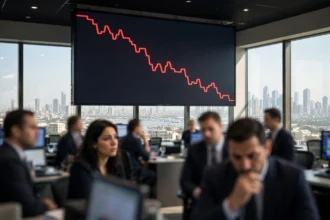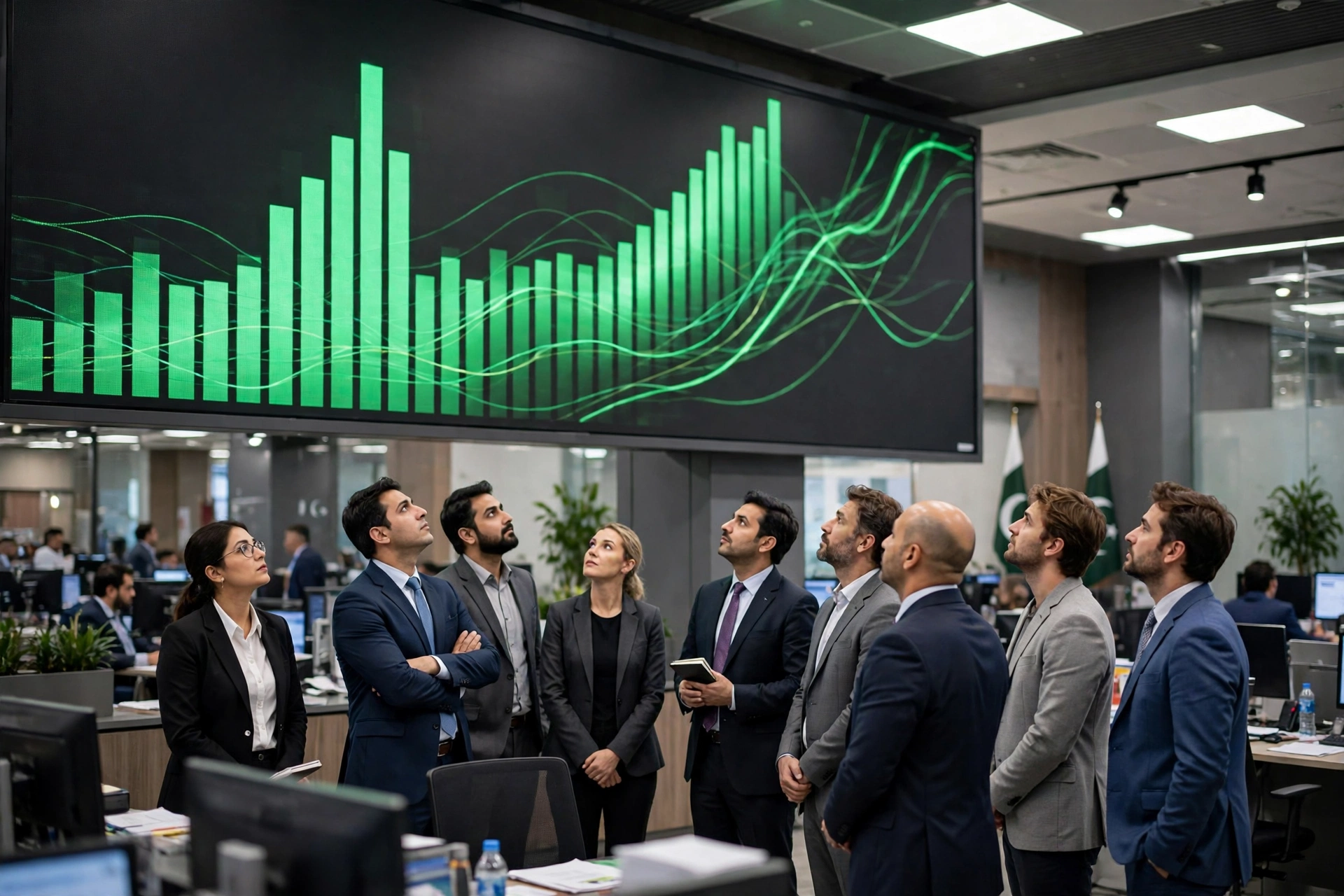

The Pakistan Stock Exchange opened its first session after the Iqbal Day holiday with a surge that carried the benchmark KSE-100 Index past 177,000 for the first time. At 9:45am on Tuesday, the index stood at 177,168.09 points, up 3,281.41 points or 1.89 per cent from Friday’s close of 173,886.69, according to Bloom Pakistan. The market had opened at 176,274, already 2,387 points higher.
Buying was broad: automobile assemblers, cement, commercial banks, oil and gas exploration companies, oil marketing companies and power generation all traded higher, Bloom Pakistan reported, and index heavyweights MARI, OGDC, PPL, PSO, HUBCO, HBL, MCB, Meezan Bank and UBL all recorded gains.
Four milestones in one morning
The Karachi Post reported the index recovered four round-number milestones in early trading, 174,000, 175,000, 176,000 and 177,000, and touched an intraday high of 177,265. Four levels crossed before mid-morning, on the first session after a public holiday.
The morning gain sits on top of a strong week. Last week the index gained 7,477.44 points, or 4.5 per cent, its strongest weekly rally in nearly six months, Bloom Pakistan reported. Put together, the index stood 10,759 points above its October close of 166,409 at 9:45am on Tuesday, a PakMirror calculation from the reported closes. In six trading sessions the market has recovered the whole of October’s 3,560-point fall and added more than 7,000 points on top.
Three drivers behind the buying
The first driver came from Washington: US President Donald Trump said the United States did not need to take further military action against Iran “at this point”, Bloom Pakistan reported. The remark eased fears of a wider Middle East war that had pushed oil prices up and interest rates higher. Asian markets rallied too: South Korea’s KOSPI climbed more than 5 per cent and Japan’s Nikkei around 3 per cent. On Monday the S&P 500 had risen 2.35 per cent, its biggest single-day rise since April, and the Nasdaq 2.7 per cent.
The second driver was oil itself. Brent crude fell 1 per cent to $91.56 a barrel, Bloom Pakistan reported, while West Texas Intermediate traded at around $87, according to the Karachi Post. For Pakistan, which imports most of its petroleum, cheaper oil means a smaller import bill. Financial analyst Sheheryar Butt told the Karachi Post the decline raised hopes of a lower import bill and less pressure on the external account, and could contain inflation and cut energy costs, if the fall lasts and reaches domestic prices. At home, the pass-through is already moving: NEPRA’s latest Rs2.37 fuel charge, approved last week, still leaves industry’s new rate selling below cost.
The third driver was closer to home: renewed optimism over Saudi-Pakistan investment cooperation, including the proposed Saudi-Pakistan private equity fund, the Karachi Post reported. The fund talks follow a separate Saudi move: Saudi Arabia rolled over its $3 billion deposit last week, with no date and no new cash attached. Market participants see the fund initiative as a sign of fresh capital inflows into Pakistan’s private sector. But PakMirror reported on Monday that the fund is an agreement to set up a fund, not money in hand: a stated 75-25 split between Pakistani and Saudi investors, but no exact size, no currency, no closing date and no named project. The market is pricing in a promise, and promises still have to be kept.
The rally has not been one way
Friday is the reminder. The index fell 1,493 points that day, closing at 173,886.69 after Thursday’s 175,379.87, a PakMirror calculation from figures reported by The News and Bloom Pakistan. The week in full: gains of 1,455 points on Tuesday, 3,995 on Wednesday and 3,366 on Thursday, then a 1,493-point fall on Friday. A market that can add 3,281 points before lunch can give some back by the close, and today’s figures are morning snapshots, not a final result.
Valuations still look modest: about 7.3 times earnings with a dividend yield near 6.8 per cent, according to market data cited by PK Revenue. Cheap valuations do not guarantee further gains, but they help explain why buyers returned so quickly.
What to watch next
Three tests will decide whether the mood survives the week: today’s close and whether the index holds above 177,000; the MSCI review scheduled for 11 November, which market watchers expect to shape foreign flows; and oil itself, with US inflation data and the US-Iran talks. The Karachi Post added exchange-rate stability and foreign investment commitments to the watchlist.
For now, the market has had its strongest run in months, built on cheaper oil, calmer geopolitics and Saudi hopes. The run is young, the fund is still a memorandum, and the close has yet to be counted. This article reports market movements; it is not investment advice.