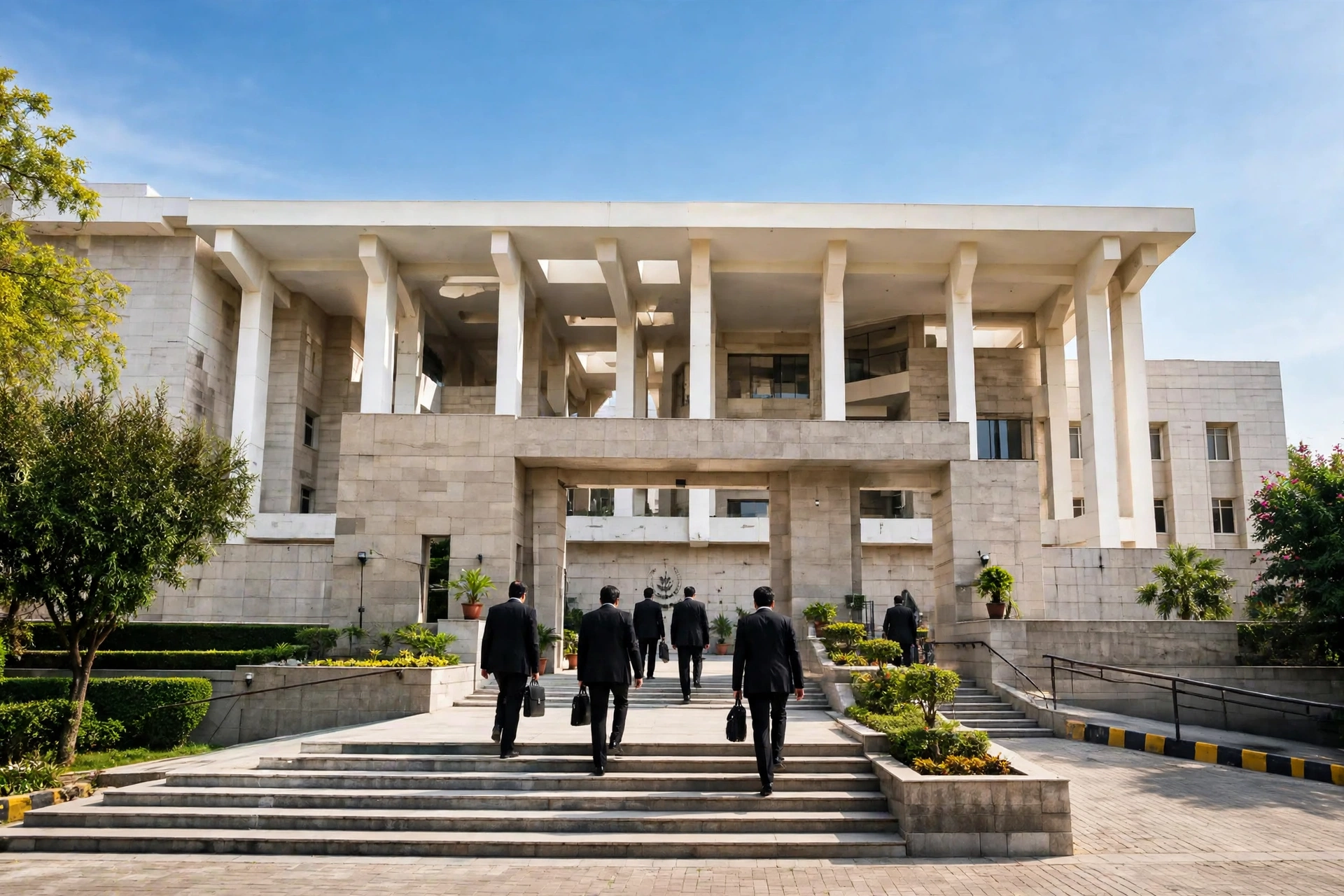

The Islamabad High Court spent Tuesday deciding who will argue Imran Khan’s appeal instead of hearing the appeal itself. Chief Justice Sardar Sarfraz Dogar ordered a one-hour meeting between lawyer Sardar Latif Khosa and the former prime minister and his wife Bushra Bibi, after Barrister Salman Safdar told the court he had only recently been allowed to meet the couple and the paper books for the appeals were not ready. No arguments were heard on the convictions, and no new date for arguments was reported.
A hearing about who argues
The appeals challenge the convictions handed down on 17 January 2025, when an accountability court sentenced Imran Khan to 14 years in prison and Bushra Bibi to seven years in the 190 million pound Al-Qadir Trust case. A division bench of Chief Justice Dogar and Justice Muhammad Asif had fixed the appeals for hearing on 10 November, the first movement since Safdar met his clients at Adiala Jail on 2 November.
In court, Safdar said he had been allowed to meet the couple unexpectedly and had received instructions to argue the appeals. He told the bench that Bushra Bibi had asked him where he had been for the past 11 months, and said the gap had created a crisis of confidence between him and his clients.
The chief justice pointed out that an earlier order had already settled that Khosa would lead the arguments, and asked Safdar to let him begin. Safdar replied that the paper books had not yet been prepared or given to the defence, so he had no material to prepare from, and he needed time to study the record.
The chief justice offered him that time. NAB prosecutor Rafi Maqsood responded that the prosecution had repeatedly been accused of delaying the case, yet it was the defence now seeking an adjournment. The chief justice added that no rule stopped appeals with large volumes of documents from being decided.
Twenty-two months on, the arguments have still not begun
The convictions date from 17 January 2025. Almost 22 months later, on 10 November 2026, the appeals have still not been argued. The case has been listed, adjourned and listed again, while the sentence keeps on running.
At the last hearing, on 5 October, the court adjourned the appeals indefinitely, after Safdar told the court that NAB had sought adjournments at 16 hearings. In June, the same bench gave the defence a final two weeks to begin arguments and said no further unnecessary delay would be tolerated. That deadline passed without arguments beginning. In May, the court had already been told the appeal had been through 17 hearings.
The side asking for time has changed, from the prosecution to the defence, but the result is the same: the appeals sit unargued. Bushra Bibi has also pursued a separate route, filing for suspension of sentence in the Federal Constitutional Court on 30 April and seeking an early hearing on 17 September.
The medical file runs on a separate clock
The hearing also carried an urgent medical question. Safdar filed an affidavit on 7 November after meeting the couple at Adiala Jail on 2 November, a meeting of about 40 minutes. It was his first meeting with Imran Khan in seven months and with Bushra Bibi in eleven months.
According to the affidavit, Bushra Bibi wore unusually dark sunglasses throughout the meeting and said she could tolerate neither sunlight nor artificial light. Doctors had diagnosed a mature cataract and advised another eye operation around 15 November, five days after the hearing.
Her application asks the court to order a full medical report, an immediate examination by an eye specialist, and permission for treatment by doctors of her choice at her own expense. The court has not yet examined the medical record or ruled on the application.
On Sunday evening, a PIMS team examined the couple at Adiala Jail, spent about two hours inside, and left without disclosing a single finding.
What has to happen next
Three things will decide whether the appeals finally move: the one-hour meeting must produce one agreed counsel, the paper books must be prepared and supplied, because no lawyer can argue an appeal without the record, and the court must rule on the eye-care application before 15 November, the date doctors advised for the operation.
The hearing came as the federal government’s confrontation with the PTI widened: the cabinet imposed emergency rule in Khyber Pakhtunkhwa, and Khawaja Asif backed restructuring the country into 12 provinces.
Until the record is ready and the lawyers agree on who argues, the appeal fixed for 10 November remains where it has been for almost two years: listed, but unargued. Tuesday’s order brought no acquittal, no suspension and no release. It brought a meeting. More national news from Pakistan