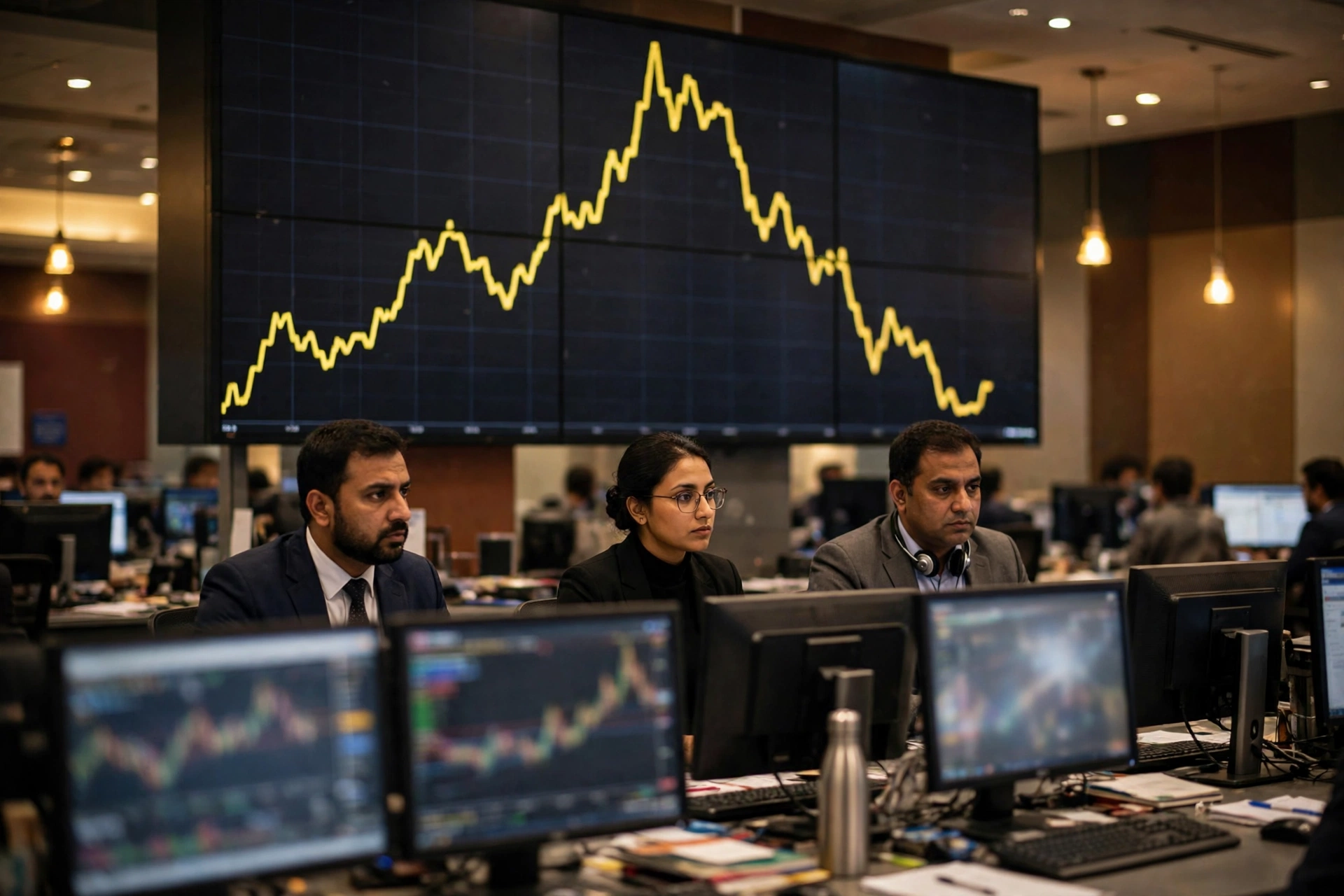

The Pakistan Stock Exchange gave investors a full round trip on Wednesday 11 November. The benchmark KSE-100 Index closed at 179,083.80, down 251.44 points or 0.14 percent from Tuesday’s close of 179,335.24. Between the open and the close the index travelled more than 2,100 points, crossing 180,000 in the middle of the session and then giving back every point of the rally before the bell.
Fear first: a 523-point fall before 10am
Selling hit the market within minutes of the open. The index dropped more than 500 points in early trade as investors reacted to renewed attacks on shipping in the Strait of Hormuz, according to Business Recorder. By 9:45am the index stood at 178,812.16, down 523.08 points or 0.29 percent, Bloom Pakistan reported. The session low came later, at 178,642.36.
Oil moved the other way. Brent crude, which had fallen to about 90.18 dollars a barrel on Tuesday, was back at 92.95 dollars, up 1.46 dollars or 1.60 percent, while US crude rose 1.58 percent to 87.40 dollars, Mettis Global data showed. For an oil-importing country, dearer crude means a heavier import bill and a weaker inflation outlook, which is why the market reads every Hormuz headline twice. A weaker rupee would add to that import bill, so traders also watch the USD to PKR exchange rate today whenever oil climbs. Cheaper oil had already fed through to fuel prices at home: petrol has fallen Rs39.91 a litre since November 2, so a fresh rise in crude puts that relief at risk.
The middle of the day: a rally of nearly 2,000 points
Then the market turned. Buying returned in banking, energy and technology stocks, and the index climbed back through 180,000, Profit by Pakistan Today reported, gaining more than 1,400 points from its early lows. The session high was 180,769.21. From the 9:45am low of 178,812.16, that is a recovery of about 1,957 points. From the session low of 178,642.36 to the high, the full intraday range was 2,126.85 points. The rebound showed that buyers were still willing to step in, but it did not last.
The close: the rally fades, the index ends in the red
By the close the index had given back about 1,685 points from its peak to finish at 179,083.80. The KSE-30 fell 175.66 points or 0.34 percent to 52,230.29, and the All Share Index slipped 40.87 points to 106,969.30. Trading in the KSE-100 totalled 326.85 million shares worth about 30.82 billion rupees, well below Tuesday’s 972.43 million shares. The banking index fell 0.64 percent and the oil and gas index fell 0.54 percent, Mettis Global data showed, so the late selling was broad rather than confined to one sector.
Two days, one story
Wednesday only makes sense beside Tuesday. On Tuesday the index surged 5,448.56 points or 3.13 percent to close at 179,335.24 after US President Donald Trump said military action against Iran was not necessary at this point. Brent fell 2.58 percent that day to 90.18 dollars, and strong remittance inflows helped: Pakistan received 3.89 billion dollars in October, up 8.5 percent from September and 13.8 percent from a year earlier, according to the State Bank of Pakistan. The Pakistan Daily noted the index had added more than 12,900 points since the start of November, a gain built almost entirely on the expectation that the Iran conflict would be settled. Wednesday’s news ran the other way. Ship attacks in the Strait reached 37 in October, the highest monthly total of the conflict, the same paper reported, and November has shown little sign of fewer. So the market spent one day pricing in peace and the next day pricing in the attacks again.
What to watch next
The index now sits about 6 percent below its 52-week peak of 191,032.73, so the record set earlier in the year is still some distance away. Traders will watch whether the Hormuz attacks escalate or fade, what happens to Brent, and the US inflation data and domestic corporate results that dealers were already waiting for before this week. At home, LPG dealers have called a nationwide strike for 16 November, a domestic risk the market has so far ignored. The wider economy still has support lines of its own: the ADB approved $500 million in contingent disaster financing for Pakistan earlier on Wednesday, though that money is only released after a disaster. The lesson of the last two days is simple: this market is moving on headlines from the Gulf, and a rally built on one headline can be undone by the next. More business and economy news from Pakistan.