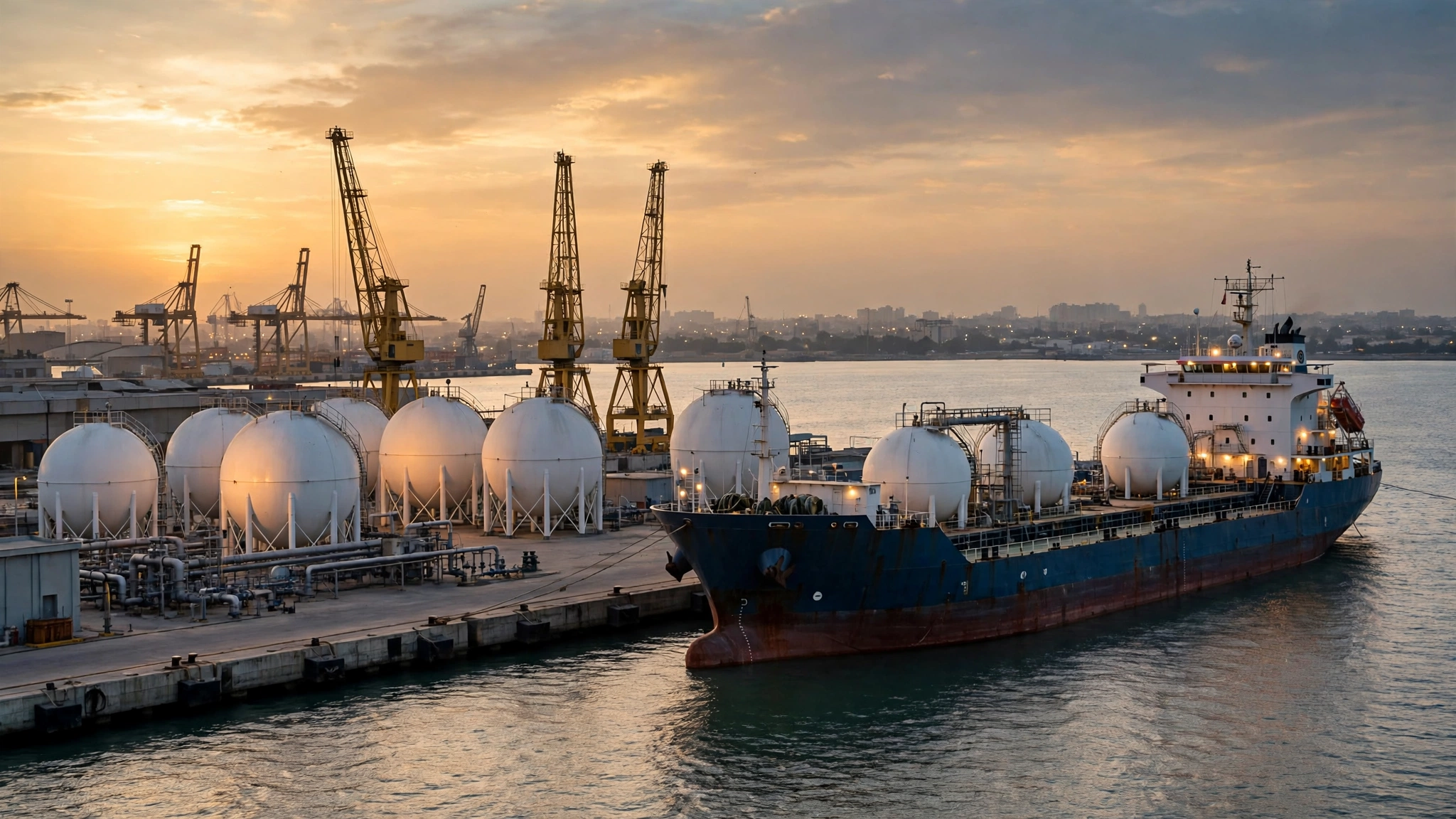

Pakistan has received what ARY News and Pakistan Observer both describe as the largest LPG shipment in the country’s history: a 15,000-tonne cargo berthed at the Engro Vopak Terminal at Port Qasim. A Petroleum Division statement cited by ARY News said public-sector companies had previously been unable to import LPG because of obstacles, and state-owned companies have now been directed to lead imports. Special Secretary Petroleum Mirza Nasiruddin Mashhood called it the beginning of a new era. The celebration is real. The arithmetic is sobering: at the rate Pakistan burns LPG in winter, this record ship carries about two days of gas.
Two days of gas in the biggest ship ever
Pakistan’s LPG market is estimated at about 2.4 million tonnes a year, or roughly 6,575 tonnes a day. In winter, daily demand passes 6,000 tonnes, and last January it reached a record 7,000 tonnes. Divide 15,000 tonnes by those figures and the record cargo lasts about two days and a bit on an average day, and just over two days at peak winter demand. That is PakMirror arithmetic.
Storage is just as tight. Pakistan has about 70,000 tonnes of installed LPG storage, or about 10.6 days of average consumption, and the two principal terminals at Port Qasim each hold about 6,500 tonnes. One 15,000-tonne cargo is more than double the storage of either terminal. The record claim rests on the two outlets’ reports and the Petroleum Division statement they cite; no shipping document has been published.
The price gap the ship has not closed
The cargo has not yet moved the price a household actually pays. For November, OGRA notified Rs294.07 per kilogram, or about Rs3,470 for a standard 11.8kg cylinder. But the Pakistan Bureau of Statistics survey for the week ending 5 November put the national average retail price of a domestic cylinder at Rs6,497.89, up 114.88 percent in a year. At about Rs557 a kilogram, the surveyed market price is nearly double the official rate.
Neither report on the ship gave a price figure or a delivery schedule, so there is no evidence yet that the cargo has narrowed the gap. The government has proposed support for vulnerable households through a mechanism linked to the Benazir Income Support Programme, with eligible consumers paying about Rs300 to Rs350 a kilogram. The pricing dispute is already before the regulator: two gas price petitions before OGRA ask for very different outcomes, and the first LPG auction is testing the new market rules with a 20-tonne daily cap per company.
Why the ship had to come by sea
The cargo matters because the land route that fed Pakistan’s LPG market has broken down. Imports account for about 71 percent of national LPG availability, and about 55 percent of total supply used to come through Iranian land-border routes. On 17 October, the Gabd-Rimdan and Taftan crossings were closed. Recorded imports fell 34.1 percent in a month, from 161,012 tonnes in September to 106,139 tonnes in October. Land-border imports fell 32.1 percent and marine imports fell 39.4 percent, so the sea did not compensate for the land.
The October assessment estimated a supply gap of 46,861 tonnes, about 21.8 percent of estimated demand, and projects a November gap of about 50,500 tonnes. The wider winter gas gap has to be filled by regasified LNG, which is why Pakistan rejected $27 LNG bids and is now scrambling for winter cargoes at far higher prices.
The state takes the wheel
The record cargo is the first visible result of a policy turn. On 4 November, the cabinet approved a revised LPG framework with market-based pricing, auctions of indigenous LPG and a bigger state role in imports. Four entities have been given import roles: Pakistan State Oil, Pakistan LNG Limited, SSGC LPG Limited and PARCO Pearl Gas. The question is whether state buying adds supply or merely moves it: PSO Pak Gas and SSGC LPG together hold only about 5.4 percent of the domestic market. Marketers threatened a nationwide strike from 16 November over a pricing formula they said could raise prices by 25 to 30 percent, then postponed it on 9 November after the Sindh governor intervened. Petrol fell to Rs325 a litre in the eleventh straight cut under a new daily pricing system, a reminder that fuel prices now move almost every day.
What happens next
The optimistic scenario has December supply at 297,000 tonnes against demand of 250,000 tonnes, and January at 282,000 against 255,000. But those are conditional projections, not confirmed deliveries. Three things will show whether the record ship was a turning point or a photo opportunity: the dates and sizes of the next cargoes, the December OGRA price notification, and the border flows. If Gabd and Taftan do not recover, two days at a time will not be enough.