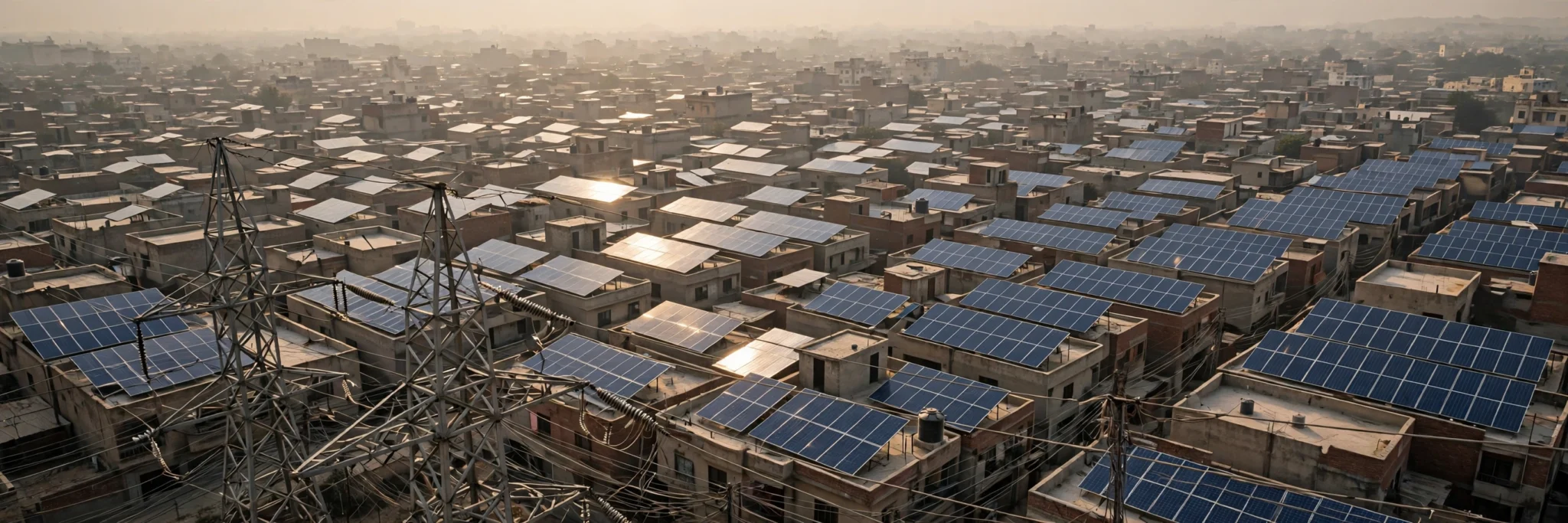

Seven million Pakistani households now own solar panels, and solar supplies 28 per cent of the country’s electricity, up from 1 per cent in 2018. Yet in October, load-shedding returned to Lahore and parts of Punjab, the shortfall passing 4,000 megawatts. The solar boom is real, and so is the problem it has created. The question is no longer whether panels work. It is who pays for the grid that remains.
A Boom That Met All New Demand
Energy think tank Ember calculates electricity demand rose 21 per cent, or 33 terawatt-hours, between fiscal years 2023 and 2025. In the same two years, distributed solar more than tripled, from 15 to 51 terawatt-hours. Solar met the entire increase in demand, while conventional grid generation fell 3 per cent. Households, not government policy, drove the boom: tariffs have more than doubled in a few years, Renewables First says, while imported Chinese panel costs fell 93 per cent. A home system with a medium battery now makes power at about Rs20 a unit, against about Rs40 for grid power. In rural Punjab, newly married Faizal Shahzad told the BBC his most prized wedding gift is a 340-watt panel. People used to gift motorbikes at weddings, he said, but now they give a solar panel and an air cooler.
The Paradox: More Power, Same Blackouts
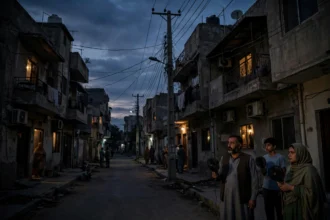
If Pakistan has never generated more electricity, why did the lights go out in October? Solar power and grid power are not the same thing at the same hour. On 5 October, ARY News reported the shortfall had passed 4,000 megawatts, and consumers in Lahore and parts of Punjab faced two to three hours of load-shedding. In mid-April, the Power Division said a sharp fall in hydropower had created a shortfall of about 4,500 megawatts at peak. Panels make power in daylight and stop at sunset, when evening demand peaks. A 2025 World Bank assessment found surplus generation capacity of 36 to 70 per cent between 2014 and 2023, yet substation capacity far below installed capacity. Pakistan often has more plants than it can use, but not the wires to carry power home.
Who Pays for the Grid Now
The government has long-term agreements with power producers that require capacity payments, fixed payments whether or not the plants run. Those payments were about Rs1.8 trillion in fiscal year 2024-25, Nepra figures say, and were projected above Rs2.1 trillion this year. Energy Minister Awais Ahmad Leghari told the BBC the exodus has cost the remaining consumers more than $500 million a year. In fiscal year 2024 alone, grid sales fell 3.2 billion units, costing distribution companies nearly Rs101 billion, passed into tariffs at about 90 paisas per unit for those who stayed. Circular debt stood at Rs2.4 trillion in June 2024, Nepra’s State of Industry Report says. So families who can afford panels pay about Rs20 a unit, while families who cannot afford them stay on a grid whose fixed charges keep rising. The capacity charge behind Nepra’s latest quarterly adjustment is part of the same pressure.
The Policy U-Turn: Net Metering to Net Billing
Under the 2015 net metering framework, every exported unit earned one unit of credit at the same retail rate, as tariffs climbed from about Rs9 in 2015 to Rs44 by 2024. In February 2026, Nepra’s Prosumer Regulations ended that deal for new consumers, replacing it with net billing. Households now sell surplus power at about Rs8 per unit, down from about Rs26, and buy grid power back at up to about Rs47 per unit before taxes. Leghari says without the change, the remaining consumers would have faced at least Rs150 to 200 billion a year extra. The country wants clean energy, but it has not yet found a way to pay for the grid that clean energy leaves behind, as Pakistan’s $188bn climate finance ask at COP31 shows.
What Happens Next
The next chapter is batteries. Kohinoor Textile Mills in Islamabad runs hundreds of machines on solar power when the sun shines. In July, the World Bank approved $375.9 million for a grid stability project, to steady the grid and bring 640 megawatts of curtailed wind power onto it. The Centre for Research on Energy and Clean Air estimates Pakistan avoided over $12 billion in oil and gas imports between 2021 and February 2026. The State Bank’s annual report recorded that the energy import bill fell 5.8 per cent in fiscal year 2025. Pakistan has committed to a 60 per cent renewable share by 2030, and Leghari wants up to 90 per cent clean power by 2036. Renewables First’s Muhammad Hassan Dajana sees two paths: solar and the grid in parallel, or Pakistan becoming a cautionary tale burdened with a costly, declining grid. More business and economy news from Pakistan is available on PakMirror.