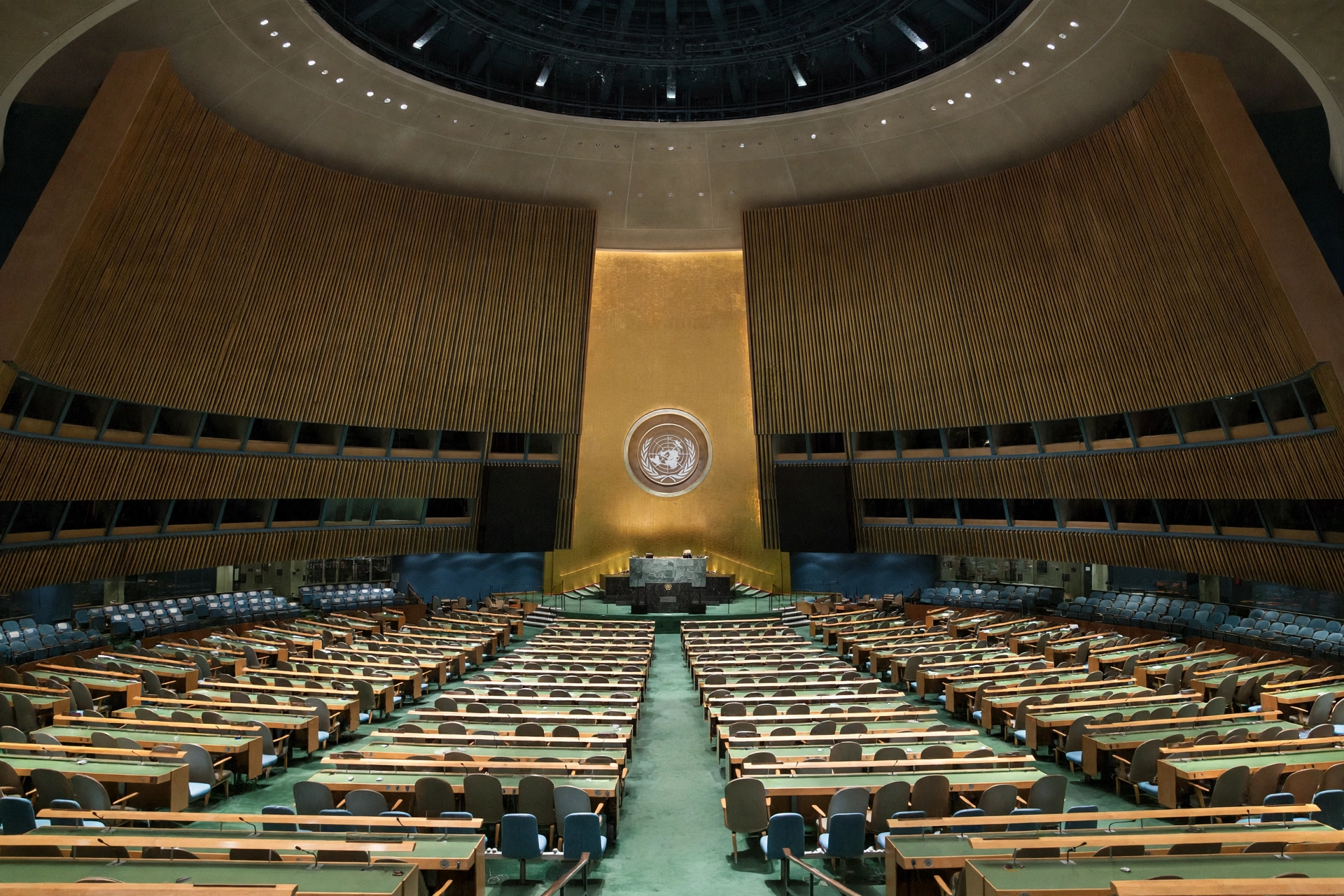

A United Nations committee has adopted, by consensus, a Pakistan sponsored resolution reaffirming the right of peoples to self-determination, but the vote that matters most has not happened yet. The General Assembly Third Committee approved the text, titled Universal Realisation of the Right of Peoples to Self-Determination, on Thursday 19 November 2026 without a formal vote. It was introduced by Pakistan Permanent Representative to the UN, Ambassador Syed Haider Shah, and co-sponsored by 62 countries. The full 193 member General Assembly is expected to endorse it next month.
Pakistan has sponsored this resolution every year since 1981. Ambassador Shah said the promise of self-determination remains unfulfilled for many peoples under foreign occupation, pointing to Palestine and Indian occupied Jammu and Kashmir.
What the resolution actually says
The resolution reaffirms the right of all peoples, including those under colonial, foreign and alien domination, to self-determination as a fundamental condition for the observance of human rights. It declares firm opposition to foreign military intervention, aggression and occupation that suppress that right, and it calls on the states responsible to cease such intervention and occupation at once, along with all acts of repression, discrimination, exploitation and maltreatment. It also deplores the plight of millions of refugees and displaced persons uprooted by such acts and reaffirms their right to return home voluntarily, in safety and honour. It urges the Human Rights Council to give special attention to the issue and asks the UN Secretary General to report to the next session of the General Assembly.
What the resolution does not do
No vote was taken, so there is no voting record and no country was forced to declare a position. Consensus in a UN committee means no delegation asked for a vote, not that every delegation agrees with every word. That distinction was on display in the same session, when India First Secretary Bhavika Mangalanandan said self-determination is a vehicle for decolonisation and not a justification for secession or for undermining the territorial integrity of any member state. She said attempts to reinvent basic principles of the UN Charter for narrow or domestic political ends are unacceptable. India still joined the consensus that adopted the text.
The text itself names no country and no territory. That is a deliberate feature, not an oversight. The trade off is clear: the resolution gains breadth but loses bite. It creates no enforcement mechanism, imposes no sanctions and orders no action against any state. It is a recommendation of the General Assembly, not a binding decision of the Security Council.
The same limit applies to its economic effect. The resolution carries no funding and no trade measures, so it does not move markets or household budgets on its own. Readers watching the economic side of Pakistan foreign policy can follow the USD to PKR exchange rate today separately, because the currency responds to trade, remittances and central bank decisions, not to a committee adoption in New York.
Why Pakistan keeps tabling it every year
For Pakistan, the value of the resolution is diplomatic rather than legal. Tabling it each year gives Islamabad a standing platform at the UN to raise the principle of self-determination and to link it, in its own statements, to Palestine and Kashmir. Support is therefore judged year by year. On that measure, this year shows a small softening: 62 countries co-sponsored the text in the Third Committee, against 65 at the same stage last year. The adoption was still by consensus, so the drop of three co-sponsors does not change the outcome, but it is the one hard number in the story that moved.
Pakistan recent engagement at the UN is not limited to this resolution. The country also recorded Pakistan climb to 119th on the UN E-Government Index, and Pakistan took its Indus waters dispute to the United Nations in a different forum. Each track runs on its own timetable, and none of them depends on the self-determination resolution.
What happens next
The next step is the full General Assembly, where the text is expected to come up for endorsement next month. Last year followed exactly this sequence: the Third Committee adopted the resolution on 19 November 2025, and the full Assembly adopted it by consensus in December 2025, with the Foreign Office announcing the endorsement on 19 December. If the same timetable holds, the December session will be a formality rather than a fresh debate. The real test is not whether the resolution passes in December, because it almost certainly will, but whether the consensus it records ever turns into pressure that changes facts on the ground. For more on Pakistan diplomacy and world affairs, see our international news coverage.