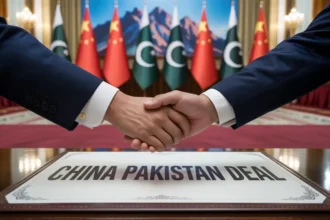

Planning Minister Ahsan Iqbal announced on Sunday that Pakistan’s first astronaut will fly to space from a Chinese space centre on November 25, 2026. The announcement, made at the closing ceremony of World Space Week in Narowal, gives the country its first firm launch date for a human spaceflight mission, sets a lunar landing target of 2035, and comes just days before the final selection between two pilot candidates is expected.
The Announcement
Planning Minister Ahsan Iqbal made the announcement on Sunday while addressing the closing ceremony of World Space Week in Narowal, an event organised in collaboration with the Pakistan Space and Upper Atmosphere Research Commission (SUPARCO). According to a handout from the planning ministry, Iqbal said the mission would fly from a Chinese space centre on November 25, and expressed hope that cooperation with China would help Pakistan “reach new heights in space exploration”.
Iqbal underlined the growing importance of space technology for agriculture, communications, climate monitoring, education and national security. He stressed that scientific research and space exploration were essential for technological advancement, and recalled that Muslim scholars had once made major contributions to astronomy and scientific discovery. He also announced plans to establish Pakistan’s first space museum at the University of Narowal, aimed at drawing young people toward space science and research.
Two Pilots, One Seat, Days to Decide
The astronaut will be chosen from two Pakistan Air Force pilots, Muhammad Zeeshan Ali and Khurram Daud, whom China selected in April for its human spaceflight programme after multiple rounds of medical, psychological and aptitude screening. Both have been undergoing intensive training in Beijing, covering Mandarin, Chinese spacecraft systems, centrifuge runs and preparation for the physical conditions of launch and weightlessness. Our report on the two pilots, the selection pipeline and the payload specialist role has the full background.
China has not said which of the two will fly. But the wait is almost over: speaking to Reuters last month, Amer Gilani, who oversees human spaceflight cooperation at SUPARCO, said a final selection decision was expected in mid to late October. That puts the naming of Pakistan’s first astronaut days away at most.
A Week in Orbit: What the Mission Will Actually Do
The chosen pilot will not command or pilot the Chinese capsule. He will fly as a payload specialist, meaning his job in orbit is to run Pakistan’s scientific experiments aboard the Tiangong station while serving as a full crew member alongside Chinese taikonauts. The stay is expected to last about a week, far shorter than the months-long tours typical of Chinese crews.
The mission is historic beyond Pakistan: whoever flies will be the first foreign national ever to board China’s Tiangong space station, which has been crewed only by Chinese taikonauts since it became operational. On the science side, more than 300 experiment proposals were submitted by universities in Karachi, Lahore and Islamabad, from which four were selected in cooperation with Chinese institutions. Reuters reported that the shortlisted work includes biotechnology research connected to food insecurity and climate change, although SUPARCO has not released a final payload manifest.
2028, Then 2035: The Ladder to the Moon
Iqbal’s second headline was bigger in ambition: Pakistan is targeting a lunar landing by 2035. Read alongside the existing cooperation, the path looks like a ladder rather than a leap. The astronaut mission flows from the February 2025 Pakistan-China astronaut cooperation agreement, which also covers a Pakistani-built lunar rover expected to join China’s Chang’e 8 mission around 2028. Human spaceflight this November, Pakistani hardware on the Moon by 2028, and a lunar landing goal a decade later.
One caution is in order: the minister did not specify whether the 2035 target means a robotic or a crewed landing, and no funded programme has been announced. The date should be read as a national target that the rover mission and the Tiangong flight are meant to build toward, not as a scheduled launch. China’s own space programme, which is also advancing work on space-based solar power and other long-range projects, gives Pakistan a partner with the launch infrastructure to make each step real.
Why This Launch Is Different
This is Pakistan’s first government-backed human spaceflight mission, the first time a Pakistani will conduct scientific experiments in orbit, and the first foreign crewed visit to Tiangong. It is also the first public launch date attached to the programme: until Sunday, Chinese and Pakistani officials had confirmed only that a mission was planned for later in 2026. Between the final pilot pick, expected within days, and the November 25 launch, Pakistan is about to compress years of space ambition into a single month. For the latest technology news from Pakistan, follow our coverage as the selection is announced.