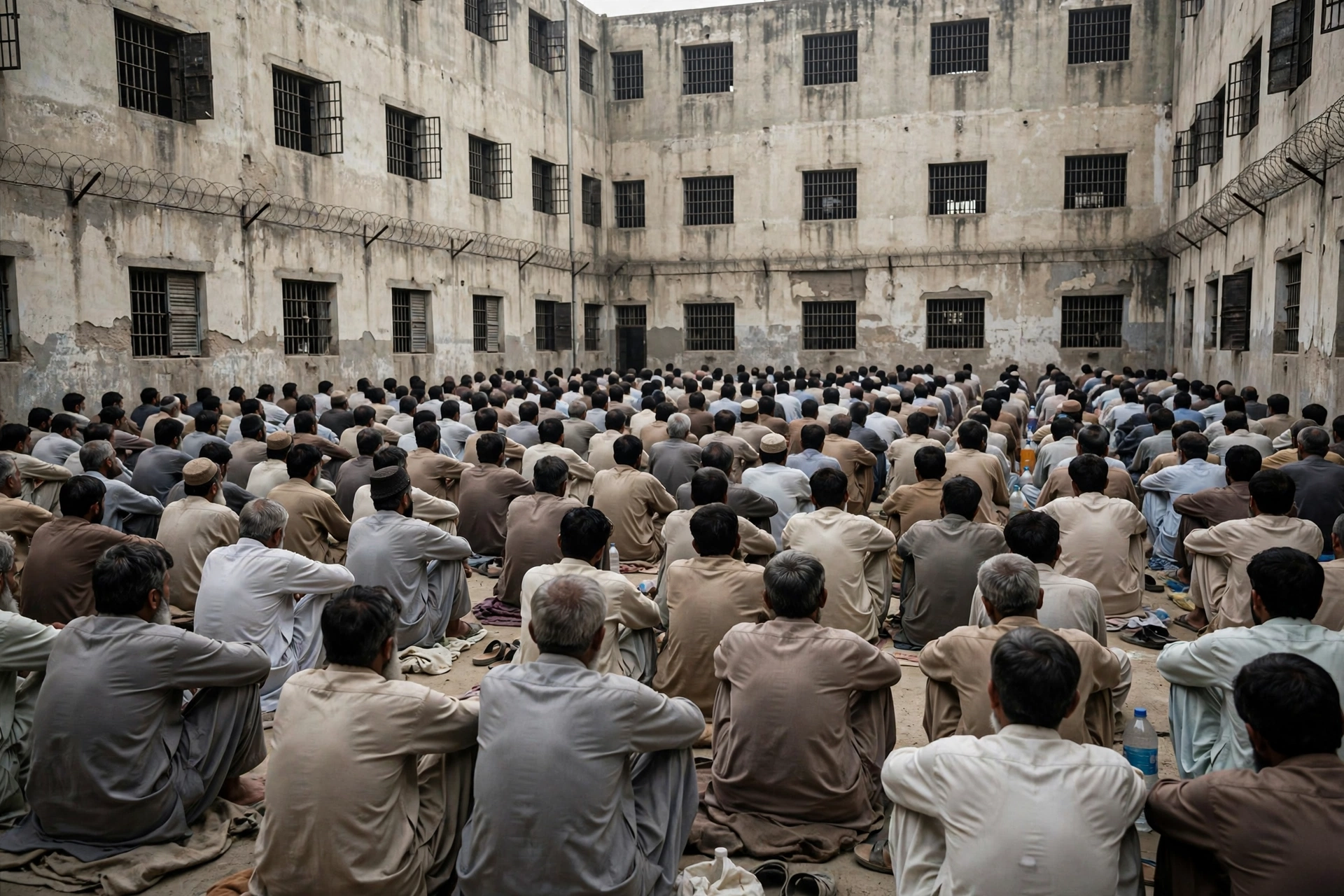

Pakistan is holding 110,513 people in its prisons while the system has authorised space for about 68,832, according to the Annual Prisons Data Report 2026 released in Islamabad on Thursday. Of those behind bars, 82,988 people, roughly three in every four prisoners, are still awaiting trial. That under trial figure on its own is 14,156 higher than the total capacity available for all inmates in the country.
The report was jointly compiled by the National Commission for Human Rights and Justice Project Pakistan, with support from the European Union. It is the second edition of the annual data exercise and brings together official prison figures from across the country to track overcrowding, pre-trial detention, bail, trial delays and the use of alternatives to custody. Its central finding is that prisons are operating at about 160.6 percent of their authorised capacity, with 41,681 more people inside than the facilities were designed to hold.
Under trial prisoners drive the pressure
The largest share of the population has not been convicted. With 75.09 percent of prisoners awaiting trial, the report links the pressure on jails to prolonged pre-trial detention, delays in criminal proceedings and barriers to bail. NCHR Chairperson Rabiya Javeri Agha said at the launch that the country faces a wider criminal justice problem, not only a shortage of prison space, because people enter custody faster than the justice system can process their cases. She pointed to delayed trials, limited access to bail and the limited use of non-custodial options as areas needing attention. Readers following Pakistan national news coverage will see this report land at a time when courts and prisons are both under sustained pressure.
Drug cases account for more than a quarter
Cases under the Control of Narcotic Substances Act form another major part of the total. More than 28,000 prisoners are held under that law, accounting for more than a quarter of all inmates. Both Dawn and Arab News, reporting the same data, put the rise since 2023 at over 43 percent, which the authors identify as a key driver of the recent growth in the prison population. The report therefore examines not only how many people are arrested, but also how drug related prosecutions move through bail, trial and sentencing, and whether laws and policies are adding to unnecessary incarceration.
Punjab and Sindh differ from KP and Balochistan
The national average hides a sharp provincial split. Punjab and Sindh continue to record rising populations and severe overcrowding. Khyber Pakhtunkhwa and Balochistan, by contrast, have reduced their prison populations and remain within their overall authorised capacity. The report attributes that difference in part to greater use of probation, parole, diversion and other alternatives to imprisonment in the two provinces. The contrast matters for policy, because it suggests that overall numbers can fall where non-custodial measures are used more consistently. Recent security reporting from the province, including the nine terrorists killed in the North Waziristan operation, shows how closely justice and security debates run together in Khyber Pakhtunkhwa.
Women, children and death row figures
The data also records growing pressure on women and children. The number of women in prison has risen by 45.96 percent since 2024, while 86.2 percent of children in prison are awaiting trial. Those figures sit alongside a fall in the death row population, which has declined by 11.7 percent since 2024 to 3,220 prisoners. Justice Project Pakistan Executive Director Sarah Belal said the purpose of collecting the data was to give policymakers, justice institutions and donors evidence for better decisions, and to show that different approaches are possible in practice. EU Delegation Head of Partnerships Jeroen Willems said how people in custody are treated is an important measure of a justice system, and that the findings should support evidence based reform.
What the report recommends
The authors call for changes to bail and surety practices, steps to reduce court delays, wider use of alternatives to incarceration and stronger oversight of prisons. They also recommend reviewing laws and policies that contribute to unnecessary detention. The aim, they say, is to cut the number of people held without conviction and to improve conditions, particularly for prisoners who have not been found guilty. The same week also saw the country mark National Resilience Day commemorations across Pakistan, a reminder that state capacity is tested in different ways across institutions. For the prison system, the next test is whether the provincial experience in Khyber Pakhtunkhwa and Balochistan can be applied more widely, so that the under trial total, now larger than the entire authorised capacity, starts to come down.