

ADB Ventures has invested in Neem, a Pakistani fintech that builds payment systems for businesses, in a bet on one of the widest gaps in the country’s financial system. The amount was not disclosed. The bet rests on a split in the State Bank of Pakistan’s own data: in the year to June 2026, digital channels handled 92 percent of retail payments by count but only 38 percent by value, while Rs415.7 trillion, about 62 percent of the money, still moved through over-the-counter channels. Consumers went digital. Businesses did not.
The investment
ADB Ventures, the venture capital arm of the Asian Development Bank, has joined Neem’s Pre-Series A round alongside DNI Group, HI2 Global, AKD Securities Limited, Epic Angels and the Pakistan Startup Fund. Neem gives businesses one platform for collections, disbursements, balances, settlement and reconciliation, and serves more than 70 enterprise clients.
ADB Country Director Emma Fan said Neem is helping enterprises move away from cash and fragmented systems toward payment solutions that are faster, more transparent and easier to manage. Neem went to market commercially in January 2025 and entered the State Bank’s first open-banking sandbox in January 2026.
“Pakistan’s businesses do not lack the ambition to go digital. They lack financial infrastructure that works as one connected system,” said Vladimira Briestenska, Neem’s co-founder. Its lending portfolio also gives employees early access to wages they have already earned, aimed at blue-collar workers who would otherwise borrow informally.
92 percent of the count, 38 percent of the money
The State Bank’s Annual Payment Systems Review for FY26, covering July 2025 to June 2026, counted 14.3 billion retail transactions worth Rs672.7 trillion. Digital channels handled Rs257.1 trillion of that, 92 percent of volume and 38 percent of value. Over-the-counter transactions still accounted for Rs415.7 trillion, down only slightly from Rs432.9 trillion the year before. Mobile phone channels processed about 11.1 billion transactions, 78 percent of all retail payment volume, up about 79 percent in a year.
One figure in today’s coverage needs correcting. It quotes 71 percent as the share of retail payment value still settled in cash. That is last year’s number: by PakMirror’s arithmetic from the State Bank’s figures, the over-the-counter share was 70.8 percent in FY25 and 61.8 percent in FY26, down about nine points in one year. The progress is real, but most of the money is still outside the digital system. All values in this article are in rupees; the USD to PKR exchange rate today frames their scale against the dollar. The same central bank data sits behind the external account picture, where the trade deficit was revised to $4.13 billion in October.
Even Raast mostly moves money between people, not to businesses
Raast, the State Bank’s instant payment system, processed about 2.76 billion transactions worth Rs80 trillion in FY26, more than double the 1.28 billion worth Rs29.6 trillion a year earlier. But paying a business through Raast is still rare. Person-to-merchant payments jumped about 37 times in a year to 182.5 million, yet that is only 6.6 percent of all Raast payments, according to figures reported from the State Bank’s provisional tables. The average business payment was about Rs5,450, against about Rs27,150 for a person-to-person transfer.
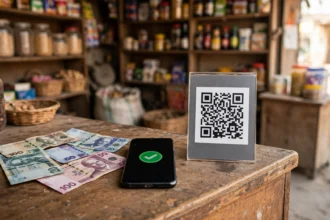
The same pattern shows in QR codes. Registered QR-enabled merchants rose from 1.09 million to 3.84 million, and point-of-sale terminals reached 337,791, yet only about 297 million QR payments were made all year, about 77 per registered merchant. Registration is not the same as use. Cash itself is still growing: cash in circulation rose about 12.3 percent to Rs11.9 trillion, and ATM withdrawals rose by the same proportion. Digital payments are growing alongside cash, not instead of it.
Two cautions: part of the count jump may reflect reporting reclassification, with branchless banking miscellaneous payments up from about 201 million to 1,953 million in a year; and registered accounts and wallets reached about 292.8 million, more than the population of 241.5 million, so registered does not mean active.
What happens next
Businesses lag because going digital means stitching together banks, wallets, payroll and reconciliation separately, a process that stays slow, costly and hard to scale. Neem’s pitch is one connected system. What to watch: whether Raast business payments keep growing near their FY26 pace, whether QR use rises above about 77 payments a merchant a year, and whether Neem’s earned-wage lending reaches small firms as well as large ones.
Large business payments in Pakistan still move through traditional bank credit lines and trade finance rather than instant payment rails, as PSO’s $200m Oman oil credit deal showed this week. An investment is a bet on the gap, not proof that it will close. Read more business and economy stories from Pakistan.