
A shallow 5.6-magnitude earthquake struck near Khuzdar in Balochistan on Saturday morning, shaking a wide area of central Balochistan and drawing an early yellow alert from the United States Geological Survey, which estimates up to one million people were in the modelled shaking zone. The quake hit at about 10:06am Pakistan time at a depth of 10 kilometres, roughly 48 kilometres west-northwest of Khuzdar. Different agencies put the magnitude between 5.6 and 5.8, which is normal in the first hours after a quake. Pakistani authorities had not released official casualty or damage figures by the time of writing.
What we know so far
The tremor was recorded at 05:06 UTC, which is 10:06am in Pakistan. Germany’s GFZ research centre reported a magnitude of 5.6 at a depth of 10 kilometres, according to Reuters, while the USGS later reviewed the event as a 5.7-magnitude shallow crustal quake centred about 48 kilometres west-northwest of Khuzdar. India’s National Center for Seismology measured it at 5.8. Early readings commonly differ because each agency uses different stations and scales; the USGS’s reviewed 5.7 figure uses moment magnitude, the standard for comparing quake sizes. The epicentre lies inland, so there is no tsunami threat. One public felt report had been filed with the USGS within the first hour, describing moderate shaking.
Why the yellow alert matters
The USGS issued a yellow alert for this event through its PAGER system, which estimates the human impact of quakes worldwide. A yellow alert signals that some casualties or damage are possible; it is a prediction, not a confirmed toll. The model places roughly one million people in the area exposed to light shaking or stronger. About 4,000 people may have felt very strong shaking, 35,000 strong shaking and 163,000 moderate shaking. Khuzdar city itself, with a population of about 141,000, is modelled at light shaking. The shallow 10-kilometre depth is the crucial detail: shallow quakes release their energy close to the surface, so they are felt more strongly and can damage buildings more than deeper quakes of the same size.
Balochistan’s buildings are the real risk
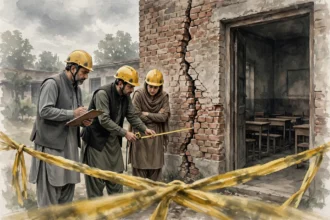
The bigger worry in this region is not the quake’s size but what it shakes. The USGS vulnerability assessment notes that the population here lives overwhelmingly in structures considered extremely vulnerable to earthquake shaking, with adobe block and informal construction, including metal, timber and galvanised-iron shelters, the predominant building types. Well-built structures usually escape a 5.7-magnitude quake with little harm; poorly built ones do not. A 5.6-magnitude quake near the Sindh-Balochistan border in March 2026 caused no casualties but left minor cracks in mud houses, a pattern that shows how construction quality, more than magnitude, decides the outcome in this part of the country. Saturday’s tremor also arrives days after the Peshawar school roof collapse put building safety under the spotlight in Pakistan, and after Khyber Pakhtunkhwa ordered province-wide safety inspections in the wake of that tragedy.
What happens next
Pakistan’s National Seismic Monitoring Centre, run by the Meteorological Department, publishes official bulletins with its own magnitude and depth readings, and its figures are the ones disaster managers will work from. Low-intensity aftershocks are common after a shallow quake of this size. The Provincial Disaster Management Authority and district administrations in Khuzdar typically send survey teams to check for damage to homes and public buildings; those surveys decide whether relief or repair funds follow. For now, the official picture is one of a moderate, shallow quake in a sparsely settled but structurally vulnerable area, with the real assessment still to come. Follow PakMirror’s latest national news from Pakistan for updates as official figures come in.