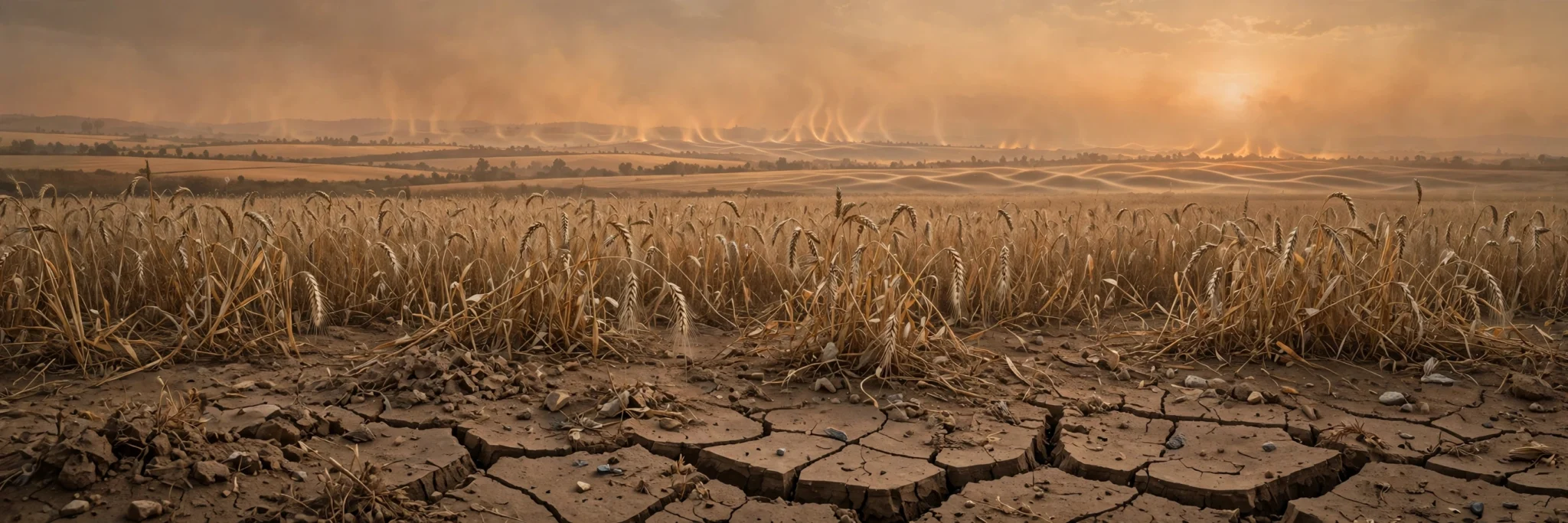

The World Bank’s Pakistan Development Update, released October 22, 2026, carries a warning that sits outside the Middle East conflict headlines: if El Nino turns out stronger than expected, Pakistan’s crop output could stall, dragging the country’s projected FY2027 growth of 3.8 percent down to 3.6 percent. The report adds that Pakistan’s existing external buffers could absorb the extra import bill such a farm shock would force, but doing so could deplete foreign exchange reserves. With the Rabi sowing season under way in Punjab and Sindh, the warning lands at the worst possible moment of the agricultural calendar.
The 0.2-Point Scenario That Changes the Year
The numbers are a conditional scenario, not the baseline forecast. The FY2027 baseline, July 2026 to June 2027, is 3.8 percent real GDP growth with inflation averaging 8.2 percent, up from 7.1 percent in FY2026. But under the report’s crop-output scenario, zero growth in crop output would shave 0.2 percentage points off that projection, leaving growth at 3.6 percent.
That 0.2-point difference looks small until it is placed against the economy the country actually has. Launching the report, the World Bank’s country director for Pakistan, Bolormaa Amgaabazar, said real per capita growth, the rate at which the average Pakistani’s income increases, remains stuck at around 1.6 percent, and that reforms to drive faster growth are now urgently needed. When per capita income is barely moving, every fraction of headline growth matters.
Why the Timing Makes the Warning Urgent
The Rabi season, when farmers sow wheat and other winter crops, is unfolding right now. A weak Rabi harvest would hit before any crop recovery has time to build, which is why the World Bank treats weather as a near-term risk rather than a distant one. The World Bank also expects El Nino conditions, combined with higher fertilizer costs during the Rabi season, to weigh on crop production, with livestock remaining the main driver of agricultural growth while crop output recovers only gradually. Follow Pakistan weather updates as sowing progresses.
What a Harvest Failure Would Actually Cost
The report’s most consequential line may be its quietest: external buffers could absorb the additional import requirements arising from an agricultural shock, but doing so could significantly deplete foreign exchange reserves. In plain terms, a crop shortfall would force Pakistan to import more food, paying for those imports out of reserves that were only recently rebuilt through strong remittances. The country would be trading one recovery for another.
Food inflation is already doing damage before any El Nino shock: in FY2026 it averaged 4.3 percent in urban areas and 5.4 percent in rural areas, driven mainly by wheat and perishable items, and by August food had become the single biggest driver of inflation. A bad Rabi harvest would pour more pressure into the same channel, squeezing the rural incomes that depend on it. See how the State Bank rebuilt its reserves, and track the interbank rupee rate against the US dollar if import pressure rises.
Energy Prices Are Still the Bigger Shadow
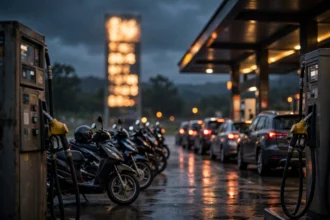
The report identifies a longer or more intense Middle East conflict as the biggest risk to Pakistan’s near-term outlook, ahead of the weather. Petroleum and gas products accounted for around one-quarter of the country’s total imports in FY2025, equivalent to 3.7 percent of GDP, while Gulf Cooperation Council countries supplied around 80 percent of these imports. The crude petroleum import bill surged by 46.4 percent year on year during January to June 2026.
The World Bank expects energy and commodity prices to return to pre-conflict levels only in the second half of FY2027, meaning elevated import costs will run through most of the fiscal year. Domestic consumers already felt this: between February and June, petrol rose about 36 percent, high-speed diesel 31 percent and liquefied petroleum gas 46 percent, before the recent petrol and diesel price revisions offered partial relief.
What Happens Next
The report’s central argument is that Pakistan has achieved macroeconomic stabilization but now needs private investment-led growth to “attain escape velocity.” It says sound policies in recent years lifted FY2026 growth to 3.7 percent from 3.2 percent in FY2025, delivered record primary fiscal surpluses of 2.9 percent of GDP, earned credit rating upgrades from S and P and Moody’s, and enabled a 3 billion dollar Eurobond issuance. Reforms already under way include power-sector tariff adjustments that cut energy subsidies from 1.1 percent of GDP to 0.8 percent, trade liberalization, and the privatization of Pakistan International Airlines.
With faster structural reforms, the report says, Pakistan could triple its incomes by 2050 and reach Vietnam’s current income level. But that long arc depends on surviving the near term. Watch rainfall through the Rabi season, fertilizer prices, and reserves data. If El Nino strengthens, the 0.2-point scenario becomes the year, not a footnote.