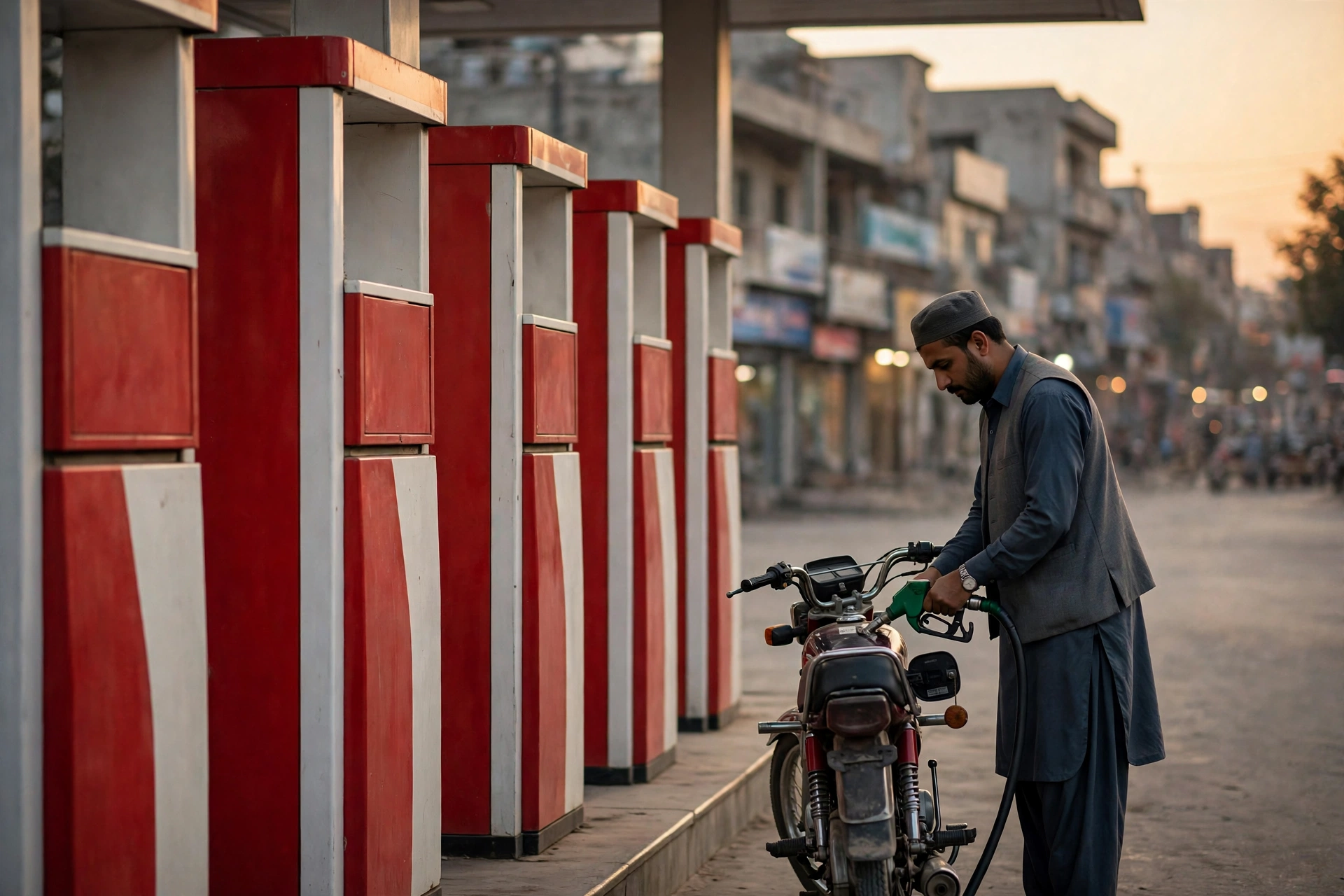

Petrol fell by Rs1.60 to Rs377.71 a litre and high-speed diesel rose by Rs1.64 to Rs391.75 on Friday, October 23, hours before the government’s negotiating committee meets Jamaat-i-Islami leaders at Punjab House in Islamabad over the party’s demand to abolish the petroleum levy. The talks were fixed after a call between Planning Minister Ahsan Iqbal and JI vice emir Liaqat Baloch on Thursday, and will run in parallel with JI sit-ins at district headquarters nationwide. PakMirror’s analysis of today’s official price breakdown shows that removing the Rs80 petroleum levy and the Rs5 climate support levy would bring petrol down to about Rs293 a litre, well short of the Rs200 a litre JI chief Hafiz Naeemur Rehman says is possible.
New prices, moving in opposite directions
Under the Petroleum Division notification reported by Business Recorder, Geo News, Express Tribune and Dunya News, petrol now costs Rs377.71 a litre, down from Rs379.31, while high-speed diesel costs Rs391.75, up from Rs390.11. It is the second consecutive day the two fuels have split: on Thursday, petrol was cut by Rs2.71 and diesel raised by 31 paisas, a pattern explored in our earlier breakdown of the daily fuel price mechanism. Diesel now sits Rs14.04 a litre above petrol, and the Friday notification stays frozen through the weekend.
What is on the table at Punjab House
According to Dawn, the two sides’ committees will meet at Punjab House in Islamabad to discuss JI’s demand to abolish the levy, and to schedule a proposed meeting between Prime Minister Shehbaz Sharif and the JI emir. The meeting was arranged after Iqbal contacted Baloch on Thursday. Despite the talks, Baloch reiterated the call for peaceful protests at district headquarters on Friday, telling Express Tribune that “negotiations and protests will continue side by side”. Dunya News reported the sit-ins are planned at 150 locations.
The campaign is more than two months old. JI launched sit-ins on August 16 in Karachi, Lahore, Peshawar and Quetta, then held a nationwide shutdown strike on September 3. Technical committees were formed, JI submitted six proposals on September 7, and on September 22 the JI chief postponed a long march whose convoy had reached Multan at the prime minister’s request.
Testing JI’s numbers against the official breakdown
Business Recorder’s reading of today’s Petroleum Division notification itemises petrol as: ex-refinery Rs266.97, petroleum levy Rs80, climate support levy Rs5, dealer margin Rs9.98, OMC margin Rs7.87 and freight equalisation margin Rs7.89, totalling exactly Rs377.71. For diesel: import cost Rs284.19, the same Rs80 levy, Rs5 climate levy, Rs9.98 dealer margin and Rs7.87 OMC margin, plus freight margin Rs4.71, totalling Rs391.75. Levies and margins are unchanged; only the import cost moved.
At the University of Karachi on Thursday, the JI chief claimed consumers pay Rs135 to Rs140 a litre in taxes and levies, including the Rs80 petroleum levy, the Rs5 climate support levy and Rs21 in customs duty, and said petrol could fall to Rs200 a litre “if taxes were reduced and international prices improved”. The Rs21 customs duty figure is the party’s claim; the published breakdown does not itemise it. PakMirror’s own calculation on today’s official numbers: removing the Rs80 levy alone cuts petrol to Rs297.71, and removing both levies brings it to Rs292.71. Even accepting the party’s Rs135 to Rs140 figure in full, petrol lands between Rs237.71 and Rs242.71. For the pump price to reach Rs200, the import and refinery cost itself must fall substantially, since that component alone is Rs266.97 today. The chief’s caveat about international prices does most of the work in his claim. On diesel, stripping the two levies takes it from Rs391.75 to Rs306.75.
Why the diesel hike hurts more than the petrol cut helps
The Rs1.60 petrol saving is worth about Rs80 on a 50-litre tank. But diesel is the fuel that moves Pakistan’s economy: goods transporters, public transport operators and farmers all run on it, and a diesel hike feeds through into freight rates and eventually food prices. At the University of Karachi, the vice chancellor said the university’s 33-bus fleet has seen annual diesel expenses rise from Rs60 million to Rs120 million. Rising fuel costs also land on exporters, already stretched by Pakistan’s $6bn auto export gamble. Import costs are converted at the interbank rate daily; see the USD to PKR exchange rate today for the current level.
What to watch next
Three things decide where this goes: the outcome of today’s committee meeting and whether a date is fixed for the prime minister’s meeting with the JI emir; the scale of Friday’s sit-ins and the government’s response; and Monday’s next daily price revision. The backdrop is unforgiving: Dawn reported crude rose about 3 percent on Thursday to a five-month high after Houthi attacks in Saudi Arabia. Follow PakMirror’s Business & Economy coverage for updates.