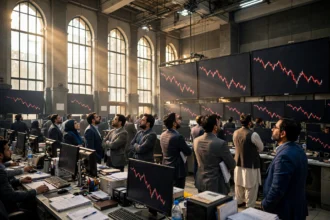

The KSE-100 Index closed the week at 166,419.72 on Friday, down 669.56 points, or 0.40 percent, from last Friday’s 167,089.28. The week’s story was written on Monday, when the benchmark crashed 1,964.87 points on the imposition of governor’s rule and an emergency in Khyber Pakhtunkhwa. A four-day recovery clawed back 1,643 points from Tuesday’s low, but it was not enough to erase Monday’s damage, and the market ended the week in the red.
It was a week of two halves. Monday and Tuesday belonged to the sellers, driven by domestic political turmoil layered over Houthi attacks on Saudi infrastructure and elevated oil prices. Wednesday to Friday belonged to the value hunters, with three straight sessions of gains built on attractive valuations after the selloff. Here is how the week played out, day by day, and what traders will watch when the market reopens on Monday.
Monday and Tuesday: the KP emergency shocks the market
The KSE-100 plunged 1,964.87 points, or 1.18 percent, on Monday to close at 165,124.41, in what The Express Tribune described as a bruising start to the week. Selling was broad based: oil marketing companies, automobile assemblers, cement makers, power producers, commercial banks and oil and gas exploration companies all fell together as investors reacted to the imposition of governor’s rule and emergency measures in parts of KP, followed by reports of a police crackdown.
Geopolitical anxiety layered on top of the domestic shock. A Houthi attack on Riyadh’s international airport kept regional risk elevated, while shifting expectations around Russian oil supplies kept international crude volatile. KTrade’s head of research attributed the weakness to geopolitical uncertainty and heightened tensions in KP, adding that higher commodity prices were keeping inflation elevated and could influence the next monetary policy decision.
Tuesday brought no relief. The index slipped another 347.97 points, or 0.21 percent, to close at 164,776.44, dragged below the 165,000 mark after swinging between 166,070.48 and 164,773.67 during the session, per ARY News. Dawn’s report noted that Pakistan Telecommunication Company, United Bank, Habib Bank, Lucky Cement and Mari Energies were the major laggards, together wiping out 343 points.
Wednesday to Friday: the recovery that fell 670 points short
The turn came on Wednesday. Attractive valuations drew investors back to cherry-pick stocks, and the KSE-100 gained 641.07 points, or 0.39 percent, closing at 165,417.51 and retaking the 165,000 level. Dawn reported the index traded between an intraday low of 164,060 and a high of 165,629. Engro Holdings, Lucky Cement, Fauji Fertiliser, Bank Al-Habib and National Bank contributed a combined 381 points on the upside, according to Business Recorder.
Thursday extended the recovery with a 768.66-point gain, or 0.46 percent, to settle at 166,186.17. Dawn reported the index traded between 165,613 and 166,877, sustaining positive momentum as equity investors continued value hunting for the second straight session. Pakistan Telecommunication Company, up 7.62 percent, joined Fauji Fertiliser and Systems Limited as the biggest contributors, while market capitalisation climbed to Rs18.475 trillion.
Friday was the quietest session of the recovery. The KSE-100 swayed in both directions before closing 233.55 points higher, up 0.14 percent, at 166,419.72, touching an intraday low of 165,956.51 and a high near 166,663, per Business Recorder. Topline Securities attributed the range-bound trading to a lack of fresh triggers and elevated crude oil prices, with Systems Limited, United Bank, MCB Bank, Bank Al-Habib and Engro Fertilisers adding a combined 269 points.
The week’s numbers in full
Monday minus 1,964.87 points, Tuesday minus 347.97, Wednesday plus 641.07, Thursday plus 768.66, Friday plus 233.55. From Tuesday’s low of 164,776.44, the recovery added 1,643.28 points by Friday’s close. But measured Friday to Friday, the week ended 669.56 points, or 0.40 percent, lower at 166,419.72 versus 167,089.28 on October 9.
The recovery had a distinctly institutional character: brokerage commentary through the week described the buying as value hunting by local investors rather than speculative momentum, with large-cap index heavyweights in technology, banking and fertilisers leading the way up.
What to watch next week
Traders return on Monday with the same unresolved questions that framed this week. Brent crude is holding above $100 a barrel, and elevated fuel prices are already squeezing household budgets at home, so any movement in the global ship-fuel market being redrawn by the US-Iran war will feed straight back into local sentiment.
On the political side, the KP emergency that triggered Monday’s crash remains in force, with parliament’s ratification process still working through its course. On the macro front, the IMF’s staff-level agreement from early October is still waiting on the Executive Board’s approval for roughly $1.2 billion in disbursements, which is why Pakistan’s turn chairing the IMF and World Bank boards in 2027 matters more as a signal of engagement than as a market driver. For more market coverage, see PakMirror’s Pakistan business and economy news.