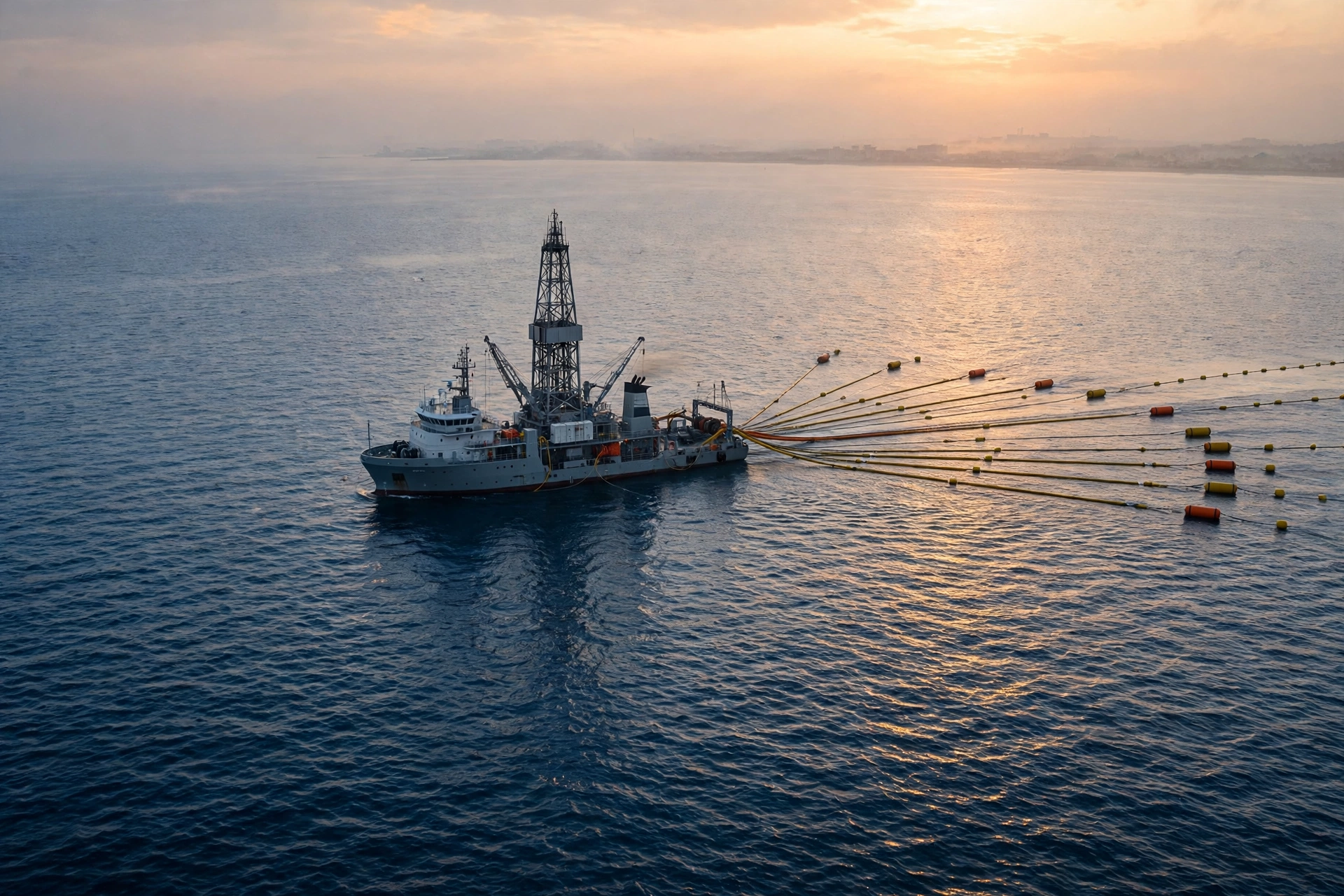

A Turkish seismic survey vessel is due in Karachi between 17 and 20 November, restarting offshore oil and gas exploration in Pakistani waters after a gap of about two decades. The Petroleum Division announced the plan on Friday, after Federal Minister for Petroleum Ali Pervaiz Malik chaired a meeting in Islamabad and said he would personally receive the vessel. The first survey will cover the Eastern Offshore Indus C block in the Arabian Sea. What the ship finds, if anything, will be data, not oil.
The vessel, the dates and the block
The vessel is operated by the Turkish Petroleum Offshore Company, known as TPOC, the offshore arm of the Turkish Petroleum Corporation. It is expected to reach Karachi in a four day window, 17 to 20 November, 10 to 13 days from today. The minister’s meeting reviewed arrangements for the arrival and the survey. Media reports have named the ship as the Oruc Reis, although the Petroleum Division’s announcement did not confirm the name, so it should be treated as reported, not confirmed.
Who owns the block, and who runs it
The Eastern Offshore Indus C block is a four partner joint venture, and the shares add up cleanly. Pakistan Petroleum Limited holds the largest stake at 35 percent. TPOC holds 25 percent and the operatorship, so the Turkish company runs the work even though it is not the biggest shareholder. Oil and Gas Development Company Limited and Mari Energies each hold 20 percent. The operator, not the largest shareholder, decides how the survey is run and what the data says. The two Pakistani partners together hold 55 percent, so the block stays majority Pakistani owned.
The twenty year gap, tested against the record
The Petroleum Division frames this as the first major offshore exploration campaign in about twenty years, and the arithmetic needs a careful look. The last offshore well in Pakistani waters was Kekra-1, about 280 kilometres from Karachi, drilled only seven years ago, in 2019. An Eni led consortium including ExxonMobil, PPL and OGDCL drilled it to more than 5,500 metres at a cost of about 100 million dollars, against a pre drill estimate of around 1.5 billion barrels of oil equivalent. It found only water and was plugged and abandoned in May 2019. Before Kekra-1, the previous offshore attempt was by Shell in 2005, which also found nothing, and the first offshore well, drilled by a US company in 1963, was dry too. Around 17 offshore wells have been drilled since 1963 and every one has come up dry. So the twenty year count works only if measured from the last sustained campaign in 2005, rather than from the last single well in 2019.
What a survey can and cannot do
A seismic survey fires sound waves into the seabed and records the echoes to build a picture of the rock below. It can show where the geology looks promising, but it cannot confirm a single barrel of oil or a single cubic foot of gas. Only drilling can do that, and drilling comes months or years after the survey, only if the survey results justify it. Kekra-1 cost about 100 million dollars for one well. The vessel’s arrival is the start of a data gathering exercise, not the start of production.
Why the stakes are high enough to try again
Pakistan imports almost all the oil it burns, and the bill is the single heaviest weight on the trade account. The petroleum group cost about 14.95 billion dollars in the first eleven months of fiscal year 2025-26, according to Pakistan Bureau of Statistics data, with crude oil at 6.34 billion, petroleum products at 5.61 billion and LNG at 2.02 billion. October imports of $6.8bn against exports of $2.9bn left a 3.9 billion dollar gap in a single month. Petrol had already fallen Rs25.32 in four days to Rs352.59 a litre this week. A domestic offshore find would change that arithmetic, but after 17 dry wells the odds are plainly against it.
What to watch next
Three tests will show whether this campaign is real or ceremonial. First, whether the vessel actually docks in Karachi inside the 17 to 20 November window. Second, whether the Petroleum Division publishes the survey’s area, duration and cost once the ship is at work. Third, whether a drilling decision and a timetable follow the survey, because a survey with no drilling plan behind it is a photo opportunity. The minister also described the cooperation as a milestone following the Makkah pact that Turkiye’s parliament ratified this week. The ship arrives in ten days. The data will take longer, and the drilling decision longer still.
For more on the economy, read October imports of $6.8bn against exports of $2.9bn, and more business and economy news from Pakistan.