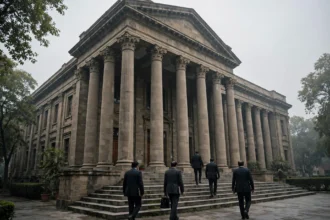
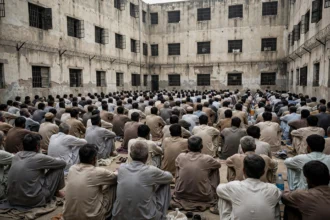
Khyber Pakhtunkhwa announced on Sunday, 8 November 2026, that it will set up faceless anti-terrorism courts and spend about Rs70 billion on its police and Counter-Terrorism Department. Home Secretary Amjad Ali Khan presented the plan at a Governor House briefing in Peshawar attended by Governor Faisal Karim Kundi. Under the plan, the identities of judges, witnesses, prosecutors and police officers would stay confidential. But no draft bill has been published, no date has been given for the first sitting, and no one explained how the law would pass with no assembly in session.
What the Rs70 billion plan promises
Rs59.8 billion goes to police infrastructure and Rs10.3 billion to the Counter-Terrorism Department, together Rs70.1 billion. About 85 percent goes to the police and about 15 percent to the CTD. The plan also promises to fill 17,000 vacant police posts, raise CTD capacity from 12 percent to 37 percent, and lift overall police capacity to 75 percent. Dera Ismail Khan, Bannu and Lakki Marwat become Safe Cities with anti-drone systems, special centres open in 10 districts, and 400 police facilitation smart desks are set up. Intelligence-based operations are to be accelerated, with 100-day and 180-day targets.
The money trail has a credibility problem
The same briefing gave reason for caution about the Rs70 billion figure. The CTD has only 638 staff, and of Rs6.4 billion approved for it in the past, only Rs1 billion was released, about 16 percent. A separate Rs12 billion announced for police infrastructure was never released, and police received only 3.2 percent of the provincial budget. The briefing put security spending over the past decade at Rs98 billion, so the new plan promises in one year about 72 percent of a decade’s spending. The gaps are not only financial: police drone protection stands at 12 percent, and operational transport at 36 percent.
The human cost behind the plan
The presentation put the toll from January 2024 to September 2026 at 1,003 military personnel, 627 police and 808 civilians killed, 2,438 people over 33 months, about 74 deaths a month. In the same period, 3,788 terrorists were killed, about 1.6 for every person lost. The violence is not history: two police officers guarding polio workers were shot dead in Mohmand during the current vaccination drive. A CTD of 638 is being asked to lead the fight against networks that killed more than 2,400 people in under three years, so tripling its capacity from 12 percent to 37 percent still leaves it below 40 percent.
Five questions the briefing did not answer
First, there is no draft bill, so nobody can tell whether Khyber Pakhtunkhwa’s version will resemble Punjab’s law. Second, there is no enactment route: under governor’s rule since 11 October, the briefing did not say whether the law would come as a governor’s ordinance or wait for an assembly. Third, nobody said who decides which case goes faceless, case by case or for whole classes. Fourth, nobody said whether an accused person can challenge being placed in the secret procedure; only the right of appeal before the High Court was named. Fifth, there is no date for the first sitting; the 100-day and 180-day targets are administrative deadlines, not legal ones. Until those five questions are answered, the plan is an announcement, not a law.
Khyber Pakhtunkhwa is third in line, and the model is already contested
Balochistan passed its amendment in September 2025, adding Section 21AAA to the Anti-Terrorism Act 1997; Punjab’s assembly passed its version on 31 August 2026. In Balochistan, official sources say about 90 suspects were detained, five released, and 40 referred for trial through faceless courts. Amnesty International called Punjab’s law a glaring attack on the right to a fair trial on 9 October 2026; it has been challenged in the Lahore High Court. Article 10A guarantees the right to a fair trial, and critics argue that hiding the judge, the prosecutor and the witnesses strains that guarantee.
What happens next
The first test is the draft text. If it follows Punjab’s model, it faces the same fair-trial challenge; if a judge, not an executive officer, decides which cases go faceless, it is a different law. The second test is the money: whether the Rs70 billion is actually released. The third test is the emergency itself. The Peshawar High Court struck about 105 petitions against the emergency from its cause list, so the 10 November hearing meant to test it may never be heard, and the legal test over emergency rule in Khyber Pakhtunkhwa remains unresolved. Until the draft is published, the funding released and the first court sits, the plan should be judged on those three tests, not on its headline figure.