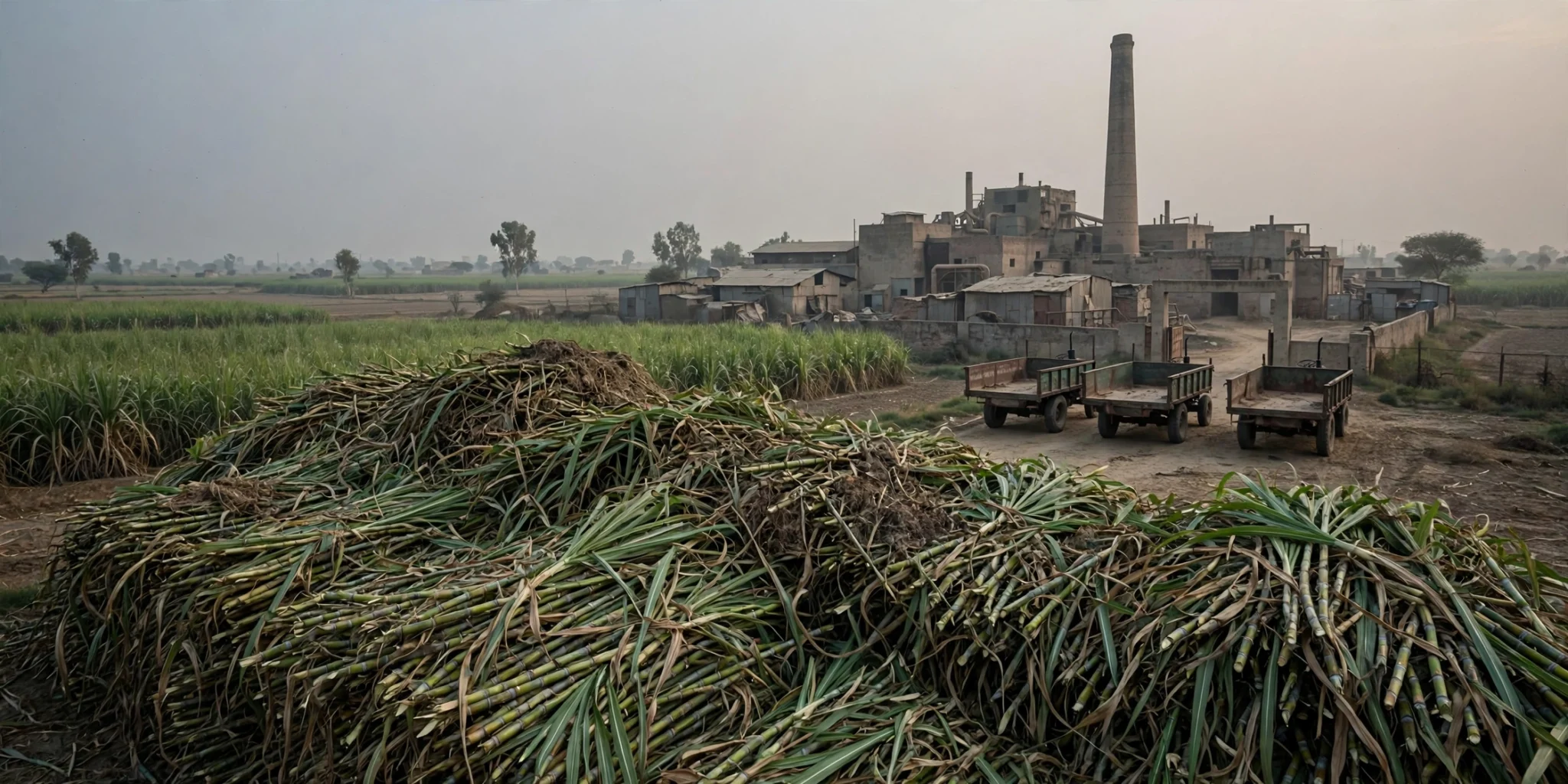

Three days after the deadline, Punjab’s sugarcane crushing season has still not started. Of the province’s 47 mills, only one is genuinely crushing cane. The rest open their gates for a few hours, take in a handful of trolleys, and shut down again. The News reported on Wednesday that the Centre has cleared a proposal to export 600,000 tonnes of surplus sugar, with an announcement expected within a day or two.
Every deadline has passed
The season should have started on 1 November. The Sugar Advisory Board, chaired by food security minister Rana Tanveer Hussain, set 15 November as the nationwide start date. The minister warned of strict action against any mill that missed it.
15 November came and went. In Punjab, only Ramzan Sugar Mills obeyed the order to start within 24 hours. In Sindh, the government has still not notified the start of the season, leaving growers in limbo. Last year crushing began on 8 December, and the mills say they cannot start before December this year either. The growers’ own ten-day deadline, set on 4 November, expired on 14 November. Nothing moved.
The price gap is now more than double
Growers want Rs650 a maund. The Sindh Abadgar Board’s cost assessment recommends Rs647. The only mill actually buying cane is offering less than Rs350 a maund, The News reported, far below the cost of production. That is less than half the cost of growing it over 13 to 14 months, growers say.
Punjab says prices will follow a market-based mechanism. Growers want a fixed support price now. The gap is the whole dispute: a market with one buyer in each district is not a market. Growers also say they have still not been paid for cane already supplied.
A surplus nobody will move
The mills say they cannot crush because their warehouses are full. The mills association puts the surplus at about 1.1 million tonnes, its chairman Asim Ghani Usman said on Monday. Its outgoing chairperson, Chaudhry Zaka Ashraf, put it at 1.3 million tonnes on Wednesday.
The government approved the export of 200,000 tonnes in September, but the mills say permission to ship it has still not been issued. The association says the government committed to 600,000 tonnes, and it now wants 400,000 tonnes more plus deregulation. It has been asking for export permission since February.
The crop coming in makes the pile bigger. Sugarcane was planted on 2.452 million acres in Punjab this year, 16 per cent more than last year, and production is projected at 8.5 million tonnes for 2026-27, against consumption of about 4.2 million tonnes a year.
Last year already showed what happens next
This is not the first time. In the first eleven months of FY2024-25, Pakistan exported about 765,734 tonnes of sugar against a permitted 700,000, earning about $411 million. The ex-mill price in December 2024 was about Rs125 to Rs130 a kilo; by June 2025, retail sugar had jumped to Rs200 a kilo, and the government approved an import plan for 500,000 tonnes.
The State Bank’s annual report linked the exports to squeezed domestic availability, price rises and urban food inflation. The export price averaged about $537 a tonne. The import price averaged $575. Pakistan sold sugar cheap and bought it back dear. Food prices are already the sore point in weekly inflation readings.
The bill is concrete: in October 2026 the National Assembly was told 306,737 tonnes were imported for Rs54.16 billion. About 198,668 tonnes have since been sold at Rs168 a kilo on average; 108,069 tonnes are still with the Trading Corporation of Pakistan.
What happens next
The immediate test is the export announcement. A senior official told The News the food security ministry has cleared the proposal for 600,000 tonnes, with an announcement likely within a day or two, and that mills would start within a week.
The mills have asked the Punjab chief minister for a 15-day extension to recall workers and fire up boilers. Zaka Ashraf added that sugar is a federal subject while sugarcane is a provincial one, which leaves the provinces unable to force the issue.
For growers, the costs keep compounding: unharvested cane loses weight every day, and wheat sowing on the cleared land is already likely to be delayed. Wheat is the other half of the squeeze: farmers demanded a support price of Rs5,000 a maund for wheat in October, and late sowing now threatens that crop too. Deputy Prime Minister Ishaq Dar has chaired three meetings on surplus sugar since late October, most recently on 13 November, each time stressing that exports must not push up retail prices. The growers’ question is simpler: if the surplus is real, why is the cane still standing in the fields?
Read more business and economy news from Pakistan on PakMirror.