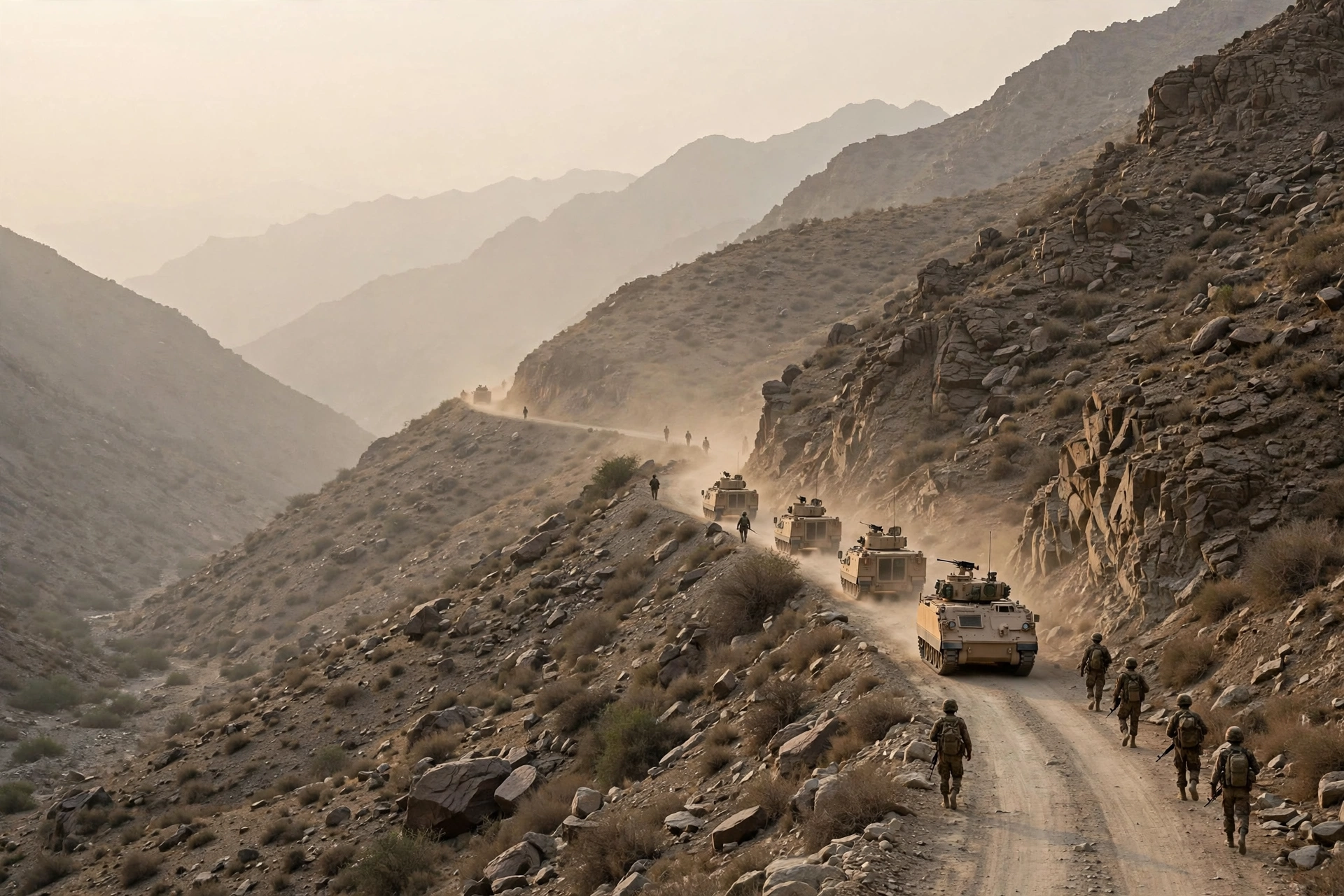

Security forces killed 22 militants in three districts of Khyber Pakhtunkhwa on 16 and 17 November, the military said on Thursday, taking the reported toll from operations in the province and Balochistan since 3 November to 120.
The latest statement, from the military media wing ISPR, is the third large toll announced in a week. It comes on the same day the army chief visited Turbat in Balochistan to review the security situation.
Where the 22 died
Fifteen of the 22 were killed in South Waziristan, where troops launched an intelligence-based operation after reports of a militant presence. The ISPR said troops engaged the hideout and, after an intense exchange of fire, killed 15 members of what the military calls the Indian-sponsored Fitna al-Khawarij.
Six more were killed in two separate encounters in Bannu district, and one more was killed in an encounter in Tank district. The military said clearance operations were continuing in the areas to find any remaining militants.
The label Fitna al-Khawarij is the state’s term for the banned Tehreek-e-Taliban Pakistan and allied groups. The military describes the dead as Indian-sponsored. India has denied backing the groups, and New Delhi did not immediately comment on this statement. No names were released, and no independent account of the fighting has been published, so the figures rest on the ISPR statement alone.
How the toll reaches 120
The count is PakMirror’s tally of the ISPR statements issued since 3 November, and the dates do not overlap. On 13 November the military reported 74 killed: 31 in a sanitisation operation in the Kurram area of Quetta district in Balochistan that began on 3 November, and 43 in Khyber Pakhtunkhwa over 48 hours, 35 in Mir Ali and eight in Orakzai.
The next day, 14 November, brought 24 more: eight in the Kolpur raid in Balochistan, including a suicide bomber, and 16 more were killed in North Waziristan. Four soldiers were martyred in Saturday’s fighting, two of them in Kolpur, including a major killed in a quadcopter attack.
Add the 22 from 16 and 17 November and the reported total since 3 November stands at 120: 74 plus 24 plus 22. Khyber Pakhtunkhwa accounts for 81 of them, Balochistan for 39.
Munir in Turbat on the same day
Field Marshal Asim Munir, the Chief of Army Staff and Chief of Defence Forces, visited Turbat in Balochistan on Thursday, the ISPR said. He was received by the Corps Commander Balochistan, laid a floral wreath at the Shuhada Monument and offered Fateha.
He was briefed on the security environment, operational preparedness and the ongoing operations against what the military calls externally sponsored terrorism, and on the progress of socio-economic development initiatives for the people of Balochistan. He reaffirmed the army’s commitment to stand with the people of Balochistan in their pursuit of peace, prosperity and sustainable development.
The visit came days after the Kolpur fighting, in which two soldiers including a major were martyred. Turbat is the divisional headquarters of Makran, one of the areas where Baloch separatist groups have been most active.
Why these two provinces dominate the toll
The concentration is not new. The Centre for Research and Security Studies reported that Khyber Pakhtunkhwa and Balochistan together accounted for nearly 96 percent of all violence-related fatalities in the country in the second quarter of 2026, with Khyber Pakhtunkhwa the worst affected region.
The tempo in the north west has been building for weeks: KP intelligence operations had already widened before this latest round, with new operations reported across the former tribal districts. The Pakistan Institute for Conflict and Security Studies recorded attacks in the former tribal districts rising from eight to 20 in the week of 30 October to 5 November. In Balochistan, attacks fell from 15 to 11 in the same week, but fatalities rose from five to seven.
The operations run under Azm-e-Istehkam, the national counterterrorism campaign approved by the federal apex committee. President Asif Ali Zardari said on Thursday that the operations would continue until terrorism sponsored by foreign elements was completely eradicated. Prime Minister Shehbaz Sharif praised the forces and said militants and their supporters would not be allowed to spread unrest.
What happens next
The ISPR said sanitisation and clearance operations were continuing in the affected areas. No end date for the campaign has been announced.
The pattern of the past two weeks suggests the next statement will follow the same shape: a 48-hour window, a district-by-district breakdown, and a fresh figure to add to the tally. Whether the pace holds after 120 will depend on whether the hideouts in South Waziristan, Bannu and Tank produce another round of engagements. For more national news from Pakistan, follow our coverage of the latest developments across the country.