
Senate Chairman Syed Yousuf Raza Gilani has accepted the honorary chairmanship of the Pakistan-China Research Center for Party and State Governance, at a ceremony reported on November 2, 2026. Established by the Pakistan-China Economic and Cultural Council, the centre is meant to link scholars, think tanks, public institutions and parliamentary forums in both countries. The headline is not another friendship speech. It is a standing institution for studying how governments are run, arriving the week a twin centre is due to open in Bangladesh.
What was inaugurated
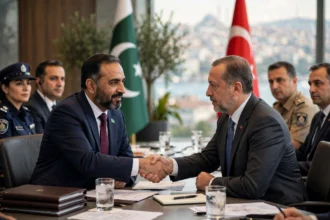
Gilani was chief guest at the inauguration and thanked the organisers for inviting him to serve as honorary chairman. He said the centre would be a platform for research, policy dialogue and practical cooperation, bridging research and policymaking. As honorary chairman, he said, he would encourage links with parliamentary institutions and exchanges among parliamentarians, policymakers, academics and young people.
The ceremony also welcomed Liu Haixing, minister of the International Department of the Communist Party of China Central Committee. Liu arrived in Islamabad on November 1 at Deputy Prime Minister Ishaq Dar’s invitation, and will co-chair a high-level event with Dar on November 2. The reporting so far names no staff, budget or building for the centre, and no first research programme. A centre is judged by its output, not by its inauguration.
The Dhaka twin, days later
Liu is scheduled to visit Bangladesh from November 3 to 5, where he will speak at a Dhaka seminar on November 4 that also inaugurates a Bangladesh-China Centre for Party and State Governance Studies. He is scheduled to meet President Mirza Fakhrul Islam Alamgir and Prime Minister Tarique Rahman there.
Read together, the two inaugurations look like a single rollout: within one tour, the International Department is helping to set up governance centres in two South Asian capitals, under almost the same name, in the same week. No Dawn, Geo, ARY, Express Tribune or Reuters report found in November 2 searches connects the two centres. That centre-to-centre link has not been drawn.
Why a party channel matters
Pakistan-China cooperation is usually described through government channels: the corridor, trade and defence. This centre belongs to a different channel, the party-to-party channel, in which political parties exchange experience on running parties and states. In July 2026, Gilani addressed a council seminar in Islamabad on Xi Jinping Thought on Party Building, attended by Chinese Ambassador Jiang Zaidong. The new centre turns that seminar format into a permanent body.
That distinction is also its limit. A research centre cannot sign a trade deal or change a law. Its influence will come through the people it brings together and the studies it publishes. The Senate’s own recent record shows why such evidence matters: the Senate was told the number of political ambassadors stayed at 17 for a decade, a disclosure that only became useful when set against earlier replies.
What Gilani named as lessons
Gilani pointed to five areas of Chinese experience for research: poverty reduction, rural development, digital governance, industrial growth and public administration. The digital item connects to Pakistan’s own technology track, since Pakistan is set to become the first signatory of the Digital and AI Compact. A centre studying digital administration could give that track a parliamentary audience, if it publishes concrete comparisons rather than general praise.
The ceremony also carried the 75th anniversary frame: diplomatic relations were established on May 21, 1951, and Gilani noted that the Senate had commemorated the milestone with a unanimous resolution. On the economy, he said the next phase of the corridor should deliver tangible results, including investment, jobs and skills.
Three tests to judge the centre by
First, the November 2 test. When Dar and Liu co-chair their high-level event in Islamabad, does it name a first research topic, a staffing plan or a dated exchange? If it only repeats friendship language, the centre starts life as a plaque. If it names a programme, it starts life as a work plan.
Second, the Dhaka test. When the Bangladesh centre is inaugurated on November 4, does its mandate mirror the Islamabad centre, and do the two centres announce any joint work? A mirrored mandate would confirm a regional programme. The diplomatic calendar is busy: Singapore’s foreign minister landed in Islamabad days earlier, on October 30, for talks that also mixed ceremony with a checkable deliverable.
Third, the output test. Before the 75th anniversary year ends, does the centre publish a study, host a named parliamentary exchange, or run a youth programme? The first time it does so in public will be the moment it stops being an inauguration and starts being an institution. Until then, it is a promising platform with its work still to prove, and more national news from Pakistan will show whether it clears that bar.