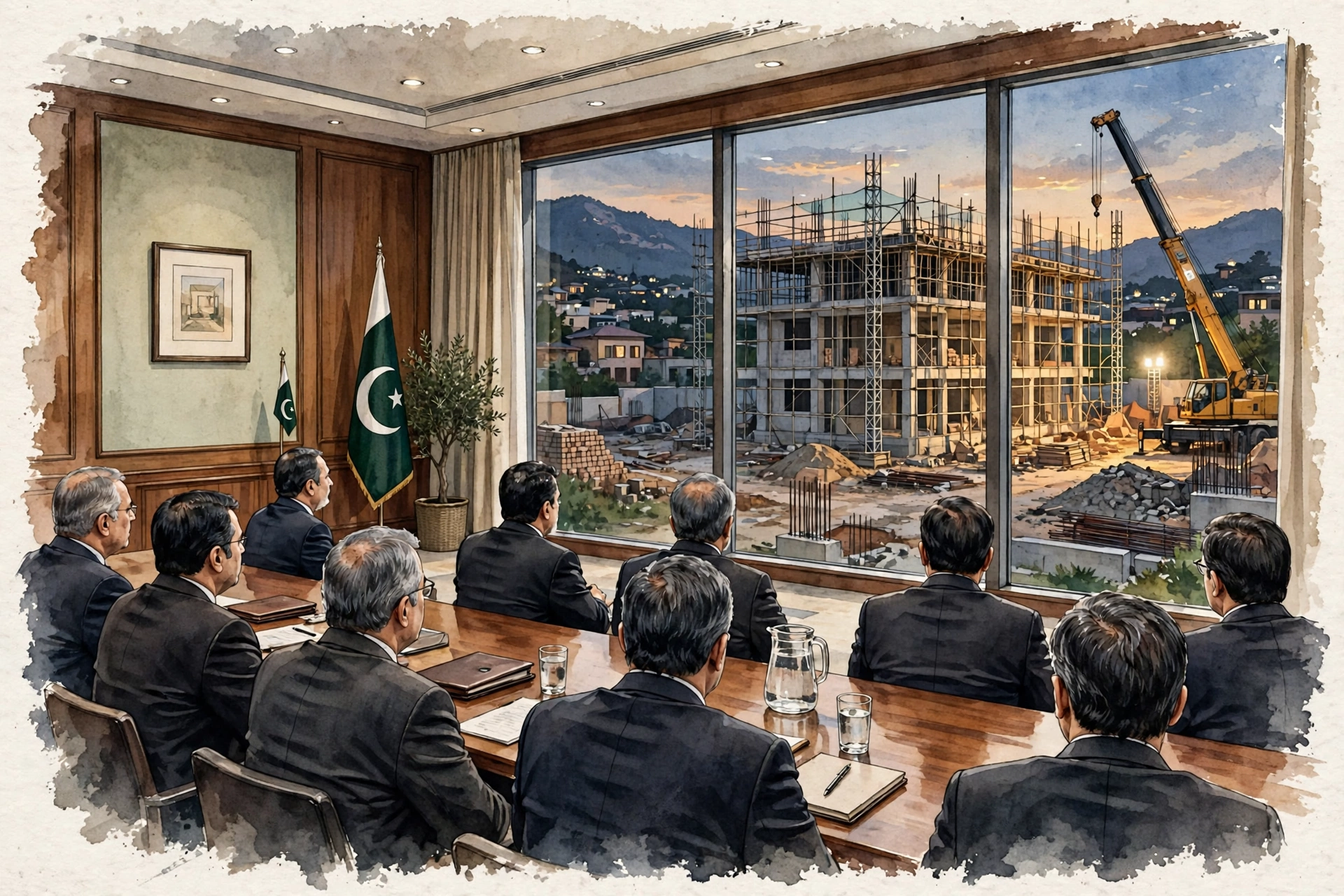

On Saturday, October 31, Prime Minister Shehbaz Sharif gave Khyber Pakhtunkhwa two opposite orders. In Islamabad he told his party’s provincial lawmakers to suspend long-term projects and chase quick relief. Hours later, chairing a review meeting from Lahore, he ordered Daanish Schools construction across Pakistan to run around the clock. The contradiction is the real story: it will decide what gets built in the province in the next six months to a year.
Two orders, one day
The first order came at a meeting of the Pakistan Muslim League-Nawaz parliamentary party from Khyber Pakhtunkhwa. The prime minister told the province’s party leadership to prioritise short-term welfare and suspend long-term projects, saying immediate measures were needed after years of neglect. His words were blunt: “Long-term projects should be suspended. If you take small steps to improve law and order, build a school and ensure medicines reach hospitals, people who have been deprived for 13 years will pray for you.”
The criticism was aimed at the Pakistan Tehreek-e-Insaf, in power in the province for 13 years. The prime minister questioned its record in education, healthcare, infrastructure and governance, and asked what projects were completed and whether funds were spent judiciously. The second order came the same day at an online review of the nationwide Daanish Schools programme, chaired from Lahore. Construction will now run around the clock with no compromise on standards, admission will stay strictly merit-based for the poorest families, and an independent third-party check will assess facilities and services. In Islamabad he had named the KP campuses in the pipeline: Chitral, Haripur, Mansehra, Bajaur and Shangla. A school programme is, by definition, long-term. That is the contradiction.
The Rs800 billion question
He pointed to the 2010 National Finance Commission Award, agreed under Yousuf Raza Gilani, which gave the province an extra one per cent share. That arrangement, he said, brought the province approximately Rs800 billion over the years. He asked how much went to the Counter-Terrorism Department and police equipment, arguing proper use could have greatly improved capacity.
The figure needs its own test. Rs800 billion is a cumulative claim about transfers over many years, not a checkable budget line, and no year by year breakdown was published with it. A single district’s school repair need, the Bannu schools repair bill of Rs4.509 billion, is less than one per cent of that claimed total, yet it covers 672 schools. If the money flowed as described, the gap between what arrived and what facilities lack is a question for the next budget.
The 8,000 empty police posts
The second number is more immediately checkable: around 8,000 police positions remain vacant. Law and order was the first item in the prime minister’s own short-term test, ahead of building a school and getting medicines to hospitals. A vacancy list that large means the short-term order starts with recruitment, not announcements. It connects to the governor’s rule backdrop: the federal government imposed governor’s rule and emergency on October 11, saying the province had disengaged from counterterrorism, and Governor Faisal Karim Kundi now runs the province with an 11-member advisory council while Parliament exercises the assembly’s powers.
The prime minister said 48 hours of PML-N and PPP talks with the PTI produced a draft, but approval never came from the PTI leadership, particularly then chief minister Sohail Afridi. Sohail Afridi taken into preventive custody after the KP emergency remains the sharpest symbol of that rupture. The new administration has ordered reviews of communications, irrigation and public health records, possibly for referral to the National Accountability Bureau.
What short term actually means
Reporting puts the short-term horizon at six months to a year, giving the order a deadline the speeches do not. Within that window, three things count as delivery on the prime minister’s own test: a visible law and order step, a school built, and medicines reaching hospitals. Campus announcements “later this year” without dates do not count, nor does a long-term project renamed as short-term relief. The government can point to one quick-relief instrument: a February fuel subsidy of Rs75 billion, whose vouchers reached about 130 million citizens. That is the scale and speed for judging the KP push.
Three things to watch next
First, watch for a named list: which KP long-term projects are suspended and which are protected. The Daanish campuses in Chitral, Haripur, Mansehra, Bajaur and Shangla must appear on one list or the other, or the halt order and the build order remain slogans. Second, watch police and Counter-Terrorism Department numbers: recruitment against the 8,000 vacancies and any account of the claimed Rs800 billion share. Third, watch Daanish delivery: the merged-districts strategy, third-party validation results, and real dates for KP campuses. The democratic calendar moves separately, after the Election Commission ordered a programme for KP local polls, but voters without local councils will judge the promise on services, not structures. For continuing coverage, follow national news from Pakistan.