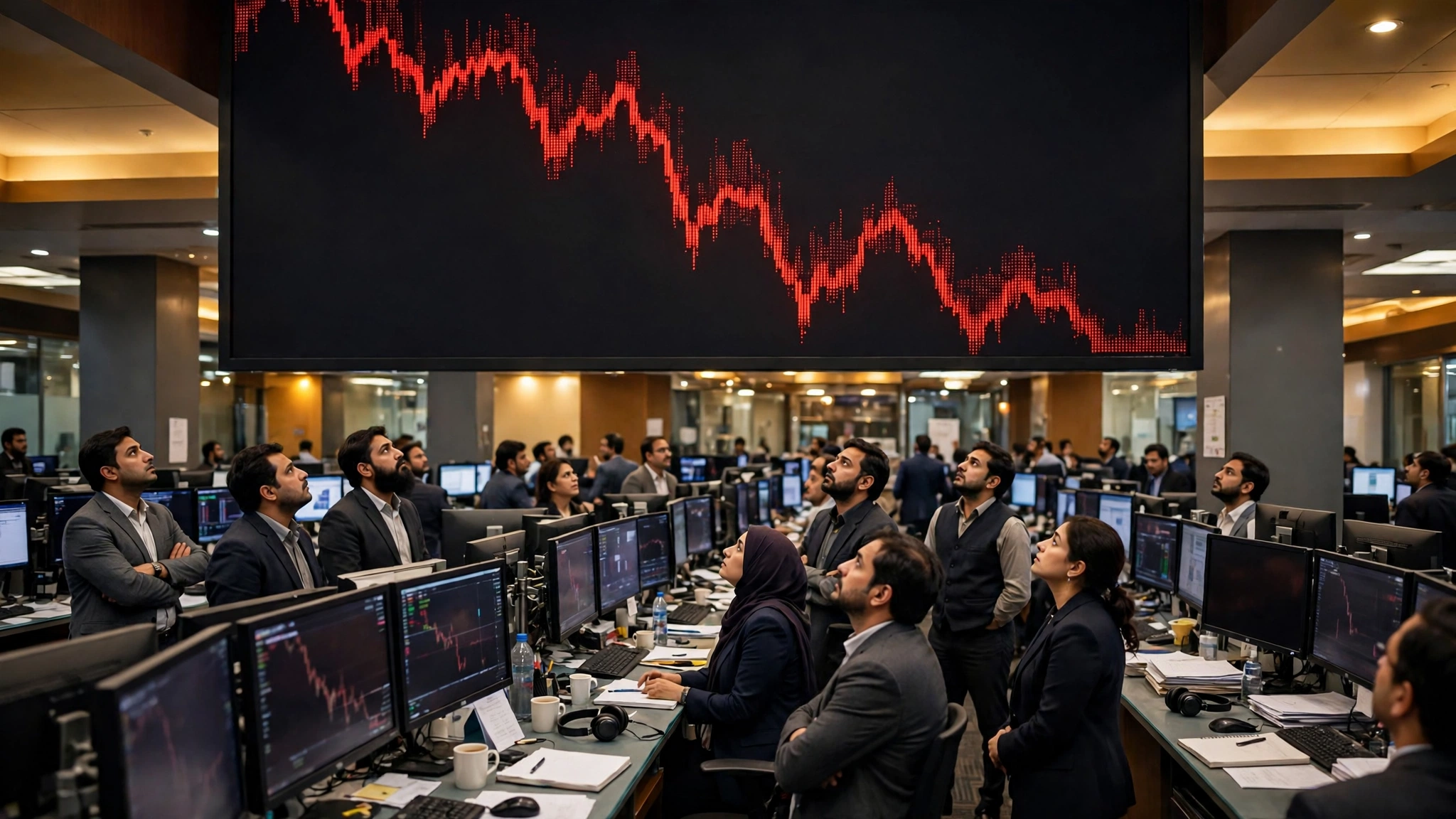

The KSE-100 crossed 180,000 for the second day in a row on Thursday, then fell almost 3,000 points from its peak to close 1,710.04 points lower at 177,373.76. The 0.95 percent fall was the heaviest one-day drop since Friday, when the index lost 1,493 points, and it wiped out more than a third of Tuesday’s 5,448.56-point rally in two sessions.
The day in numbers
The index opened at 179,528.52, up 444.72 points on Wednesday’s close. By 9:40am it stood at 179,951.08, up 867.28 points, and it kept climbing to an intraday high of 180,310.44, a second morning past 180,000.
By 12:50pm the index had slid to 177,871.25, down 1,212.55 points on the day, and it never recovered. It closed at 177,373.76, just 102.16 points above the day’s low of 177,271.60. The full range of the session was 3,038.84 points, and 2,936.68 points were given back from the high to the close.
The KSE-30 closed at 52,418.73, down 505.36 points or 0.95 percent, the All Share at 106,122.87, down 846.42 points or 0.79 percent, and the KMI-30 at 253,872.99, down 2,200.83 points or 0.86 percent.
180,000 has now said no twice
Wednesday’s round trip above 180,000 ended 251 points lower, with the index touching 180,769.21 before closing at 179,083.80. Thursday repeated the pattern and made it heavier: a high of 180,310.44, then a close of 177,373.76.
From Tuesday’s close of 179,335.24, the index has fallen 1,961.48 points in two sessions. That is 36 percent of the 5,448.56 points it gained on Tuesday, given back in 48 hours. The level that looked like a launch pad on Tuesday has now rejected the market twice, and the second rejection cost nearly seven times as many points as the first.
The week is still in positive territory, but only just. The market was closed from November 7 to 9 for Iqbal Day, and Friday’s close was 173,886.69. Against that, Thursday’s close of 177,373.76 is still up 3,487.07 points for the week. The rally has not been erased, but it has been cut by more than a third, and the buyers who drove it have gone quiet at exactly the level that matters most.
What changed between the open and the close
The morning rally had a clear driver. Market coverage credited easing geopolitical fears after Russia and Ukraine agreed to a major prisoner exchange during two days of peace talks in Abu Dhabi. Oil eased at the same time, with OPEC+ output in October near pre-war rates and the American Petroleum Institute reporting a rise in weekly US crude and fuel inventories, both of which cap crude prices and ease inflation worries for an oil importer like Pakistan.
The afternoon slide has no single named trigger in the intraday reporting. Business Recorder’s mid-session update records only that selling pressure returned after the positive open. What the numbers show is profit-taking at a round-number level: sellers stepped in as soon as the index crossed 180,000, and buyers did not come back to defend it. The shipping attacks in the Strait of Hormuz, which knocked more than 500 points off the index in early trade on Wednesday, were in the background, and nothing during Thursday’s session gave buyers a reason to push through the level.
The volume tells its own story
KSE-100 volume was 236.4 million shares, against 326.9 million on Wednesday, about 28 percent lower. The market fell further on thinner trading, which means fewer buyers stepped in as the index slid. The close, just 102 points above the day’s low, fits the same picture: no late buying lifted the index off its lows, the way Wednesday’s session had steadied into the close.
What to watch next
Friday will show whether buyers defend the 177,000 area or the slide continues into the weekend. Analysts quoted in market coverage point to the US inflation print and the MSCI review as the next catalysts for foreign allocations. Foreign investors watch the currency as closely as the index, so the USD to PKR exchange rate today is worth checking before Friday’s open.
Oil is the other watchpoint: Brent stood at $92.95 on Wednesday, and ship attacks in the Strait of Hormuz reached 37 in October, the highest monthly total of the conflict, so any fresh attack can push crude higher and drag the market with it. At home, petrol has fallen to Rs335 a litre after seven cuts in ten days, which should ease inflation pressure, while LPG dealers have called a nationwide strike for November 16. None of that decides Friday’s session on its own. What Thursday decided is that 180,000 is now a ceiling the market has failed twice, and the next attempt will need a better reason than the first two had.