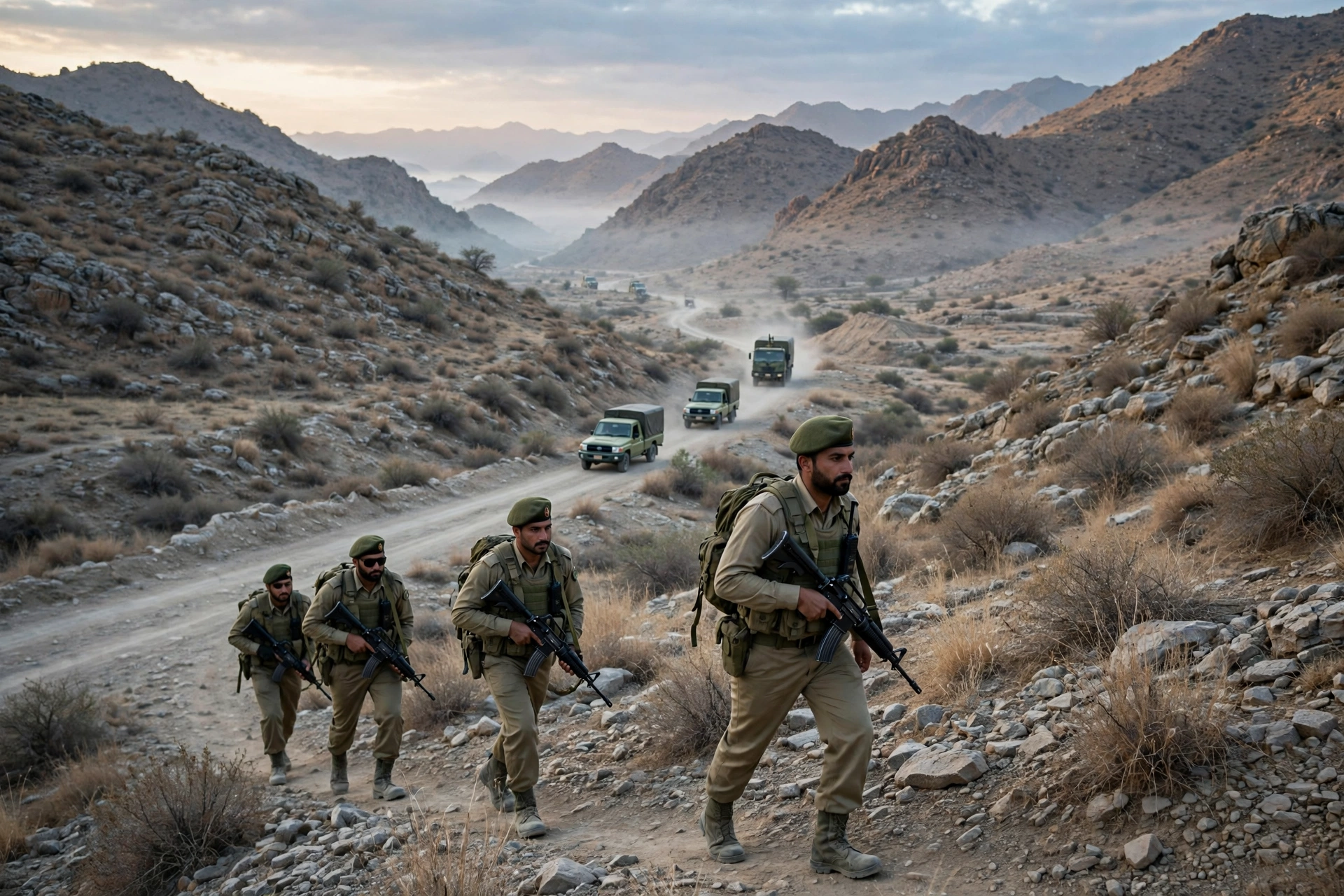

Pakistan’s military said on Friday that security forces killed 74 militants in intelligence-based operations in Balochistan and Khyber Pakhtunkhwa. The headline number hides a split that matters more than the total: 31 of the deaths came in a ten-day clearance operation in one area of Quetta district, while 43 came in just 48 hours in two districts of KP.
Ten days in Quetta, 48 hours in KP
The Inter-Services Public Relations (ISPR) said troops launched a comprehensive area sanitisation operation in the Kurram area of Quetta district on 3 November against militants from Fitna al-Khawarij and Fitna al-Hindustan. After multiple engagements at several hideouts, 31 militants described as India-sponsored were killed, and weapons, ammunition and explosives were recovered.
The KP operations ran on a very different clock. Over the past 48 hours, security forces killed 35 militants in Mir Ali and eight in Orakzai, 43 in total. The ISPR said troops engaged multiple locations in intense exchanges of fire and recovered a large cache of weapons, ammunition and explosives, including homemade explosives and improvised explosive devices, which it said would have been used in attacks.
Put side by side, the two operations moved at very different speeds: about three deaths a day in Quetta over ten days, against about 21 a day in KP, roughly seven times faster. Mir Ali alone, with 35 deaths, passed the whole ten-day Quetta count in two days. The difference is the kind of fighting: a slow area-clearance grind in Quetta, and rapid raids on known locations in KP. The same area has seen earlier operations too: two mosques were cleared in Mir Ali, with no one arrested.
Sanitisation operations continue in both areas, the ISPR said, and the counter-terrorism campaign under Azm-e-Istehkam will continue at full pace.
What the count does not prove
All 74 deaths come from the military’s own statement. No independent verification of the tolls has been reported, and no names or other evidence were published with the statement. The description of the dead as India-backed is also the military’s own characterisation; no evidence for that link was published alongside it. Fitna al-Khawarij is the official term for the proscribed Tehreek-e-Taliban Pakistan.
The statement also says nothing about casualties on the security forces’ side in these operations, or about civilians caught in the areas where the fighting took place. A death count says how many people the military says it killed. It does not say how much of the network behind them survives, or how long the calm will last.
The quarter that flipped the map
The week’s toll lands in a landscape that changed sharply last quarter. The Centre for Research and Security Studies (CRSS) recorded at least 1,415 violence-linked deaths in Pakistan in the third quarter of 2026, across 385 incidents, an 83 per cent rise on the 774 deaths of the second quarter and the sharpest quarterly increase since 2021.
Balochistan drove the rise. Its death toll nearly tripled, from 265 in the second quarter to 829 in the third, a 213 per cent increase, and it accounted for nearly 88 per cent of the national increase. Balochistan overtook KP as the worst-hit province in both deaths and incidents, with 186 incidents against KP’s 173. The two provinces together accounted for 98 per cent of all violence-linked deaths in the quarter.
Only one quarter earlier, the order was reversed: KP recorded 475 deaths, 61 per cent of the national total, against Balochistan’s 265. Friday’s split, 31 deaths in Balochistan and 43 in KP, sits inside the flipped map. A single week of operations is not a trend.
The CRSS data also cuts against a simple reading. Outlaw deaths more than doubled, from 453 to 921, nearly three-quarters of the extra deaths. But civilian deaths rose 36 per cent, from 187 to 254, and security personnel deaths rose 79 per cent, from 134 to 240. Together they lost 494 lives, up 54 per cent. The quarter’s rise was not only militants dying; the people the operations are meant to protect died in greater numbers too. The same two provinces also produce the other kind of toll: ten police officers died raiding illegal gold mines in Kohat, an ambush that had nothing to do with a militant hideout, and polio teams still work under gunfire in KP and Balochistan.
What happens next
The ISPR said clearance operations continue in the affected areas and that Azm-e-Istehkam will continue until foreign-sponsored terrorism is eliminated. Three things will show whether Friday’s count means anything beyond a week: whether the Quetta clearance produces arrests or further tolls; whether the Mir Ali and Orakzai tempo repeats; and whether fourth-quarter data shows Balochistan holding its new position as the worst-hit province, or KP taking it back.