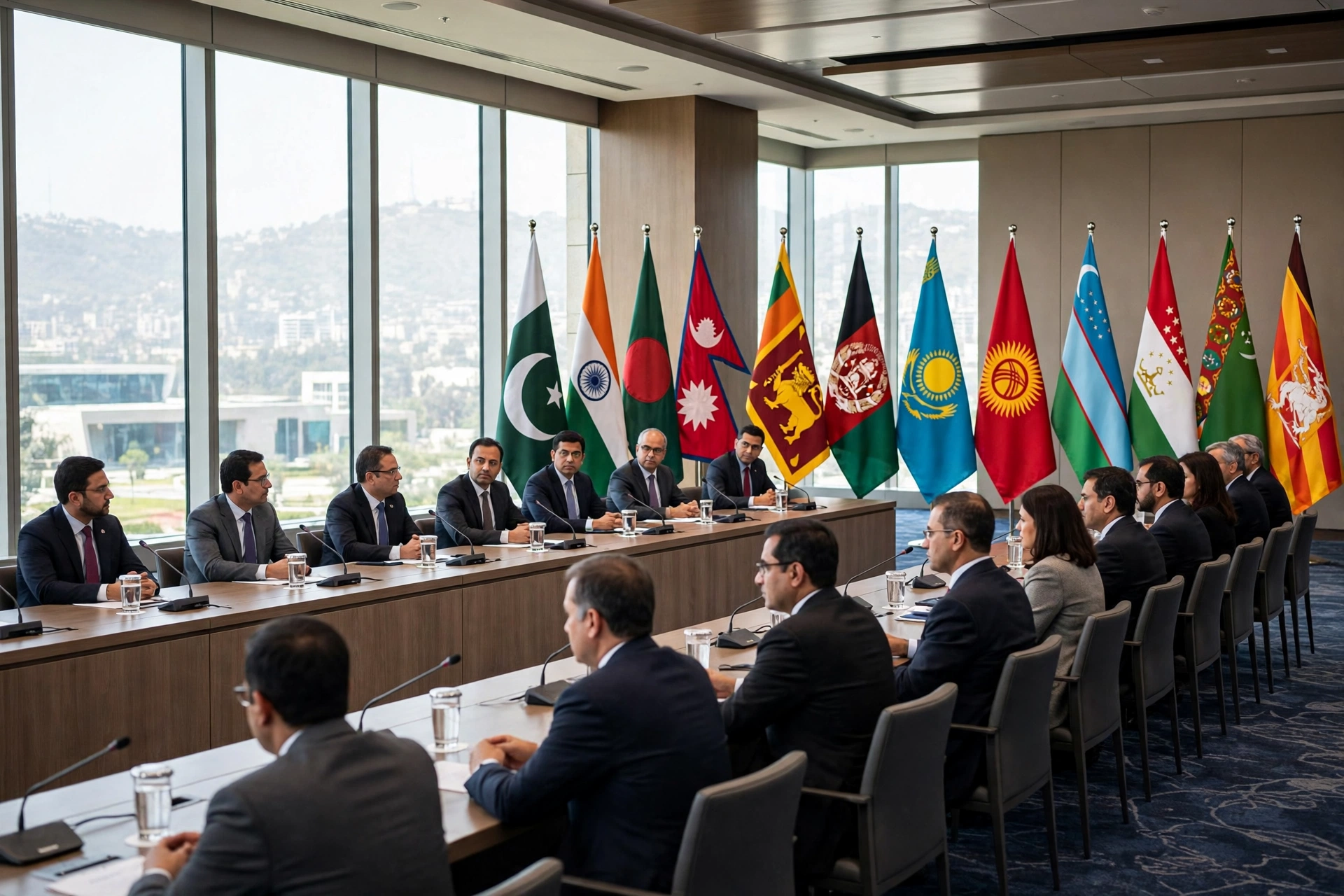

The two documents Pakistan’s chairmanship was waiting for are adopted. On Monday, the foreign ministers of the Economic Cooperation Organization meeting in Islamabad adopted the Islamabad Communiqué and the Strategic Goals of Economic Cooperation 2035, the ten-year framework that replaces Vision 2025. At the same time, Deputy Prime Minister and Foreign Minister Ishaq Dar told reporters that Afghanistan’s membership stands suspended, and set out a calendar running to a summit in Tehran in December and one in Pakistan in 2027. The adoption answers the questions this meeting opened with, but not the one underneath: the trade corridor the plan promises runs through the one member now shut out of the room.
What the two documents actually say
The communiqué welcomes the Strategic Goals 2035 as a framework for regional integration, connectivity, resilience and prosperity, and looks to the 18th ECO Summit in Tehran for guidance on putting the goals into practice. On trade, the ministers called for faster amendment and implementation of the ECO Trade Agreement, known as ECOTA, and backed joint trade zones, cross-border business, regional value chains, simpler customs and e-commerce. On movement, they stressed full implementation of the Transit Transport Framework Agreement, transport corridors, better seaport access for landlocked members, lower transport costs and fewer barriers to goods moving. On energy and technology, it notes cooperation in energy security and clean energy, welcomes the ECO Clean Energy Centre in Baku opening, and calls for joint work in artificial intelligence. On climate, it stresses cooperation on water, glaciers, desertification and resilient farming. The ministers also rejected unilateral sanctions and economic pressures as contrary to the United Nations Charter. They also voiced concern over Gaza and called for urgent supplies and full implementation of the October 2025 ceasefire.
The suspension, stated plainly
The suspension goes further than the condition Dar set on Monday morning: Afghanistan must act on terrorism before trade can grow. At his press conference after the meeting, Dar said Afghanistan’s ECO membership had been suspended and that Pakistan does not recognise the interim government in Afghanistan. Pakistan took the ECO chair on Sunday, with three delegations led by deputy foreign ministers, and Afghanistan’s seat was empty from the start. Dar added two qualifications. First, Afghanistan still attends some sub-ministerial meetings, and the ECO Secretariat handles membership matters. Second, Pakistan remains ready to work with Afghanistan, but only if Afghan territory is not used for terrorism against neighbours, particularly Pakistan. Kabul lodged a diplomatic protest over its exclusion, Particle News reported. The Taliban administration had earlier said its representatives would attend an ECO meeting in Tehran in December, the Kabul Tribune reported, which sets the first test: whether Afghanistan is in the room when the leaders meet.
A calendar with dates, at last
The meeting fixed dates where the last vision had none. Iran hosts the 18th ECO Summit in Tehran on 3 and 4 December 2026, and Pakistan hosts the 19th ECO Summit and the 31st Council of Ministers meeting in 2027. Pakistan’s chairmanship runs to December 2027 under the theme “Reviving Regionalism for a Resilient ECO”. Dar said Pakistan would turn the goals into a phased action plan with clear responsibilities and measurable indicators. The communiqué also commended Pakistan’s mediation in the Iran-United States crisis, naming the Islamabad Peace Talks, the resulting memorandum and the talks in Burgenstock, and appreciated Qatar’s role as facilitator. Dar added that the apex committee of the Makkah Joint Defence Agreement, signed with Saudi Arabia and Türkiye on 7 August, is expected to meet in Islamabad late in November. Prime Minister Shehbaz Sharif welcomed the adoption when he met the delegation heads on Monday.
The question the documents do not answer
None of this settles the corridor test. Pakistan’s pitch is that it is the route from landlocked Central Asia to the Arabian Sea, and the shortest land route runs through Afghanistan, where the border is closed and whose membership now stands suspended. The cost is already visible at home: the closed border has already doubled pomegranate prices in Quetta. The record behind the new plan is unflattering. The ECO secretary general said in October that total ECO trade with the world reached 1.058 trillion dollars in 2025, while trade between members stood at 138.6 billion dollars, only 13 percent of external trade, and the Vision 2025 target of doubling intra-regional trade was not achieved. ECOTA, the trade agreement the communiqué now wants amended and implemented, was signed in 2003, took effect in 2008 and has never been fully implemented. The adoption, the calendar and the suspension are all real. Whether the action plan names corridors and dates, and whether Afghanistan is back in the room in Tehran, will show if this chairmanship is a turning point or another set of words.