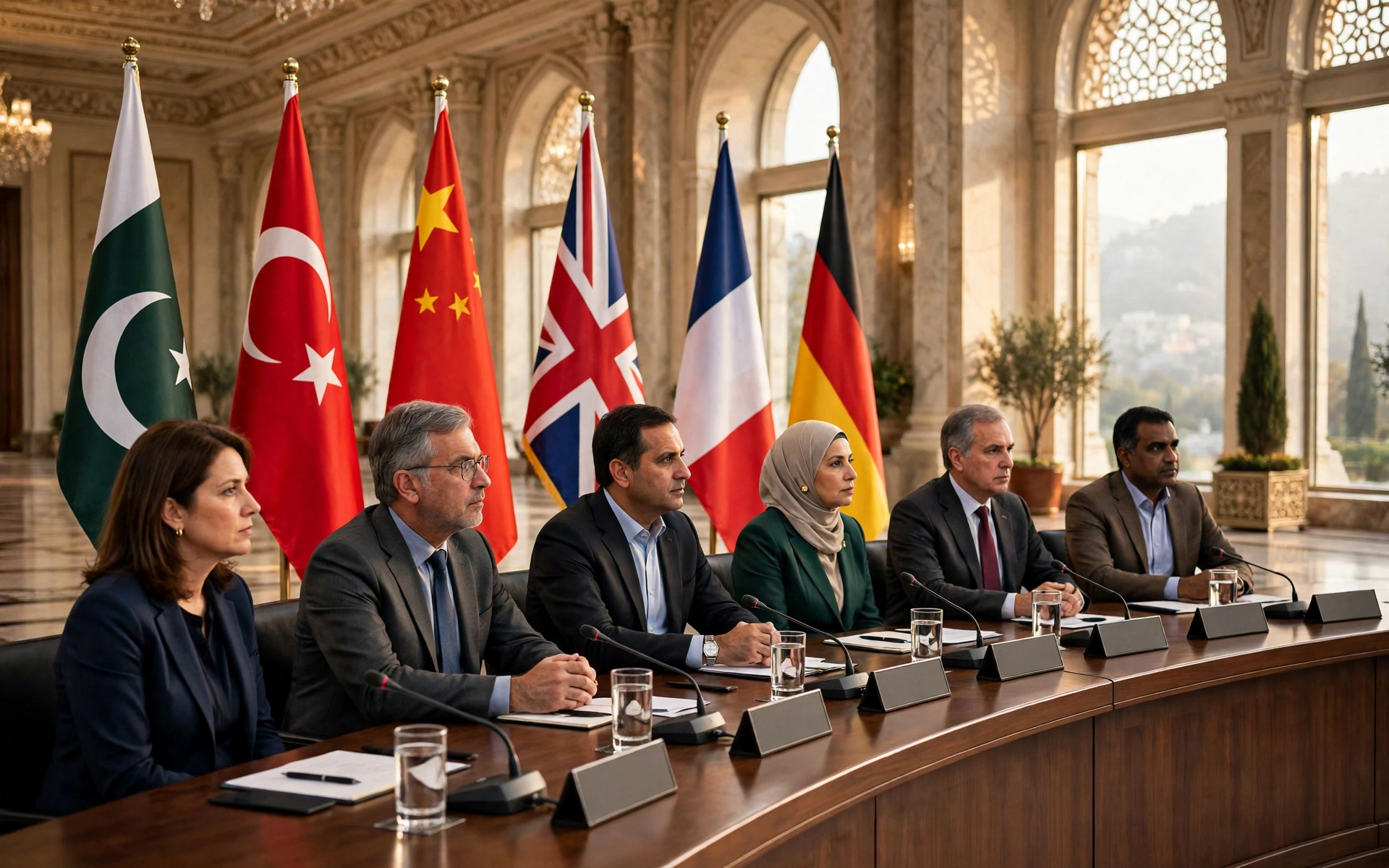

Pakistan opened the second day of the Economic Cooperation Organization’s Council of Ministers meeting in Islamabad on Monday with a condition attached to its chairmanship. Deputy Prime Minister and Foreign Minister Ishaq Dar told the foreign ministers of the 10-nation bloc that Afghanistan must act against terrorism before regional trade can grow, calling that action absolutely essential for sustained economic cooperation. He set out five priorities for Pakistan’s two-year chair, and said the test would be progress in people’s lives, not commitments.
The condition, stated plainly
Dar’s words on Afghanistan were the sharpest part of his welcome address. He said Pakistan desired a peaceful, prosperous and stable Afghanistan, fully integrated within the ECO framework, at peace with itself and all its neighbours. Then came the condition: progress required the Afghan authorities to address the legitimate security concerns of neighbouring countries, particularly the threat of terrorism, because a secure environment was essential for sustained partnerships.
The condition matters because it sits on top of the corridor Pakistan wants to build. One chairmanship priority is better transport and transit links between Central Asia, South Asia and Pakistan’s ports on the Arabian Sea, and the shortest land route for that trade runs through Afghanistan. Afghanistan was not invited to the meeting, though its tricolour flag appeared on official banners. The Pakistan-Afghanistan border remains closed. Dar’s condition gives that limit a name and a price: no security action, no sustained trade.
Five priorities for two years
Dar listed five priorities for the chairmanship. First, wider market access, stronger regional value chains and greater private sector participation, particularly by small businesses. Second, better transport and transit links between Central Asia, South Asia and Pakistan’s ports on the Arabian Sea. Third, a more effective, inclusive and digitally enabled trade framework, based on the negotiating strategy agreed in November 2025. Fourth, cooperation in disaster preparedness, early warning, water management and climate-resilient infrastructure. Fifth, skills for the region’s youth through education, research and vocational training.
He said reviving regionalism did not require reinventing the wheel, but building on foundations already laid. He added that peace and development reinforced each other, and warned that conflict disrupted trade routes, energy supplies and investments. His summary was a chain of three steps: translate geographic proximity into connectivity, connectivity into commerce, and commerce into lasting prosperity.
The attendance question, answered
One open question from Sunday is now settled. Iranian Foreign Minister Abbas Araghchi arrived in Islamabad, received by Additional Foreign Secretary Muhammad Tariq Wazir. On Sunday his attendance was still uncertain, with reports split between expected and confirmed. His arrival changes the shape of the room. Pakistan took the ECO chair on Sunday, with three delegations led by deputy foreign ministers, while Iran’s foreign minister came in person, alongside the OIC secretary general and the SCO deputy secretary general.
Dar hosted a welcome dinner on Sunday evening and later met ECO Secretary General Asad Majeed Khan, reaffirming Pakistan’s commitment to hosting the ECO Summit in 2027. He also met OIC Secretary General Ismail Ould Cheikh Ahmed, who commended Pakistan’s diplomatic efforts during the Iran-US conflict. Pakistan urged calm at the United Nations as Gulf tensions rose, and the OIC chief welcomed that role again in Islamabad.
Two documents still to come
The meeting is expected to adopt two documents before it closes today: the Islamabad Declaration and the Strategic Goals of Economic Cooperation 2035, the ten-year framework succeeding Vision 2025, adopted at the 2017 Islamabad Summit. Even the first document’s name is not settled in public. Turkmenistan’s government calls it the Islamabad Declaration, while the Foreign Office says senior officials finalised a draft Islamabad Communiqué. The ministers will also meet Prime Minister Shehbaz Sharif.
Vision 2035 covers trade, investment, transport, energy, the digital economy and climate change. The test is the last vision’s record. The ECO secretary general said in October that total ECO trade reached 1.058 trillion dollars in 2025, with intra-regional trade of 138.6 billion dollars, or 13 percent of external trade, while the Vision 2025 target of doubling intra-regional trade was not achieved. Other estimates put the share at 8 to 10 percent.
What to watch next
Four tests will show whether the chairmanship means more than ceremony. First, whether the two documents are adopted today, and what they say about the ECO Trade Agreement and the Transit Transport Framework Agreement, the instruments that would simplify trade and cut transport costs. Second, whether the ministers’ meeting with the prime minister produces anything beyond the formal call and luncheon. Third, whether any minister responds publicly to the Afghanistan condition. Pakistan named its climate minister, Musadik Malik, to attend the SCO dialogue in New Delhi, and the same week tests whether Islamabad’s diplomacy travels beyond its capital.