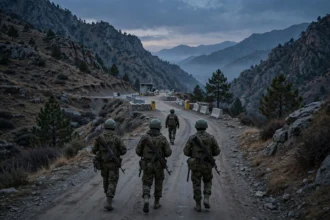

The United States destroyed five Iranian oil tankers on Tuesday night and Iran answered with missile strikes on an American base in Jordan. It was the sharpest escalation yet of the six-month-old war, a day after Pakistan said it had not given up trying to restart talks. Oil rose above $100 a barrel before easing.
What happened overnight
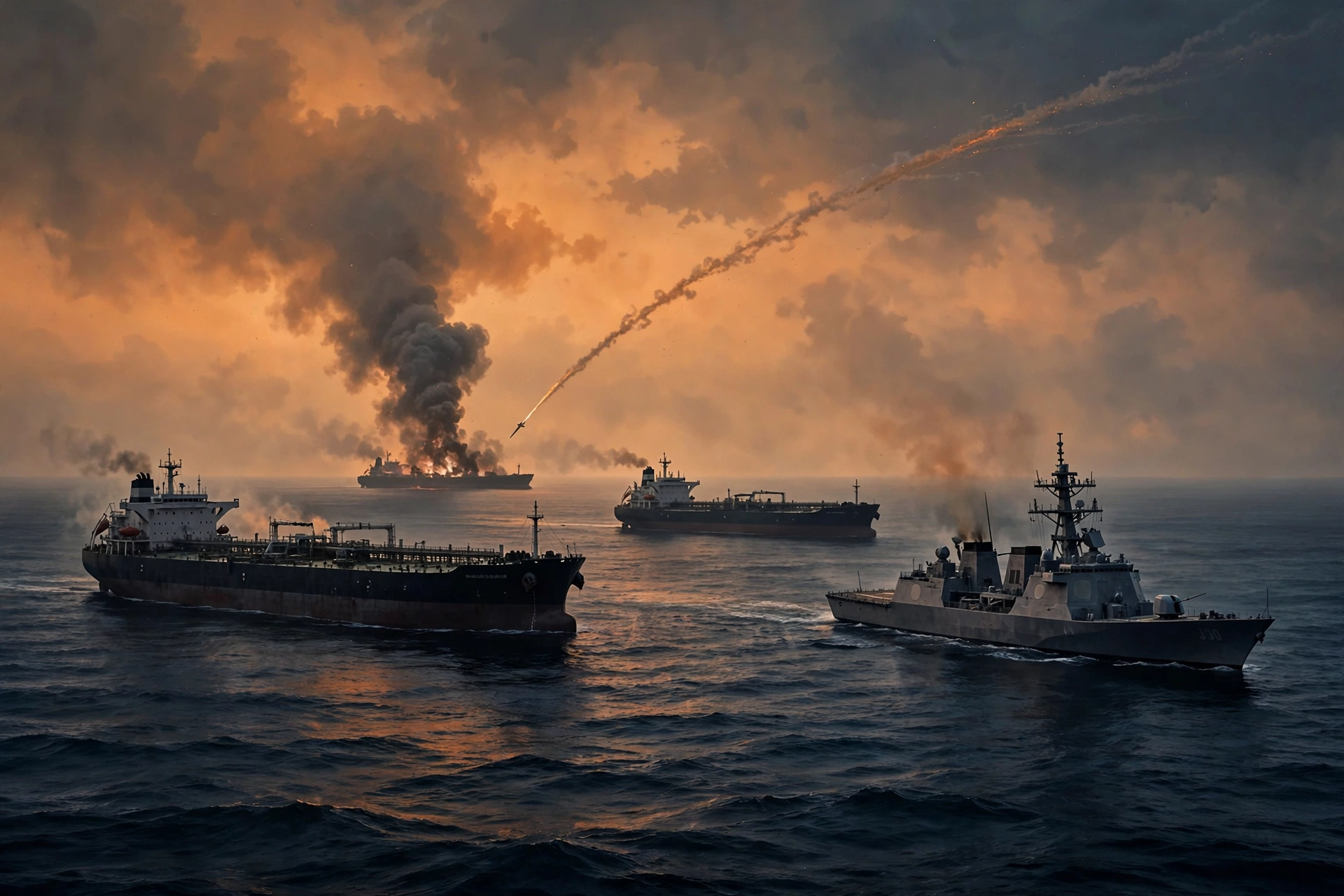
Central Command said Iran’s Revolutionary Guard tried twice in two days to hit an American warship with ballistic missiles. The vessel evaded both attempts and no American personnel were harmed. Washington struck the M/T Kaviz, M/T Charminar, M/T Horizon 1 and M/T Riesco in the Gulf of Oman, and the M/T Derya near Kharg Island.
Iran’s Revolutionary Guard confirmed that five tankers were targeted. It said it hit the Al-Azraq base in Jordan, which hosts American forces, with fierce missile strikes and claimed fighter-jet hangars were destroyed. It also claimed missile hits on destroyers DDG-119 and DDG-53. Jordan said its air defences intercepted 18 of 20 ballistic missiles, and two fell in unpopulated areas.
Its navy said it attacked two American vessels and eight tankers near Hormuz, and warned tanker crews near Bahrain and Kuwait to leave at once. Reuters reported Bahrain intercepted Iranian aerial attacks on Wednesday, Iranian drones had hit an American radar in Bahrain on Tuesday, and the United States struck a missile site on Qeshm Island in reply.
The United States had already attacked three Iranian tankers on 5 September, one of which sank, and three more last weekend. Counting those, eight Iranian tankers have been hit in four days. Secretary of State Marco Rubio said Iran keeps trying to hit American ships and that for every attempt it will lose tankers.
The mediation that ran out of road
On Monday, Foreign Minister Ishaq Dar said Pakistan had not given up hope or efforts to settle the crisis. Tehran had fast-tracked its plan to reopen Hormuz within seven days into a two-day plan, tied to the United States meeting seven demands, including lifting sanctions. Pakistan’s three-track mediation effort ran through GHQ, Dar’s diplomacy and Parliament.
Talks continued on Tuesday between Iran and mediators Oman and Qatar even as the two sides traded fire, but the two-day Hormuz plan now has nothing to wait for. Iran called the tanker strikes a war crime and warned Washington and its partners bear full responsibility. The mediation is not formally abandoned, but it has no live proposal and no date for resumed talks.
The oil price whiplash
The fighting drove oil above $100 a barrel in early trading on Wednesday, according to Al Jazeera. Brent had settled on Tuesday up 0.76 percent at $93.14 a barrel, and by 0149 GMT on Wednesday it was trading at $92.98, after American crude stocks rose. Brent has risen by about a quarter since early August.
Yemen’s Houthis said on Tuesday they had launched five drones at two pumping stations on Saudi Arabia’s East-West pipeline, which Riyadh uses to bypass Hormuz. The strait carries about a fifth of the world’s seaborne oil, so every attack there feeds into the price Pakistan pays for fuel.
What it costs Pakistan
Pakistan’s petroleum import bill reached $16.86 billion in fiscal year 2025-26, up 5.76 percent, per the Institute of Strategic Studies Islamabad. Crude imports rose 31.58 percent to $7.17 billion. In October 2026, petroleum imports stood at $1.60 billion, 27.24 percent of all imports that month. Over the first four months of the current fiscal year the bill was $5.91 billion, and the International Monetary Fund projects $16.31 billion for the full year.
Pakistan’s current account surplus was only $39 million in October, the State Bank reported, after a $371 million deficit in September. Petrol fell to Rs325 a litre in the eleventh straight cut on Wednesday, after Brent fell about 21 percent this month before the overnight escalation. Under daily pricing, the next review will reflect the spike, so the relief may last only a day. Diesel stayed at Rs358, and the State Bank’s annual report has warned the energy import bill is the largest strain on external finances.
What happens next
Neither side is signalling a pause. Rubio’s warning sets a rule that every attempted attack on an American warship will cost Iran a tanker, while Tehran’s warnings to crews near Bahrain and Kuwait point to more disruption.
The Oman and Qatar channel remains the only live route back to talks, and Islamabad’s standing as mediator depends on keeping it open. At home, the next daily fuel price review will show whether the Rs325 petrol price survives a Brent spike. Until the strait reopens, every tanker hit is also a line on Pakistan’s import bill, and more national news from Pakistan will follow the mediation as closely as the fighting.