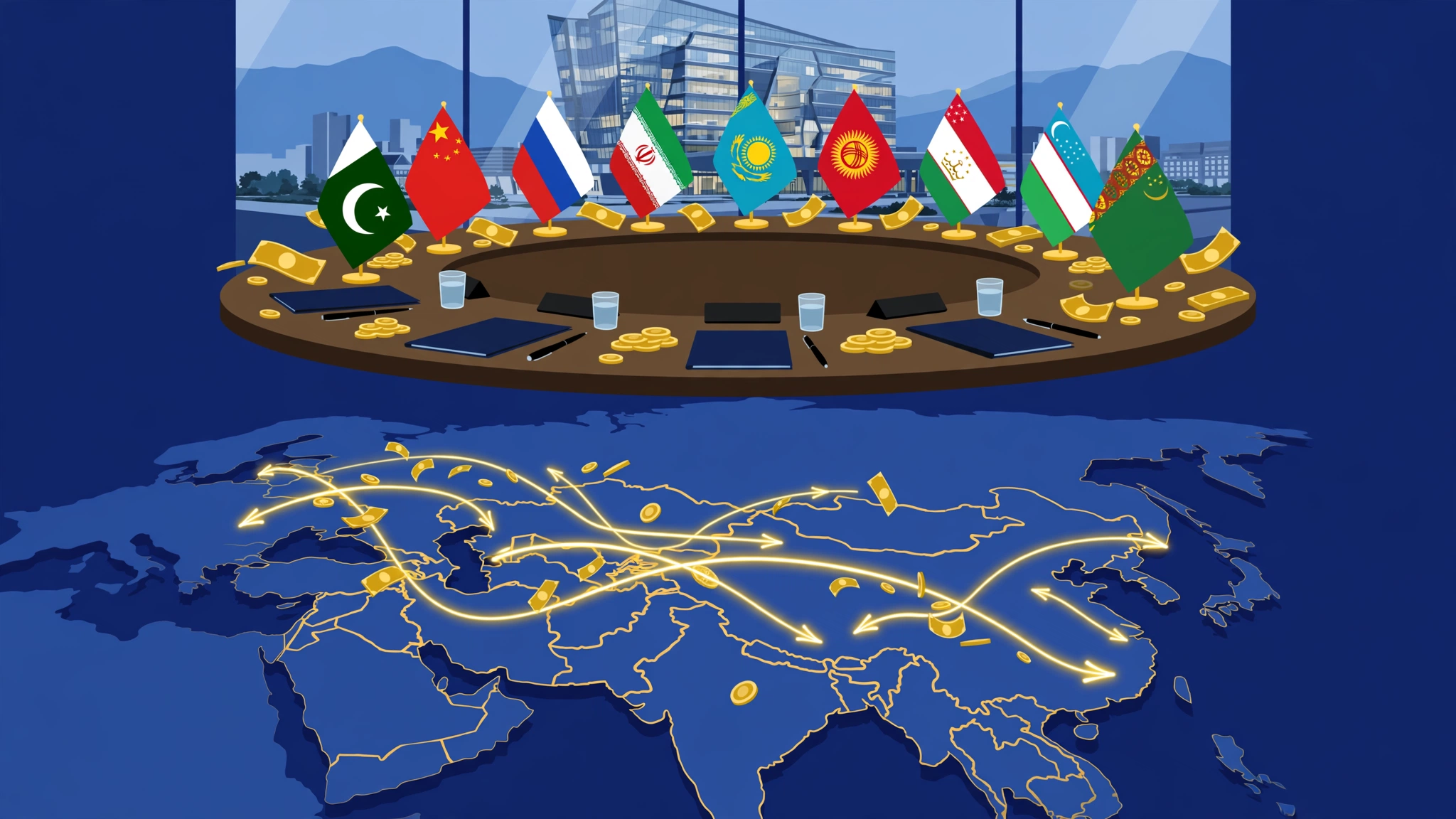

Pakistan used the Shanghai Cooperation Organisation’s government-heads meeting in Dushanbe on Tuesday to press member states to settle trade in national currencies and to move ahead with a long-proposed SCO Development Bank, Development Fund and Investment Fund. Deputy Prime Minister and Foreign Minister Ishaq Dar told the 25th SCO Council of Heads of Government that the tools would help the region “offset international financial shocks” and advance development projects. But the pitch was not new. It is the latest entry in a year-long paper trail that runs from Moscow to Tianjin, Washington, Bishkek and Hangzhou, and Pakistan has already tested the local-currency idea once, paying for its first Russian crude cargo in Chinese yuan.
What Dar asked for in Dushanbe
Addressing the gathering in Tajikistan’s capital, Dar said: “We reiterate the need to accelerate efforts to promote the use of national currencies for mutual settlement and establishing SCO development bank, SCO development fund and an investment fund.” According to the Foreign Office statement, he told leaders that such tools would “advance development initiatives and help the SCO region to offset international financial shocks.”
He criticised protectionist policies and unilateral economic measures, arguing they undermined growth and technological progress, and said reform of the global financial architecture and trade regimes was essential for equitable development. Dar also offered the China-Pakistan Economic Corridor as a platform for SCO partners, calling it “a compelling opportunity to participate in and accelerate our shared journey towards comprehensive economic integration,” and stressed that investment in energy and transport was vital for seamless regional integration.
On the sidelines, Dar called on Tajik President Emomali Rahmon to discuss bilateral and regional cooperation. The SCO brings together ten member states: Pakistan, China, India, Iran, Russia, Kyrgyzstan, Belarus, Kazakhstan, Tajikistan and Uzbekistan, with Afghanistan and Mongolia as observers.
The same proposal, a year of paperwork
None of this began in Dushanbe. Dar made the same three proposals at the 24th SCO Council of Heads of Government in Moscow in November 2025: a development bank, a development fund, an investment fund, and wider use of national currencies for settlements. The political decision to establish the bank came even earlier, at the SCO Council of Heads of State in Tianjin on September 1, 2025, where the Tianjin Declaration recorded that interested member states had resolved to set up the institution and accelerate consultations on how it would work.
In April 2026, Finance Minister Muhammad Aurangzeb conveyed Pakistan’s “full and unconditional support” for the bank to his Chinese counterpart Lan Fo’an in Washington, according to the Finance Ministry. Then came the September 2026 sequence: the Bishkek Declaration, adopted at the 26th heads-of-state summit under Kyrgyzstan’s chairmanship, noted the progress made and stressed the importance of continuing the work, with 28 documents signed overall.
Thirteen days later, the fifth round of consultations on the bank’s establishment was held in Hangzhou, co-chaired by China and Pakistan, with 29 states and the SCO Secretariat taking part in what the organisation described as a thorough exchange on the bank’s operational parameters. Dushanbe is therefore best read as Pakistan returning to an open file, not opening a new one.
Pakistan has already paid in yuan
There is also a practical precedent. When Pakistan received its first government-to-government consignment of discounted Russian crude in June 2023, a 100,000-tonne purchase with the first 45,000 tonnes docking at Karachi, Petroleum Minister Musadik Malik confirmed to Reuters that the payment had been made in Chinese yuan, a clear break from Pakistan’s dollar-dominated payments policy.
The shift was driven by necessity: foreign-exchange reserves were severely strained, the same pressure tracked in the USD to PKR exchange rate today. Pakistan and China also maintain a bilateral currency swap arrangement to facilitate trade in local currencies, referenced publicly by then power minister Khurram Dastgir Khan and by Pakistan’s ambassador to China. None of this means local-currency settlement is easy at scale, but it does mean Islamabad’s pitch in Dushanbe asks others to try something it has already attempted under pressure.
What is stuck, and what happens next
The bank still does not exist. The Bishkek summit adopted 28 documents but left the development bank unresolved, and even the question of where it would sit is contested: Kyrgyzstan’s bid to host the headquarters was followed by a competing offer from Kazakhstan, according to regional reporting. That leaves Pakistan, which assumed Pakistan’s SCO chairmanship after the Bishkek summit, holding a file with political endorsement but unfinished plumbing.
Islamabad is separately negotiating investment protection with Ottawa, where the Pakistan-Canada bilateral investment treaty talks entered a third round this week, part of a wider effort to make cross-border capital flows more predictable. For continuing coverage of Pakistan’s trade and finance diplomacy, see our business and economy news.