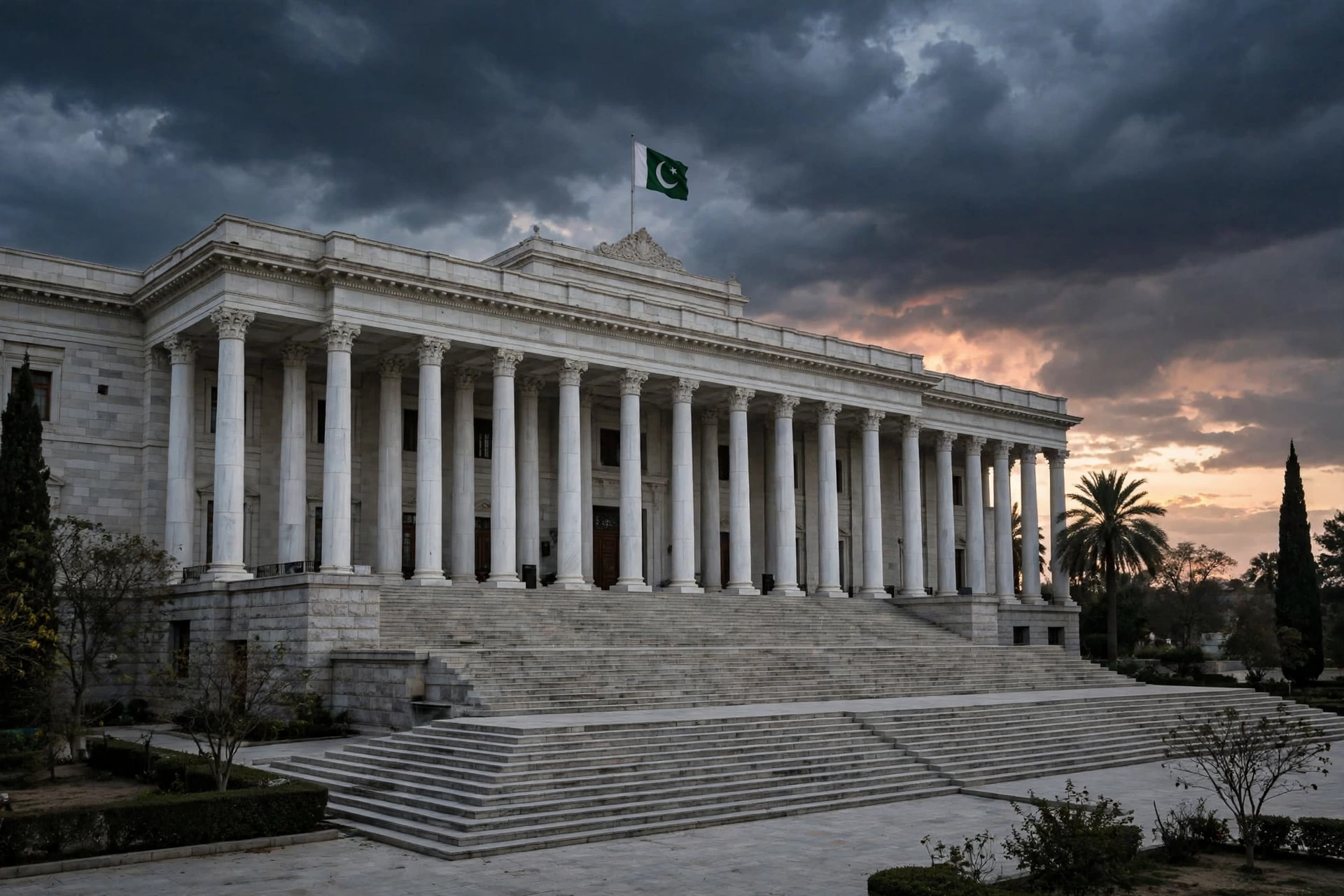

The Federal Constitutional Court on Monday narrowed its own 5 November order that had shut the Peshawar High Court out of detention cases, allowing the high court to hear other constitutional petitions again. But the challenge to governor’s rule and the detentions under the Maintenance of Public Order law stay frozen. And the review board that is supposed to hear detained workers will not exist for three months.
What the 5 November order did
On 5 November, a two-member bench headed by Chief Justice Aminuddin Khan barred the Peshawar High Court from hearing petitions against arrests under Section 3 of the Maintenance of Public Order Ordinance. Its written order held that, because the armed forces had been called in aid of civil power under Article 245, Article 199 petitions filed on or after 12 October stood suspended. The call-out order came on 11 October and the Defence Ministry memorandum on 12 October, making that date the cutoff.
Before that order, the high court had restrained Section 3 arrests, ordered the release of 28 PTI workers detained in various districts, and granted bail to 23 more. The provincial government appealed, and the Constitutional Court suspended those orders.
The high court’s own administrative committee then went further than the order itself. It directed that no Article 199 petition filed on or after 12 October be fixed for hearing, and that new petitions be returned, not received. On 7 November, about 105 petitions were struck from the Peshawar High Court’s cause list, including the emergency challenges and the recovery petitions for former chief minister Sohail Afridi, assembly Speaker Babar Saleem Swati and PTI provincial president Junaid Akbar. The 10 November hearing meant to test the emergency was emptied, and the petitioners were told to approach the appropriate forum. No authority has said which forum that is.
What changed on Monday
The same bench heard a petition filed by the PTI and allowed it, amending the earlier injunction. Barrister Gohar, appearing for the petitioners, argued that the 5 November order had severely affected the high court’s routine proceedings and brought lawyers’ practices to a halt.
The court clarified that its 5 November stay order was limited to matters concerning governor’s rule and the MPO. The Peshawar High Court can keep hearing other cases under Article 199.
Justice Aamer Farooq remarked that a plain reading of Article 245 would mean cases under Article 199 could not be heard, but an entirely literal interpretation would bring the whole judicial system to a standstill. The same judge had asked on 5 November whether the high court would then stop hearing its daily Article 199 cases.
The court also allowed the Peshawar Bar Council to become a party, and adjourned the hearing indefinitely.
What did not change
The freeze still covers the two matters at the centre of the dispute: the challenge to the emergency and governor’s rule has no hearing date, and the petitions against detentions under Section 3 of the MPO remain suspended. The orders releasing the 28 detained workers stay without effect.
The second door is shut too. Gohar told the court that a review board had yet to be formed in Khyber Pakhtunkhwa, the body before which a detained person can challenge a detention order. The provincial advocate general replied that a review board would be formed in the province after three months. That leaves a detained worker with neither the high court nor the review board for the next three months, while detentions under Section 3 continue.
Sardar Akhtar Mengal and Senator Raja Nasir Abbas applied on 14 November to become parties and asked for the 5 November order to be amended or withdrawn. The court has not said whether Monday’s amendment answers their applications.
What happens next
Four dates now decide the dispute. The first is whether the high court’s committee lifts its 6 November directive for cases outside governor’s rule and the MPO. The second is the advocate general’s seven-day report on where the armed forces are no longer required in aid of civil power, due around 12 November and not made public. The third is the review board, promised in three months, which would arrive around mid-February 2027. The fourth is the six-month limit on governor’s rule, ending on 11 April 2027 and extendable by a joint sitting two months at a time.
Parliament backed the emergency and governor’s rule in Khyber Pakhtunkhwa, and the emergency under Article 232 has no fixed end once approved. A month into governor’s rule in Khyber Pakhtunkhwa, the province is run by the governor and an 11-member advisory council. The core question, whether the emergency and governor’s rule are lawful, still has no hearing date, and Monday’s amendment does not give it one. More national news from Pakistan