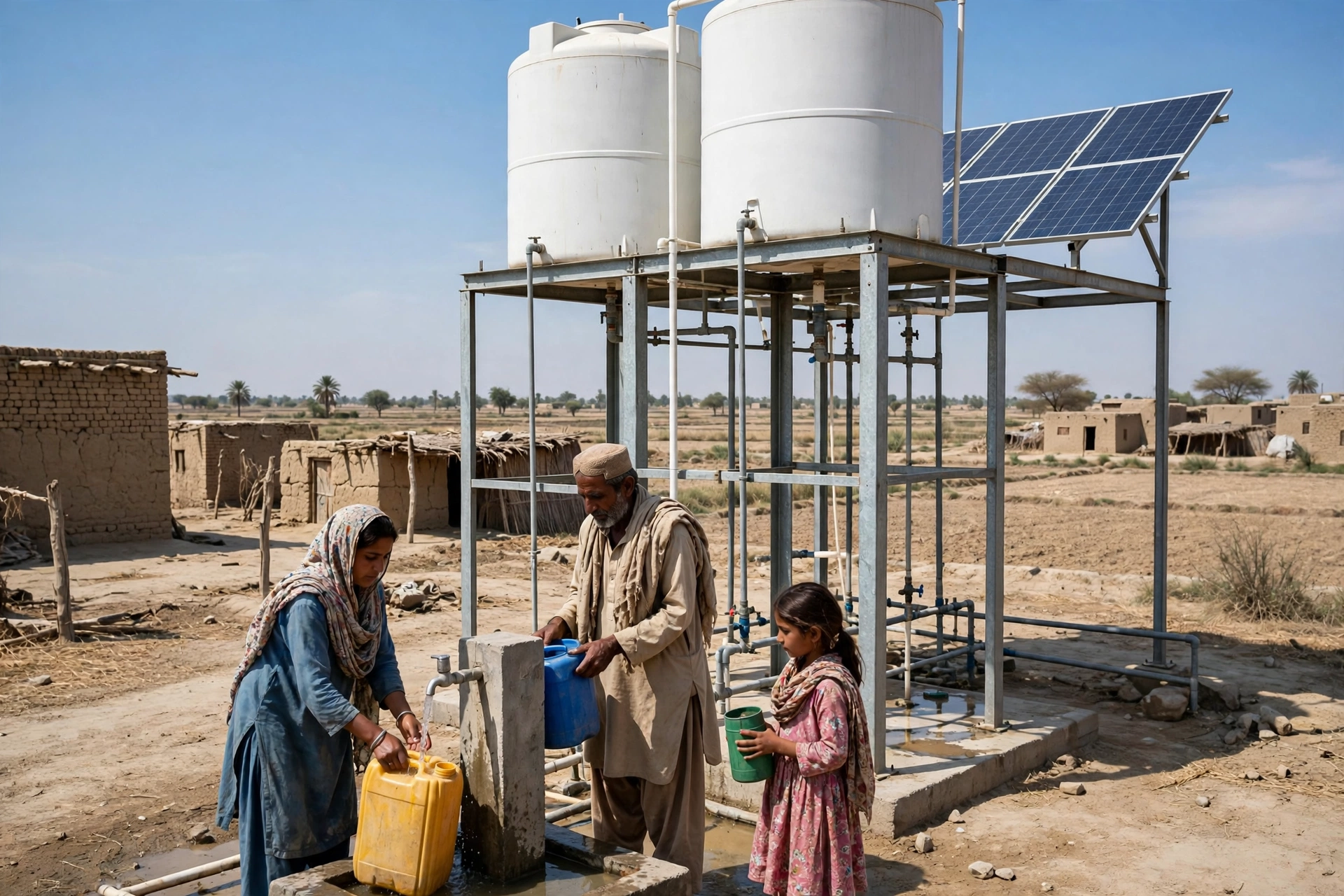

The World Bank approved $300 million on Friday for safe water, sanitation and hygiene for 1.5 million people in rural Sindh. The money funds STAR WASH-1, the first phase of the project, which costs $540 million in total. But the headline number hides two quieter facts: only half of the 1.5 million people are promised safely managed water, and the target itself is 40 percent smaller than an earlier plan.
Where the $540 million comes from
The World Bank’s $300 million splits into $200 million from the International Development Association, its concessional lending arm, and $100 million from the International Bank for Reconstruction and Development. The Asian Development Bank adds $150 million under a Full Mutual Reliance Framework. The Sindh government puts in the equivalent of $90 million as counterpart funding. The biggest slice, $482 million of the $540 million, goes to water supply, sanitation and hygiene services themselves, according to the project information document.
Pakistan’s Central Development Working Party recommended the Rs151.2 billion project to the Executive Committee of the National Economic Council on 25 September. It was the largest of seven foreign funded Sindh projects, worth $895 million, to clear the working party. The project document had scheduled approval for 25 November, and the board approved on 13 November instead.
What 1.5 million people actually get
Of the 1.5 million people in the project’s sights, 750,000 should get safely managed water, the project information document shows. The document targets safely managed sanitation services for all 1.5 million. It aims to halve water contamination at the point of use and connect 80 percent of targeted communities to a professional provider. The money will pay for solar powered water schemes, upgraded sanitation systems, and hygiene campaigns in selected rural areas. The bank estimates the project will create more than 14,000 jobs. It will also turn Sindh People’s Housing for Flood Affectees, a non-profit, into a utility company for rural water and sanitation.
The health case is stark. More than half of children under five in rural Sindh are stunted, and unsafe water and poor sanitation cause repeated diarrhoea that limits physical and cognitive development. “Stunting is among Pakistan’s most severe and persistent human capital challenges, and unsafe water, sanitation and hygiene is a major underlying driver,” said Bolormaa Amgaabazar, the World Bank’s country director for Pakistan. At the proposal stage in September, only 29 percent of Sindh’s rural population had access to safely managed water. Earlier World Bank documents found about 90 percent of rural households in Sindh drink water carrying E. coli, often from poor hygiene, not a dirty source. Punjab needs 10bn cubic metres more water a year, the FAO warned on Monday.
The target that shrank
An earlier project plan envisaged reaching about 2.5 million people, while a September Sindh stakeholder engagement plan identified 1.5 million beneficiaries. That works out to 40 percent fewer projected beneficiaries, though the documents do not say why the number came down. The Asian Development Bank’s project page still lists 16 of Sindh’s 23 districts, but no district list for the first phase has been published, so it is not possible to say which villages are in and which are out. Sindh has seen this failure up close: Tharparkar’s water plants stand dry while crops fail, after drought destroyed about 90 percent of the district’s crops. The cut deserves an explanation the documents do not give.
Why this time might be different, and what to watch
Earlier rural water schemes in Pakistan focused on building assets and did not deliver lasting services at scale, according to the bank’s documents. Pipes were laid, schemes were handed over, and then operation and maintenance failed. STAR WASH-1 is built around the opposite idea: a shift from building infrastructure to safe and sustainable service delivery, with a utility company meant to keep the water flowing. That is the delivery test, and it is the part no approval announcement can pass in advance.
Four things to watch now. First, whether the Executive Committee of the National Economic Council clears the project after the working party’s recommendation. Second, the first disbursement and the publication of the district list. Third, the three further financing rounds the 10-year programme still needs: STAR WASH-1 is only the first of four phases in a programme worth $2.45 billion, covering Sindh, Khyber Pakhtunkhwa and Punjab. Fourth, the closing date of 31 December 2030. 13 mineral deals signed at PMIF, but only $100m is real money, and the same caution applies to the $540 million. Approval is a promise of financing, not water in a tap, and no construction start date has been announced. The provinces’ cash position is tight: provinces sent the Centre only Rs57bn in the first quarter.