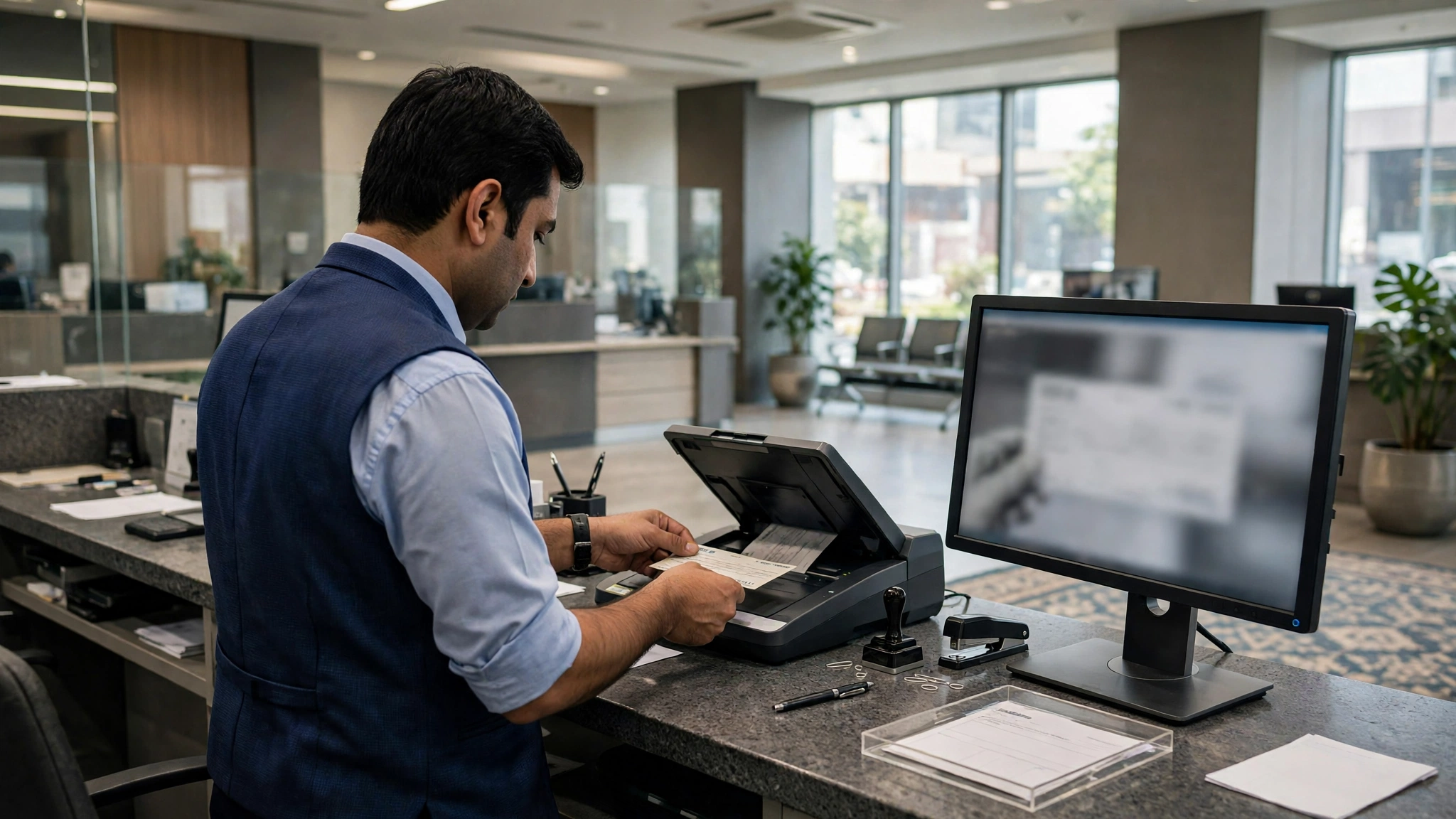

From today, Monday 16 November 2026, the paper cheque in Pakistan starts a different journey. The State Bank’s Pakistan Express Clearing System, or PECS, moves out of its pilot phase into its extended phase, as every remaining member of the clearing house joins. Your bank now scans a deposited cheque and sends the image on for clearing. The paper stops travelling between banks.
What changes at your branch
PECS works on a method called cheque truncation. The bank where you deposit the cheque captures its image and the details needed for clearing. That image goes to the National Institutional Facilitation Technologies, or NIFT, which runs the clearing house. NIFT passes it to the bank the cheque is drawn on, which processes the payment from the image. The State Bank set out this flow in Circular No. 02 of 2026, dated 5 October.
For most account holders, little changes at the counter. You still write a cheque and hand it in at your bank. The circular gives no right to photograph a cheque at home and deposit it through a mobile app, so keep following your bank’s existing deposit procedure until the bank says otherwise. Only rupee cheques, payment orders and banker’s cheques are covered; cheques settled inside one bank stay outside the flow.
The dates that matter
The rollout runs in three stages. The pilot ran from 15 October to 15 November at a limited group of banks chosen by the State Bank with NIFT. The extended phase runs from today to 31 December, reaching all remaining participating institutions, which widen truncation across their branch networks step by step. Full nationwide coverage is due by 30 April 2027.
One detail is easy to misread. During the rollout up to 31 December, an extra PECS clearing cycle runs every day, and the clearing house must submit it to the State Bank by 3pm. That 3pm time is a clearing house deadline, not a promise your account will be credited by 3pm. The circular sets no guaranteed crediting time.
What PECS is not
Two misunderstandings are worth clearing up today. First, PECS is not Pakistan’s first image-based cheque clearing. NIFT says image-based clearing began in the Karachi region in September 2021, when cheques were collected from banks and scanned at NIFT centres. PECS formalises the next step, in which the collecting bank captures the image itself. Second, PECS is not an instant payment system. It clears cheques. It does not turn a cheque deposit into a Raast transfer.
There is also what the State Bank has not published. No public list of the pilot banks exists, and none has been published of which banks and branches join from today, or when any branch will be ready. Until your bank gives specific instructions, ask your branch whether it uses PECS and what clearing times apply.
The other cheque change that lands today
PECS is only one of two cheque changes that take effect today. From today, every payment made through a government Asaan Assignment Account goes through Raast, the State Bank’s instant payment system, and cheque payments through those accounts stopped on Sunday 15 November. PakMirror reported that switch on Friday, including the one question still open, the fee shopkeepers will pay on digital sales.
Together, the two changes cover both ends of the cheque. The state has stopped writing one class of cheque, and the central bank has stopped moving the paper on the rest. Officials expect most government institutions to finish digitising payments by December. Islamabad’s government counters go cashless from 30 November, with all shops in the capital expected to be digital by 31 December.
Why the state is pushing so hard
The push sits on published State Bank numbers. Its Payment Systems Quarterly Review counted 3.7 billion retail transactions in January to March 2026, with 92 percent on digital channels. Raast alone carried 742 million transactions worth Rs23.27 trillion in that quarter, up from 295.7 million in October to December 2024. Government to person payments through Raast and digital channels rose from Rs472 billion in July 2025 to Rs4.402 trillion in June 2026, a Finance Ministry document reported by ProPakistani says. The same strategy channels remittances through digital routes, so today’s dollar to rupee rate is a figure more households now follow.
What to watch next
Three dates matter. The extended phase runs to 31 December, when the extra daily clearing cycle ends. The nationwide deadline is 30 April 2027. The State Bank’s July to September 2026 payments review is also due, and it will show whether cheque volumes are actually falling. The first test is the simplest. Ask your bank whether your branch is on PECS yet. The answer will differ from branch to branch for months. More business and economy news from Pakistan.