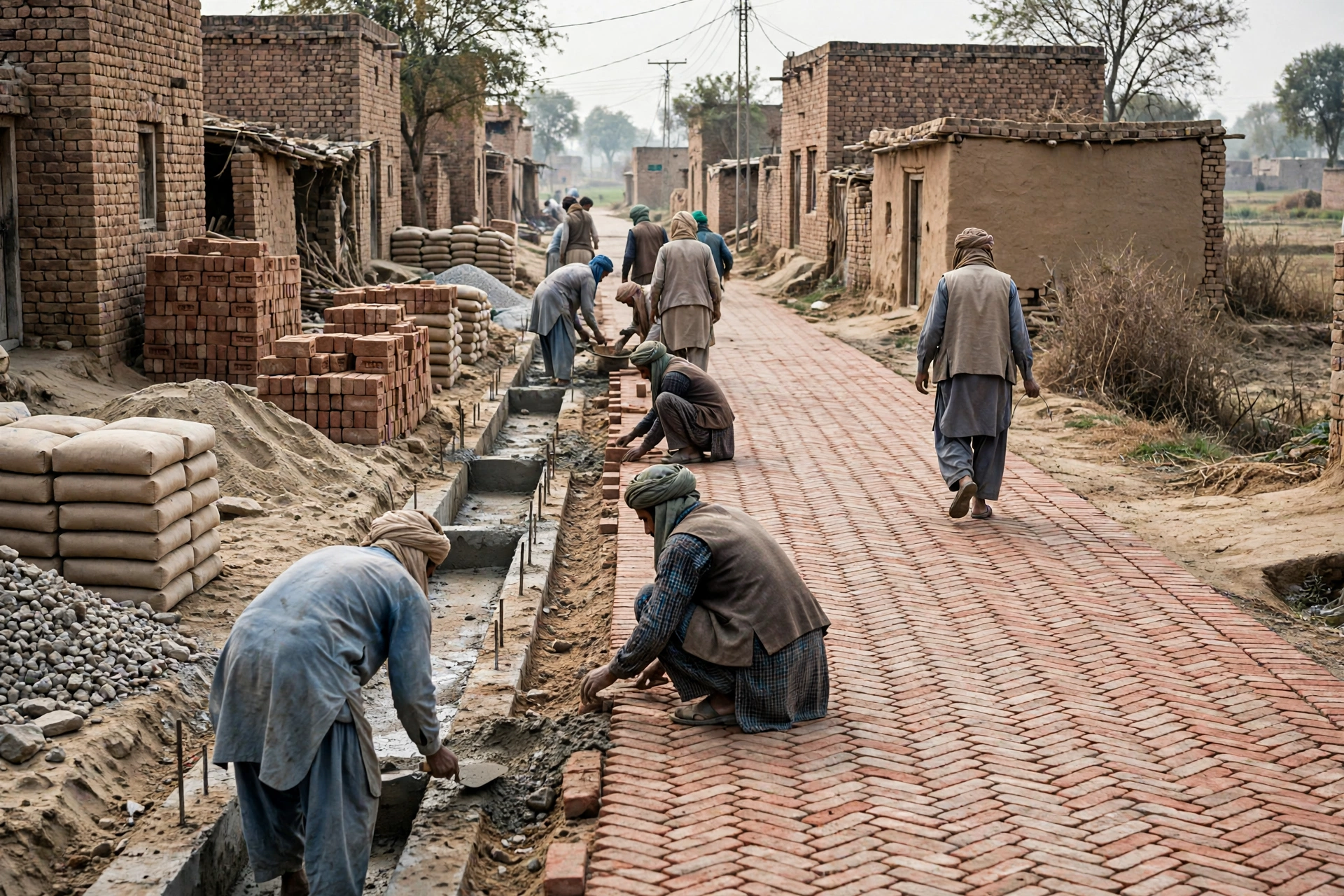

Punjab Chief Minister Maryam Nawaz Sharif has approved Rs23.85 billion for the first phase of the Khushhal Dehat Programme, which will spend Rs50 million in each of 475 villages on paved streets and organised sewerage systems. The first instalment of the money is to reach village committees by November, and the chief minister has asked officials to prepare a plan for 2,000 more villages in a second phase.
The announcement was made on Saturday. Maryam Nawaz said her resolve was to provide paved streets and an organised sewerage system in every village in Punjab, with development uniform across the province, in cities and villages alike, and political affiliation not allowed to stand in the way.
The headline figures leave Rs100m unaccounted for
The two numbers at the centre of the announcement do not quite reconcile. At Rs50 million per village, 475 villages come to Rs23.75 billion, which is Rs100 million less than the Rs23.85 billion approved. The government has not said what the extra Rs100 million covers, it may be administration or other programme costs, but the gap is in the announcement itself.
The bill grows fast from here. If the second phase covers 2,000 villages at the same Rs50 million each, it will cost Rs100 billion. Phases one and two together, 2,475 villages, would cost Rs123.75 billion at the same rate. That is more than five times the first phase, and it is not yet approved or funded, only a plan has been sought.
Who holds the money
The money will not flow through the usual departmental channels. Each village will have a nine-member Khushhal Dehat committee, with five government representatives and four private members, headed by the additional deputy commissioner for social services. The union council chairman and the sub-engineer will also sit on it. The committees will oversee the work and the use of the funds in their villages.
That design is a change from the pilot announced on 20 October, when the committees were described as eight-member bodies headed by an assistant commissioner. The new structure puts a more senior officer in charge and adds private members. Whether the committees publish what they spend is the test that matters, and no reporting requirement has been announced yet.
The deadline is the sharpest part of the announcement. The first instalment must reach the committees by November, which means within the next two weeks. That is a fast timetable for 475 committees that do not yet exist in public, and it is the first date on which the programme can be judged.
The pilot still has no published list
The programme did not start from scratch. On 20 October the Punjab government approved a pilot to turn 120 villages into model villages and announced plans to introduce the Khushhal Dehat Act 2026. But the pilot’s basic facts are still unpublished: no district-wise list of the 120 villages, no total budget, no per-village allocations and no completion deadlines. The Act has been announced as a proposal, not enacted as law.
The last published per-village price tag is a warning. In Vehari district, 14 model villages are being developed at a cost of Rs1.895 billion, which works out at about Rs135 million per village. That package is wider than streets and sewerage, it includes water supply, wastewater treatment, children’s parks and streetlights, so the two figures are not directly comparable. But it shows what a fuller model village has cost in practice, and Rs50 million per village buys a narrower job.
The same chief minister made another big Punjab numbers claim this week, when Maryam Nawaz told the minerals forum that Punjab’s rivers hold gold, a figure PakMirror found rested on two-year-old evidence. The village programme deserves the same treatment: the announcement is real, the arithmetic should be checked, and the delivery should be watched.
What to watch next
Four things will show whether this is a programme or a press release. First, the list of the 475 villages, which has not been published. Second, the first instalment reaching the committees by the end of November. Third, whether the committees publish what they spend, village by village. And fourth, the plan for the 2,000 villages in phase two, and whether it comes with a funded budget or only a promise. Punjab’s government has shown it can move fast when it wants to, as its smog squad put out 650 field fires in a single day, but enforcement and construction are different jobs. The scale of the money is also worth keeping in proportion: the ECC approved Rs359bn in extra grants in a single meeting earlier this month, so Rs23.85 billion is a large provincial commitment, not a federal-scale one. More national news from Pakistan