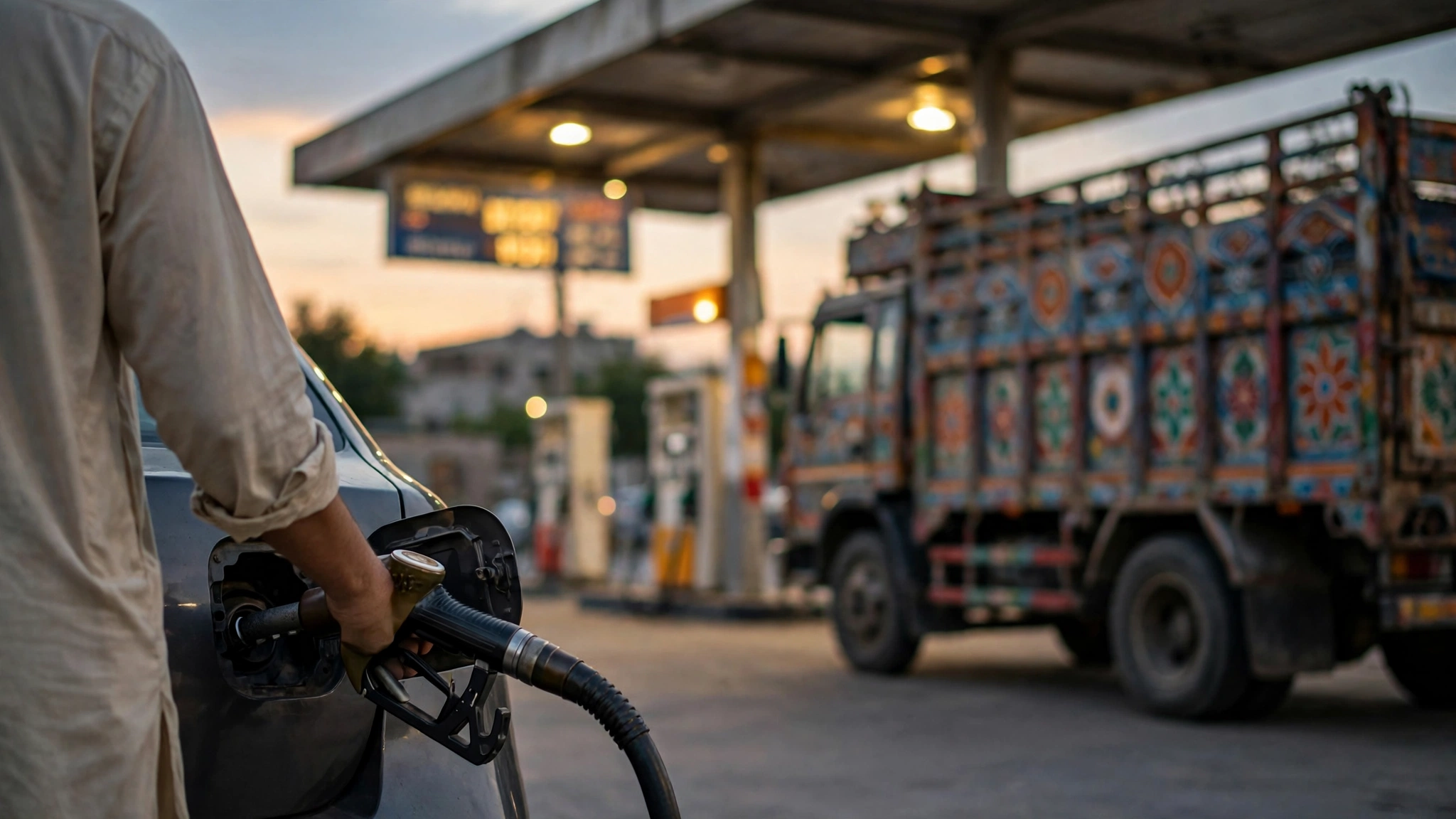

Petrol became cheaper for the ninth time in thirteen days on Saturday, falling by Rs2 a litre to Rs330, while high-speed diesel stayed unchanged at Rs360. The Oil and Gas Regulatory Authority issued the notification on Friday, and the new rates are in force from Saturday 14 November to Monday 16 November. The cut itself is the smallest news in the story. What matters is what the nine cuts add up to, how the new daily pricing system works, and whether the relief is now reaching beyond the pump.
The nine-day ledger
Petrol stood at Rs377.91 a litre on 2 November. It fell to Rs346 by 7 November, then to Rs338 on 11 November, Rs335 on 12 November, Rs332 on 13 November and Rs330 today. The total fall is Rs47.91 a litre, about 12.7 percent, in thirteen days. Diesel followed a similar path, from Rs402.96 down to Rs360, a fall of Rs42.96, about 10.7 percent, but it has now held at Rs360 for two days. The nine cuts came on 3, 4, 5, 6, 7, 11, 12, 13 and 14 November. No revisions were issued on 8, 9 and 10 November, so this is nine cuts in thirteen days, not nine days in a row. Petrol fell to Rs332 in the eighth straight cut on Friday, when diesel also dropped by Rs4 to reach Rs360. ProPakistani reports that Rs330 is the lowest petrol price since August 2026.
How the daily pricing system works
Since 2 November, OGRA has revised pump prices every morning under a daily pricing mechanism, working off a seven-day rolling average of international oil benchmarks instead of the old fortnightly review. That is why the cuts come in small steps, Rs2 or Rs3 at a time, instead of one big fortnightly move. The weekend is the exception. The rates announced on Friday stay in force for three days, Saturday to Monday, and the next revision comes on Monday 16 November. The notified prices are ex-depot rates, so what a driver actually pays at the pump can differ slightly from district to district because of the freight margin. Taxes are still a large part of the price. The government levies Rs114 a litre in taxes and duties on petrol and Rs100 on diesel, so roughly a third of the Rs330 pump price is tax, not fuel. Pakistan imports its fuel, so the price at the pump also moves with the dollar, and the dollar to rupee rate today sets part of the cost before OGRA even starts its calculation.
The freight test: fares fall 5 percent
The first test of whether cheaper fuel reaches ordinary buyers came on Saturday, when the Karachi Goods Carriers Association announced a 5 percent cut in freight fares. Association president Rana Muhammad Aslam said the benefit would be passed on to the public, and he also demanded cuts in toll taxes and withholding tax relief for the transport sector. The national body had already moved first. The All Pakistan Goods Transport Alliance announced the same 5 percent cut on 6 November, after four to five days of falling fuel prices, and its president Malik Shehzad Awan said then that fares would fall in view of the decline. One detail matters here. Diesel is the fuel trucks actually burn, and diesel has not moved for two days. The fare cut therefore rides on the earlier diesel fall, from Rs402.96 to Rs360, not on today’s petrol cut. Neither announcement mentioned passenger fares, and neither set out when the new freight charges take effect or how the 5 percent applies across routes.
What the cuts do not settle
Two questions are still open. The first is Monday. The next revision comes on 16 November, and nothing in the notification guarantees a tenth cut. A seven-day rolling average can turn up as well as down, and the weekend freeze means three days of world prices will land in one revision. The second is the refinery clock. Under an arrangement announced on 2 November, oil refineries are contributing to the petroleum levy for 30 days, and that window runs out around 2 December. Fuel is only one part of the winter energy bill. Pakistan rejected $27 LNG bids, and winter gas may now cost $34, so gas is the next price the same households will have to pay. For now, the ledger is clear: nine cuts, Rs47.91 off petrol, Rs42.96 off diesel, and freight fares already falling in response. Whether the tenth cut comes on Monday will say more about where this experiment is heading than the ninth cut did.
More business and economy news from Pakistan covers the markets, prices and policies behind stories like this one.