
Pakistan posted a fiscal surplus of Rs1.274 trillion in the first quarter of the current financial year, the Finance Ministry said on Friday, extending a run of first-quarter surpluses to three years after 23 years of deficits in the same quarter. But the headline hides a thinner story. The surplus is Rs845 billion smaller than the same quarter last year, and the State Bank of Pakistan’s annual profit booked in the quarter, just over Rs1.9 trillion, is larger than the entire surplus on its own.
The surplus equals 0.9 percent of gross domestic product, or $4.55 billion at the USD to PKR exchange rate today. The primary surplus, which leaves out interest payments, was Rs2.974 trillion, or 2.1 percent of GDP, beating the budget target by Rs239 billion.
A smaller surplus, three years running
This is the third first-quarter surplus in a row. Pakistan recorded surpluses of Rs1.896 trillion in the first quarter of FY25 and Rs2.119 trillion in the first quarter of FY26, followed by Rs1.274 trillion in the first quarter of FY27. The streak reverses a 23-year pattern in which the July to September quarter always ended in deficit. In FY26 the fiscal deficit fell to 2.6 percent of GDP, its lowest in 22 years, and the primary surplus reached 2.9 percent of GDP, its highest since at least FY2001.
What changed is the size. Last year’s surplus of Rs2.119 trillion has fallen to Rs1.274 trillion, a drop of Rs845 billion, or about 40 percent. The primary surplus was about Rs2.94 trillion last year and Rs2.974 trillion this year, almost flat in rupees, but down as a share of the economy, from 2.3 percent of GDP to 2.1 percent. The question is whether this is a pause in the improvement or the start of a reversal.
The profit that makes the surplus
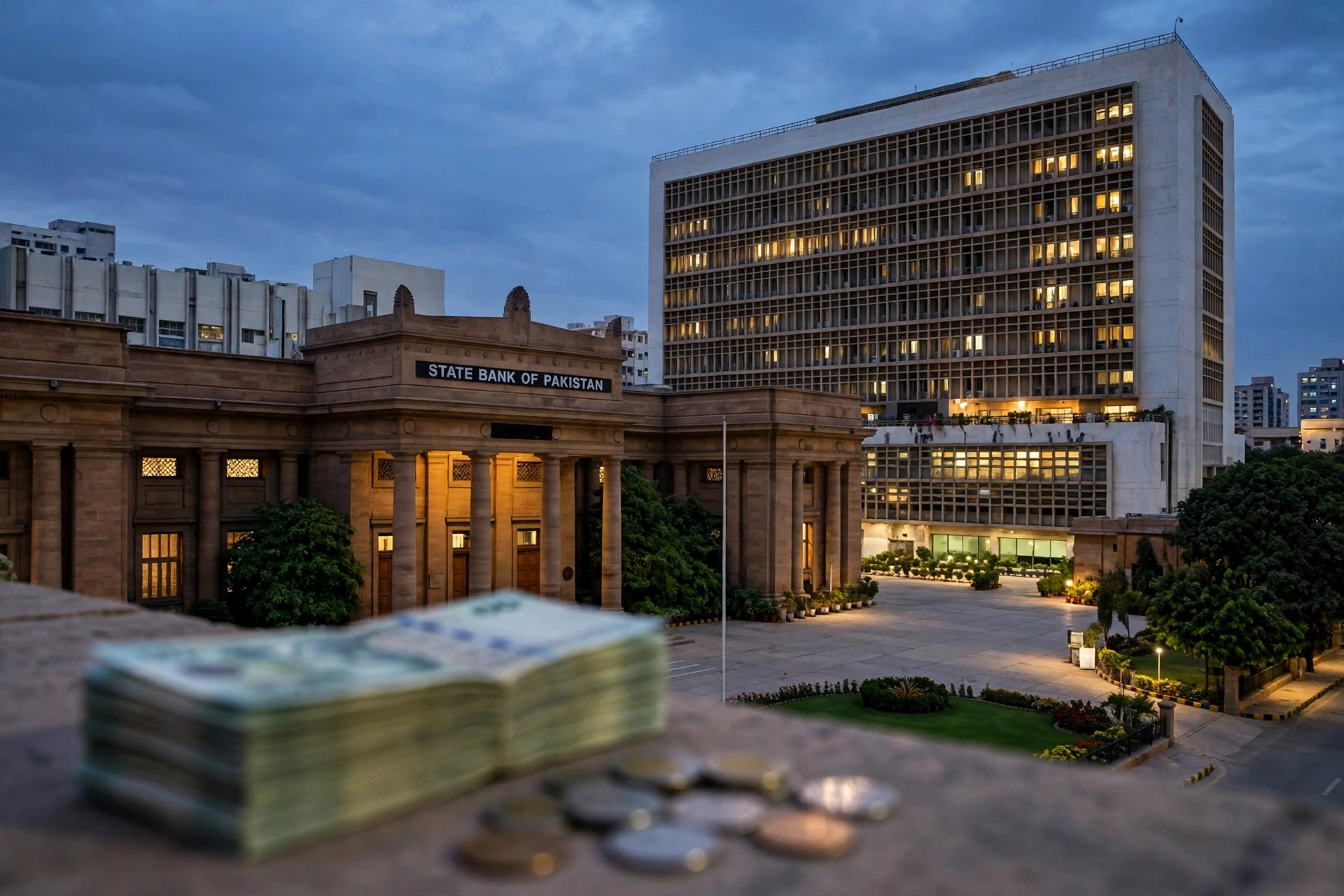
The answer starts with the State Bank’s annual profit. The central bank’s profit for the year, just over Rs1.9 trillion, was booked in full in the first quarter, even though it was down roughly 20 percent on last year. That single transfer counts as government revenue, inside federal non-tax revenue of Rs2,365.9 billion for the quarter.
The arithmetic is blunt. The profit of just over Rs1.9 trillion is about Rs630 billion bigger than the whole reported surplus of Rs1.274 trillion. Without that one transfer, the quarter would have ended in deficit. The profit is a once-a-year event, so later quarters must stand on tax revenue and spending control alone.
Tax beat its target, but interest ate the gain
Tax collection did its part. The Federal Board of Revenue collected Rs3,086.2 billion in the quarter, up 7 percent on last year and Rs33.2 billion above the quarterly target. Even so, reports note collections slipped after September.
On the spending side, interest payments came to about Rs1.7 trillion in the quarter and defence spending to Rs495 billion. The Finance Ministry’s own October update said interest payments had risen almost 37 percent and development spending had increased, even after subsidies were cut by 90 percent. The government keeps borrowing to fund itself: sovereign Sukuk issuance crossed Rs10 trillion this year.
The IMF test comes next month
Finance Minister Muhammad Aurangzeb has said Pakistan met three of the four fiscal conditions set by the International Monetary Fund, and that an IMF board review is tentatively expected next month to consider $1.2 billion in loan tranches. The first-quarter numbers will be part of that review, and the fund will look past the headline to the shrinking surplus and the one-off transfer behind it.
The government is also tightening how it handles its own money. From Monday, government payments go through Raast from Monday, replacing cheque-based payments, as part of the wider cashless push. That will not change the surplus, but it clarifies government spending.
The wider economy gives the surplus some cover. Workers sent home $10.9 billion in remittances in the quarter, up 14 percent, and the overall balance of payments recorded a surplus of $3.1 billion, against a deficit of $274 million a year earlier. But the current account deficit widened to $874 million from $755 million, imports rose 14.3 percent to $17.8 billion against exports of $8.5 billion, and the State Bank raised its policy rate to 12 percent in late October.
What to watch
Three things will decide whether the streak survives: whether the second quarter stays in surplus without another State Bank profit booking, whether tax collection holds up after the slippage since September, and whether the IMF board clears the $1.2 billion in tranches next month. The first quarter proves Pakistan can post a surplus. It also proves how much of that surplus depends on a single transfer that will not come again this year.