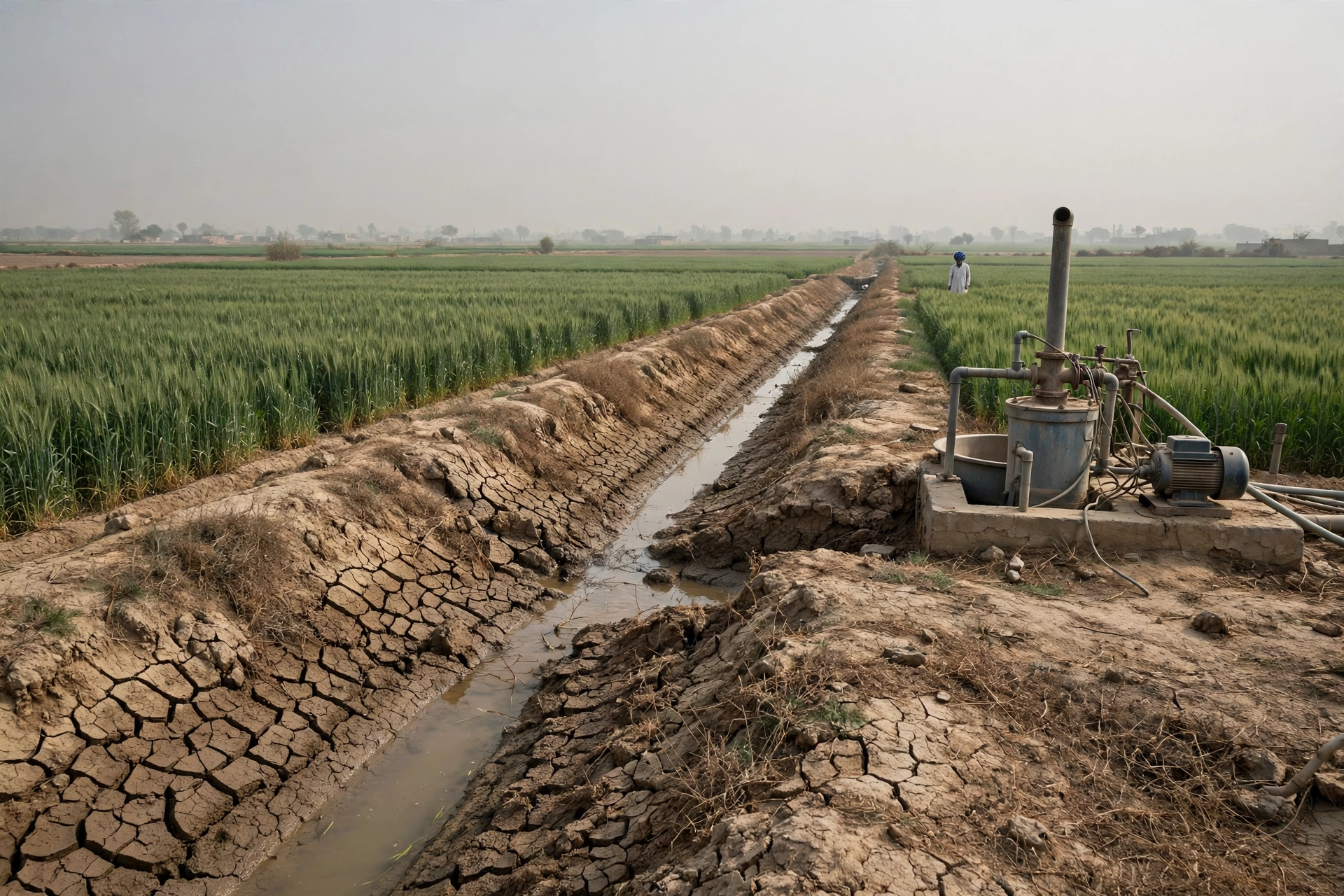

Punjab’s water demand has outrun its supply in every sector, a United Nations assessment published on Monday warns. The Food and Agriculture Organisation says the province’s groundwater is falling by about 5.5 billion cubic metres a year, and Punjab needs an extra 10 billion cubic metres of usable water every year to close the gap. It lands mid-Rabi season, when the province already faces a 22 percent irrigation water cut.
The numbers behind the gap
The report, Water and Land Accounting in Punjab, builds its case from annual water accounts covering five water years, from 2012 to 2017. River flows through the province have fallen by about 30 billion cubic metres since the 1960 Indus Waters Treaty with India, and Punjab holds only 1.7 percent of wetland areas.
The province’s canal system adds to the strain. It operates as a run-of-the-river system for half the year and cannot draw its full authorised share of river water. The report’s diagnosis names four challenges: growing scarcity, continuous groundwater depletion, competition among sectors and unaccounted transfers, and protecting renewable water resources and wetlands.
One figure deserves a careful reading. The detailed accounts put the aquifer’s average annual fall at about 5.5 billion cubic metres, while the FAO’s own summary rounds the five-year average to about six billion. The two numbers describe the same loss; the gap between them is rounding, not disagreement.
A warning built on decade-old data
The most important caveat sits in the report’s own method. Its accounts cover the water years from 2012 to 2017, which means the warning published on Monday describes a gap measured a decade ago. Since then, demand, cities and tubewells have all kept growing. That makes the 5.5 billion figure a floor, not a ceiling: the loss today is likely larger.
Water is already moving away from farms
The study’s most striking finding is not a single number but a shift it says is already happening. Its five-year provincial balances show a water transfer from agriculture to other sectors without any reallocation, alongside high net water-use efficiency but low productivity across sectors. In plain terms, water is leaving farming without a formal decision.
The Rabi season makes it urgent
The warning is not abstract. The Indus River System Authority has approved a projected 22 percent irrigation water shortfall for Punjab and Sindh in the Rabi season, which runs from 1 October 2026 to 31 March 2027. Total availability is set at 29.183 million acre-feet, against roughly 38 million envisaged under the 1991 Water Apportionment Accord.
Reservoirs entered October well below last year. On 30 September, Tarbela, Mangla and Chashma together held 9.343 million acre-feet, against 13.214 million a year earlier. Delays in Tarbela’s Tunnel 4 and Tunnel 5 works have limited storage, and the authority approved a 21-day closure of the Chashma Barrage from 26 December to 14 January.
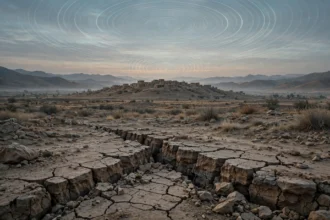
Punjab is not the only province where water failure is already visible. Tharparkar lost 90 percent of its crops while its water plants stood dry, a reminder that the shortage reaches beyond the canal commands into the driest districts.
What the FAO wants Punjab to do
The report’s central recommendation is institutional, not technical. It recommends a commission to conduct a one-time review of provincial water resources, water-related policies, institutional mandates and existing strategies. It would align national and inter-provincial water policies and set up a coordination cell in the Planning and Development Department.
It also calls for steps to increase surface water, improve recharge and build inter-seasonal transfer mechanisms. The FAO is already working with the Punjab Agriculture and Irrigation departments, MNS University of Agriculture Multan and IHE Delft on a WaPOR water budgeting study. In October, Feature Pakistan reported that Pakistan eyes 18 billion dollars of water investment by 2029, even as the province’s own water accounting runs a decade behind.
The contrast with the provincial government’s recent announcements is hard to miss. Punjab approved Rs23.85bn for paved streets and sewerage in 475 villages last week, and Maryam Nawaz told a minerals forum that Punjab’s rivers hold gold. Neither announcement touches the aquifer. The FAO does not say stop spending on villages or minerals; it says the water beneath both needs a commission and current accounts first.
What happens next
Three dates will test whether the warning changes anything. The 22 percent shortage estimate will be reviewed periodically through the Rabi season, which runs to 31 March. The Chashma Barrage closure from 26 December to 14 January will tighten supplies further in mid-winter. The FAO’s proposed commission has no start date yet. Until one exists, Punjab’s water policy will keep running on accounts that end in 2017, while the aquifer underneath it keeps falling by more than five billion cubic metres a year. More national news from Pakistan.